On this page
- What the law or standard says about asset finance
- Who should read this
- What does a credit committee read in an asset-finance file?
- What do the banks publish for asset finance?
- Which Bank of Tanzania rules shape the questions?
- The supplier pro-forma invoice: what the committee checks
- How much must you put down?
- Registration, insurance and security of the asset
- What is new on movable-asset security?
- How does the committee test the cash flow?
- Worked example: a TZS 240,000,000 refrigerated truck
- What do borrowers miss most often?
- Does anything change in Zanzibar?
- Which government fees touch an asset-finance file?
- What to do now
- Key dates
- What the NEMBO desk prepares
- How Zatra helps
- Sources and status
- Frequently asked questions
What does a Tanzanian credit committee read in an asset-finance file?
It reads the supplier pro-forma invoice, proof of your own contribution, the plan to register and insure the asset, the cash flow that repays it, and the security. Banks publish different contributions, from 25 percent upward, so confirm each bank's terms in writing.
A lender that finances a truck, a generator or a packing line reads a different file from the one it reads for working capital. The asset is the purpose of the request and part of the security. So the committee asks whether it exists, who will own it, what it will earn, and what happens if it stops earning.
This guide does not repeat the general SME file. For that, read the NMB, CRDB and NBC comparison and the CRDB SME Bidii file. For the supplier document, read the pro-forma invoice guide.
What the law or standard says about asset finance
No single Tanzanian Act is called an asset-finance law. The structure the bank chooses decides which instrument matters. In a finance lease, the lessor keeps title during the lease. In an asset-based term loan, you own the asset and the bank takes a charge over it.
The Financial Leasing Act, 2008 (Act 5 of 2008) covers the first route. As the desk read it, the Act commenced on 1 July 2008, the lessee selects the asset, and the lessor keeps title (section 4(4)).
| Instrument | What it means for the file | Status to confirm |
|---|---|---|
| Financial Leasing Act, 2008 | Lessor keeps title; lessee selects asset | In force since 1 July 2008 |
| Financial Leasing Regulations, GN 151 of 2011 | Lessors need a Bank licence; credit report carries weight | Scan is hard to read |
| Risk Assets Regulations, GN 287 of 2014 | Sets loan classification and file weaknesses | Published 22 August 2014 |
| Consumer Protection Regulations, GN 884 | Key facts statement; total cost of credit | Company borrower coverage unclear |
| Motor Vehicles Insurance Act, Cap. 169 | Third-party cover compulsory on a road | Version read is dated 2002 |
| Secured Transactions (Movable Property) Act, 2026 | Collateral Registry at the Bank of Tanzania | Reported; not yet in force |
The last row is news reported by law firms and the press, not read in the Gazette by the desk. Zatra also keeps a note on the Bank of Tanzania draft banking regulations of 2026.
Who should read this
Owners and finance managers of Tanzanian companies buying equipment, vehicles or machinery with bank money: transport operators, processors, contractors, clinics and farms. Consultants and accountants who prepare the file for a client will also use it. A salaried person buying a private car is a different product.
What does a credit committee read in an asset-finance file?
The committee reads for four things: the asset is real and fairly priced, you can fund your share, the cash flow covers the instalment, and the bank can control and recover the asset. The NMB term-loan page gives the most detailed document list among the banks the desk read, and the table builds on it.
| File item | What the committee checks | Often missed |
|---|---|---|
| Application letter | Asset, amount, tenor, use | Amount differs from pro-forma |
| Supplier pro-forma | Price, specification, validity | Expired or unsigned |
| Company documents | Certificate, constitution, board resolution | Resolution omits the amount |
| BRELA returns | Recent filings with the Registrar | Annual return out of date |
| TIN and tax clearance | Tax status of the borrower | Certificate expired |
| Financial statements | Three years audited, plus management accounts | Management accounts stale |
| Projections | Cash flow for the facility period | Asset income not shown apart |
| Own contribution | Source and date of the cash | Source not explained |
| Insurance quotation | Cover for the loan term | No quotation attached |
| Security and valuation | Value and legal control | Existing charges not disclosed |
The NMB bank loan page also asks for a business licence and a business plan. It shows no date. The desk accessed it on 6 November 2026.
What do the banks publish for asset finance?
None of the pages shows a publication date, so the table records what each page states on the access date. Use it to prepare questions, not to quote terms back to a bank.
| Bank page | What the page states | Not stated |
|---|---|---|
| CRDB SME Asset Financing | Up to TZS 5 billion; grace up to six months; joint names | Contribution; documents |
| CRDB MSE Asset Financing | Up to TZS 20 million; motorcycles, three-wheelers | Contribution; documents |
| CRDB Investment Financing | 25 to 35 percent equity on asset loans; 6 to 60 months or more | Security; documents |
| NMB term credit facility | Own funds at least 25 percent; preferred five years with grace | Interest rate |
| Stanbic Vehicle and Asset Finance | Finance lease, asset loan, sale and lease-back | Deposit; tenor |
| TADB Asset Financing | Farm machinery, boats; up to 75 percent of project cost | Security; rate |
| NBC business loans | General business loans only | Asset-finance terms |
The CRDB investment page names agribusiness in its eligibility text, so a non-farm borrower should ask whether it applies. The Stanbic page sits under business loans, but its eligibility lines mention salary deposits, which suggests an individual borrower. The CRDB pages carry a 2026 copyright and the TADB page a 2025 one.
The NCBA Tanzania page, last modified 4 May 2026, covers personal car loans. It finances up to 90 percent of a new vehicle and 70 percent of a second-hand one, and it requires comprehensive insurance.
Banks also work with suppliers. On 20 July 2026 The Citizen reported an NMB and Mantrac Tanzania partnership for mining and construction machinery. The visible text gave no terms, so ask your supplier about such programmes.
Which Bank of Tanzania rules shape the questions?
No rule says "attach a pro-forma invoice". The documents come from bank credit policy. The Bank of Tanzania rules explain why staff are strict.
The 2014 Risk Assets Regulations flag these file faults: unlocated title documents, improperly executed security, unregistered mortgages, and inadequate or expired insurance. They also flag company borrowing without an authenticated board resolution. A loan 91 to 180 days overdue is substandard, 181 to 360 days is doubtful, and over 360 days is loss. Provisions rise from 1 percent on a current loan to 100 percent on a loss.
So the committee tests the cash flow before the asset. Late repossession is a cost, not a repayment.
For finance leases, the 2011 Regulations require a lessor to hold a Bank licence. As the desk read the scan, they also tell a lessor to weigh the lessee's credit bureau report. Expect the bank to pull yours. Zatra explains the bureau side in its note on the credit reference bureau licence.
An independent source, Clyde & Co on Mondaq, 2016, adds that micro leasing is outside the 2011 Regulations when the average asset value is up to TZS 10 million and the term is up to 24 months. It also noted that the leased-asset registry was not yet set up. The desk could not confirm today whether it exists.
The supplier pro-forma invoice: what the committee checks
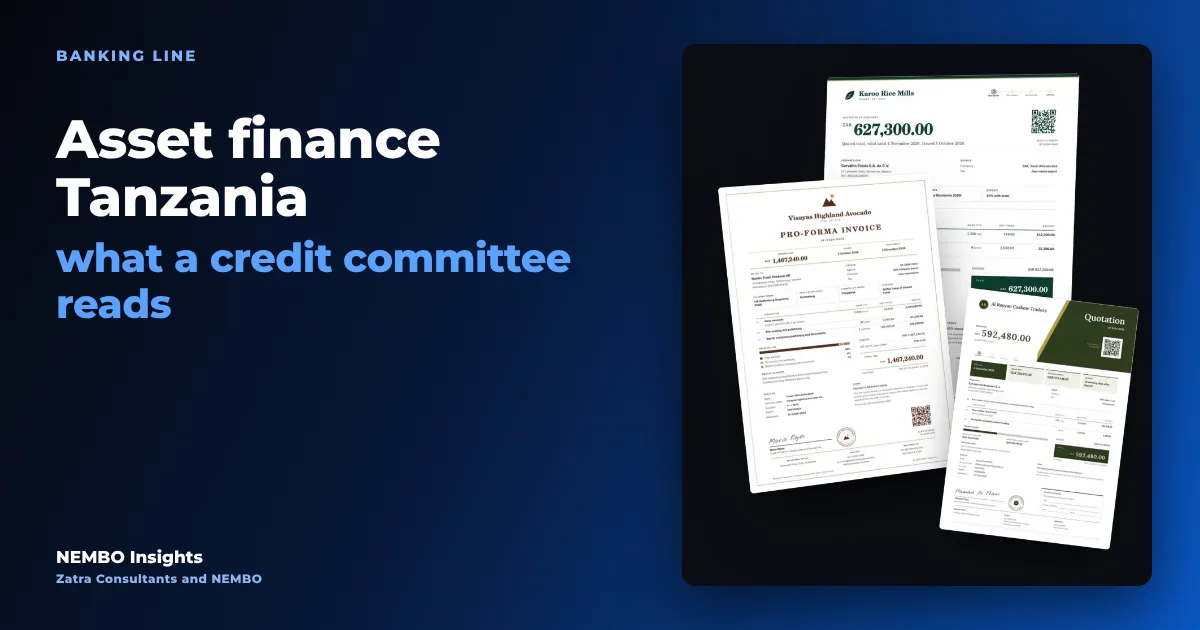
The pro-forma fixes the amount to be financed. It is not a tax invoice. Read quotation, pro-forma and tax invoice for the difference. A committee-ready pro-forma shows:
- The supplier's legal name, address and TIN.
- Your exact registered name as buyer, matching the application.
- The asset's model, year, capacity and serial details.
- The unit price, VAT as its own line, and the total in one currency.
- A validity date, delivery terms and payment terms.
A foreign supplier adds the import route, duty, clearing costs and an exchange-rate assumption. Those points sit in the import pro-forma guide. After delivery, the supplier issues the tax invoice or fiscal receipt. The fee register notes that input tax is not claimable after six months from the invoice or receipt (register ID F0245). See EFD receipt or VAT tax invoice.
How much must you put down?
The contribution is the figure bank pages state most often, and it varies by product.
- NMB: at least 25 percent of total investment from own funds.
- CRDB investment financing: 25 to 35 percent equity on asset loans.
- TADB: up to 75 percent of project cost, so 25 percent is yours.
- NCBA personal car loan: 10 percent on a new vehicle, 30 percent on a second-hand one.
The CRDB SME and MSE pages ask for a contribution "as required" without a figure. Ask for it in writing before you order from the supplier. The committee also asks where the cash came from, so attach the bank statement and a note on the source. For owner money lent to the company, see Zatra on shareholder loan versus equity.
Registration, insurance and security of the asset
Registration: the CRDB and NCBA pages say the asset is registered in joint names with the bank. Stanbic describes a charge by debenture or chattel mortgage. Vehicle steps sit with the revenue authority; see Zatra's motor vehicle transfer guide. The desk did not verify how a bank's interest is noted on the card, so ask the bank's lawyers.
Insurance: the Motor Vehicles Insurance Act makes third-party cover for death or bodily injury compulsory on a road. It does not require cover for your own vehicle. A bank may still require comprehensive cover, and the CRDB and NCBA pages offer to finance the premium. Zatra's note on mandatory business insurance covers the wider list.
Security: NMB asks for proposed security with a valuation report. The 2014 Regulations cap credit for collateral at market value, or an independent valuer's figure where no market exists. Disclose every existing charge, because a hidden charge ends the file.
What is new on movable-asset security?
On 8 October 2026 FB Attorneys reported that the Secured Transactions (Movable Property) Act, 2026 was published in the Gazette on 2 October 2026. Its legal update says the Act creates a Collateral Registry in the Bank of Tanzania, and ranks competing interests by time of registration. It starts on a date the Minister appoints, and the eligible assets are still to be prescribed.
Press reports used other titles. TanzaniaInvest, 2 September 2026, described a Movable Property Security Rights Bill tabled on 31 August. The desk has not read the Act in the Gazette and could not match the titles. The position is: a movable-collateral law is reported, it is not in operation, and its text needs checking. Until commencement, plan on joint registration, charges and the lender's own checks.
How does the committee test the cash flow?
The committee builds a line for the income the asset generates, deducts running costs, and divides what is left by the instalment. This ratio is called debt service cover. Each bank sets its own minimum, and no page the desk read publishes one.
Show the asset's income apart from the business, then show the whole company, because the loan is repaid from all cash if the asset underperforms. A thirteen-week view covers the first months; see the 13-week cash forecast guide and financial model assumptions lenders challenge. Ask which interest method applies. Kemi Advocates summarises the 2025 amendment as making reducing balance mandatory. Zatra compares the methods in flat rate against reducing balance.
Worked example: a TZS 240,000,000 refrigerated truck
This is an illustrative case for a fictional company, Pwani Fresh Logistics Limited. The rate, premium and cash flow are assumptions, not bank terms.
| Line | Working | Amount (TZS) |
|---|---|---|
| Pro-forma price | As quoted, VAT included | 240,000,000 |
| Own contribution | 25 percent of 240,000,000 | 60,000,000 |
| Amount financed | 240,000,000 less 60,000,000 | 180,000,000 |
| Insurance premium | 4 percent of 240,000,000 | 9,600,000 |
| Cash before delivery | 60,000,000 plus 9,600,000 | 69,600,000 |
| Monthly instalment | 48 months, 18 percent reducing | about 5,287,500 |
| Total repaid | 5,287,500 times 48 | 253,800,000 |
| Interest over the term | 253,800,000 less 180,000,000 | 73,800,000 |
Assume the truck earns TZS 21,000,000 a month and costs TZS 11,500,000 to run. Net cash before debt service is TZS 9,500,000. Divided by the instalment of TZS 5,287,500, cover is 1.80 times.
The committee then stresses it. If revenue falls 20 percent to TZS 16,800,000, net cash is TZS 5,300,000 and cover is 1.00 times. The truck barely covers its own instalment, so the officer looks to the rest of the business, or asks for more security. The TZS 69,600,000 needed before delivery is the figure owners most often forget.
What do borrowers miss most often?
This checklist comes from the bank lists and the 2014 rules above; the desk found no rejection statistics.
- An expired or unsigned pro-forma. The committee prices the asset from it.
- A mismatch of names. The buyer on the pro-forma differs from the applicant.
- An unexplained contribution. The cash is in the account, but the source is unclear.
- No insurance quotation. The bank cannot show cover for the loan term.
- A resolution without the facility. It authorises borrowing but not this amount.
- Stale company filings. See Zatra on BRELA company forms 2026.
- Undisclosed charges. A prior lender's interest appears at the search.
Does anything change in Zanzibar?
The Bank of Tanzania supervises banks, and the banks above operate on both sides of the Union. Vehicle records, tax and licences are a different matter. This guide reads Mainland law, and the sources the desk read do not say whether each Mainland Act applies in Zanzibar.
| Point | Mainland | Zanzibar |
|---|---|---|
| Bank terms | As on bank pages | Ask the Zanzibar branch |
| Tax and vehicle records | TRA | Zanzibar Revenue Authority; confirm |
| Company filings | BRELA | Confirm the registry with the bank |
| Leasing and collateral laws | Acts read above | Application to be confirmed |
If the asset will work in Zanzibar, ask an advocate which law and which registry apply before the supplier is paid.
Which government fees touch an asset-finance file?
These are fees at 26 September 2026 from Zatra's fee register. They are paid to the authority, separate from any professional fee. The bank's instrument decides which line applies.
| Item | Fee | Register ID |
|---|---|---|
| BRELA charge, TZS 100m to 500m secured | TZS 50,000 | F0011 |
| Stamp duty, bill of sale as security | 1 percent, maximum TZS 100,000 | F0270 |
| Stamp duty, mortgage deed or debenture | 1 percent, maximum TZS 10,000 | F0274 |
| BRELA annual return | TZS 22,000 | F0007 |
For the TZS 180,000,000 in the example, the charge fee is TZS 50,000. The duty line is capped at TZS 100,000 or TZS 10,000, depending on the instrument. The amount on the authority's control number governs on the day of payment.
What to do now
- Choose the structure: ask each bank whether it offers a finance lease, an asset loan or a sale and lease-back, and who holds title.
- Get terms in writing: record contribution, tenor, grace period, security and fees from each bank.
- Request a compliant pro-forma: use the list above, in your exact registered name, with a validity date.
- Prove your contribution: show the cash, its source and the date it was set aside.
- Obtain an insurance quotation: ask for third-party and comprehensive options.
- Build the asset's cash flow: show it apart from the business, with a 20 percent revenue stress.
- Refresh company documents: board resolution naming the amount, BRELA filings, TIN, tax clearance and licences.
- List existing charges: disclose every prior charge before the bank searches.
- Ask about the new registry: ask whether the bank expects to use it, and from what date.
Key dates
No statutory deadline governs an asset-finance application. These are the dates of the rules and sources the desk relied on.
| Date | Event |
|---|---|
| 1 July 2008 | Financial Leasing Act commenced |
| 22 August 2014 | Risk Assets Regulations published |
| 23 May 2025 | Consumer protection amendment dated, per Kemi Advocates |
| 2 October 2026 | Movable-property Act reported as gazetted |
| 6 November 2026 | Bank pages accessed by the desk |
| To be announced | Commencement of the movable-property Act |
What the NEMBO desk prepares
The Client shares the facts: the supplier quotation, company records, bank statements, the lender's own checklist and the business history. Zatra Consultants prepares and checks the content. NEMBO designs and delivers the finished documents:
- A business plan or feasibility study that sets out the asset's case.
- A cash-flow and debt-cover section in the financial report and CFO pack, with the stress case.
- A clean quotation and pro-forma invoice layout.
- A lender file index, matching the free SME loan file checklist.
Two cost buckets apply. Government fees at the official rate are paid to the authority and are separate from NEMBO's and Zatra's fees. Fees are published on the packages page and the pricing page, and quoted in writing. See how a job runs, or share the details.
How Zatra helps
Zatra Consultants checks the facts and figures before the file goes to the bank: names and numbers on the pro-forma, the instalment and cover arithmetic, dates on company filings, and the match between the board resolution and the facility. It checks that each statement about a bank's terms points to the bank's own page. Zatra offers financial modelling, business plans and bank readiness.
Tax questions, such as input VAT on the asset, go to an accountant. Security documents, disputes with a lender and opinions on title or repossession go to an advocate. The desk does not decide or guarantee any authority's outcome, whether that authority is a bank, a tender panel or a regulator.
Business plan and feasibility study
Zatra Consultants prepares and checks the content on the details the Client shares. NEMBO designs and delivers it. Fees are published on the packages page and quoted in writing.
Open the desk pageSources and status
Accurate as at 6 November 2026. The desk read each bank's own page and each rule at the link shown, and treated law-firm and press summaries as secondary.
- 1Financial Leasing Act, 2008Parliament of Tanzania via TanzLII, 2008. Accessed 6 November 2026.
- 2Financial Leasing Regulations, GN 151Government of Tanzania via TanzLII, 2011. Accessed 6 November 2026.
- 3Management of Risk Assets Regulations, GN 287Bank of Tanzania, 22 August 2014. Accessed 6 November 2026.
- 4Financial Consumer Protection Regulations, GN 884Bank of Tanzania, 2019. Accessed 6 November 2026.
- 5Motor Vehicles Insurance Act, Cap. 169Government of Tanzania via TanzLII, version of 2002. Accessed 6 November 2026.
- 6SME Asset FinancingCRDB Bank PLC, page undated, copyright 2026. Accessed 6 November 2026.
- 7Bank loan, term credit facilityNMB Bank Plc, page undated. Accessed 6 November 2026.
- 8Vehicle and Asset FinanceStanbic Bank Tanzania, page undated. Accessed 6 November 2026.
- 9Asset FinancingTanzania Agricultural Development Bank, copyright 2025. Accessed 6 November 2026.
- 10Financial Leasing in TanzaniaClyde & Co on Mondaq, 3 February 2016. Accessed 6 November 2026.
- 11New Law on Movable Assets as Security for LoansFB Attorneys, 8 October 2026. Accessed 6 November 2026.
- 12Tanzania Tables Bill on Movable Assets as CollateralTanzaniaInvest, 2 September 2026. Accessed 6 November 2026.
Figures to confirm before you act
- Contribution, tenor, grace period and fees: confirm with each bank in writing, because the pages are undated.
- Whether the Secured Transactions (Movable Property) Act, 2026 is gazetted under that title, and its start date.
- Whether a registry for leased assets now operates under the Financial Leasing Act.
- Whether the consumer protection regulations cover a company borrower, and the text of GN 298 of 2025.
- The stamp duty line your bank's instrument attracts.
- How a bank's interest is noted on a vehicle's registration card.
This article is general information based on official sources available at the date of publication. It is not legal, tax or financial advice. Laws and notices change. Verify with the issuing authority or consult Zatra before acting.
Frequently asked questions
Is asset finance the same as an ordinary business loan?
No. The money buys a named asset, the supplier is paid against a pro-forma, and the asset is part of the security. An ordinary loan rests on cash flow and general collateral. Asset finance adds questions about the supplier, registration and insurance.
Can I use a pro-forma invoice from a foreign supplier?
Banks can accept one, but the file then needs the import route, duty, clearing costs and an exchange-rate assumption. The bank decides what it accepts. Ask first, and read the import pro-forma guide before you sign with the supplier.
Will the bank own the asset?
It depends on the structure. In a finance lease the lessor keeps title under the Financial Leasing Act. In an asset loan you own it and the bank holds a charge. Some pages use lease wording and also say joint registration, so ask which applies.
Is comprehensive insurance compulsory?
By statute only third-party cover for death or bodily injury is compulsory for a vehicle on a road. A bank may still require comprehensive cover as a loan condition, as NCBA does for its personal car loan. Ask for the quotation before you apply.
Will the new movable-property law change what I can pledge?
Possibly, once it starts. It is reported as gazetted on 2 October 2026 but not in operation, and the eligible assets are still to be set by the Governor. Do not assume your equipment qualifies until the bank confirms it.
Can a young company get asset finance?
It can apply, but expect more questions. The pages refer to established businesses, to operating history, and to three years of audited statements at NMB. A younger company should offer a larger contribution, extra security or a supplier-backed programme.
What if the bank declines or changes the terms after signing?
Ask for the reasons and the key facts statement. Under the amendment as Kemi Advocates summarises it, complaints can be escalated to the Bank of Tanzania. For a dispute over security or repossession, consult an advocate promptly.