On this page
- What the law or standard says
- Who should read this
- What must a Tanzanian company prepare and file each year?
- What does the directors' report need to contain?
- When is the BRELA annual return due, and what does it cost?
- Who may audit the accounts, and is an audit always needed?
- Which reporting framework applies, TFRS or IFRS?
- How does the annual report line up with the TRA return?
- What do banks, donors and investors read first?
- What page structure should the report follow?
- How do Mainland and Zanzibar differ?
- Worked example: one set of headline figures tied to the notes
- What to do now
- Key dates
- What the NEMBO desk prepares
- How Zatra helps
- Sources and status
- Frequently asked questions
What must a company annual report in Tanzania contain?
A governance report, financial statements with notes, and an auditor's report, all approved by the board. The accounts go to BRELA with the annual return and must agree with the TRA return. A CPA in public practice signs the audit. Lenders read the notes first.
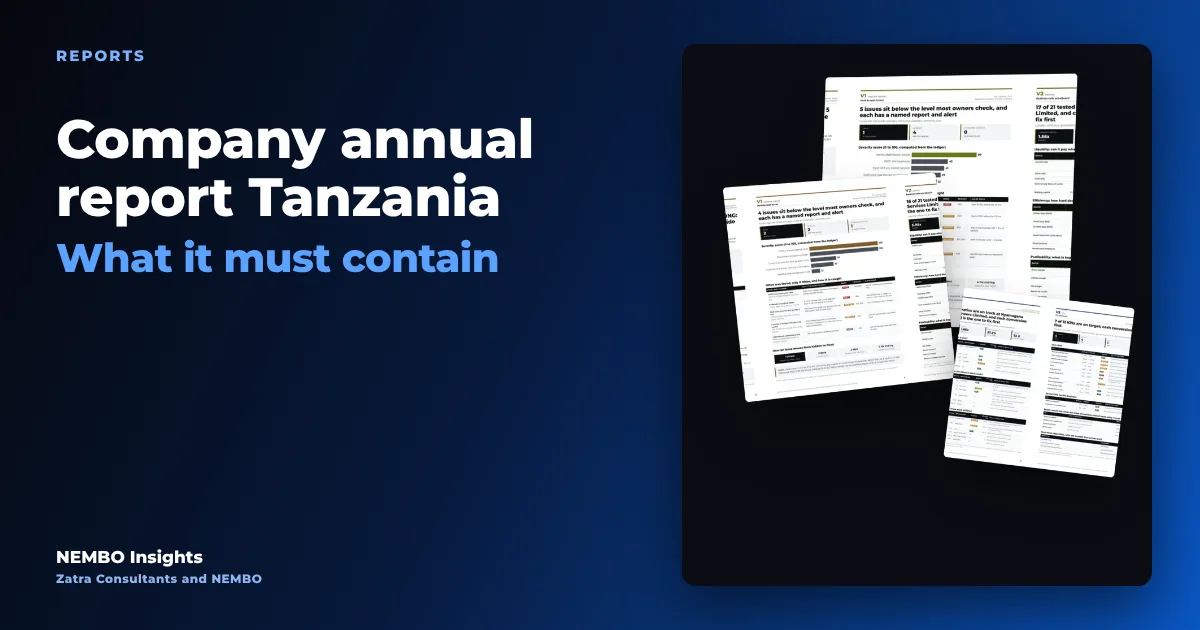
A company annual report in Tanzania is a filing the law requires, and also the document a bank, donor or buyer reads before it decides. Most companies prepare it for the first reason and are judged on the second.
This guide sets out what a Mainland company must prepare and file each year, who may audit, how the framework is chosen and how the pages should be arranged. It ends with fictional figures tied from the headline page to the notes.
What the law or standard says
Four instruments sit behind the report. The Companies Act, Cap. 212 (Revised Edition 2023), governs the accounts, the directors' report, the audit and the annual return. The Accountants and Auditors (Registration) Act, Cap. 286, governs who may audit. NBAA pronouncements set the framework. Tax law governs the TRA return.
The Revised Edition 2023 table of contents on the BRELA copy of the Act lists the relevant headings. Section 131 is the duty to deliver annual returns, and sections 132 to 135 cover its contents and the accounts annexed to it. Section 162 is the duty to prepare a directors' report. Section 169 requires the accounts to be laid before the company in general meeting. Section 170 requires delivery to the Registrar. Sections 173 to 176 cover the appointment of auditors, the exemption for qualifying private companies and the right to require an audit.
The desk read those headings, not the body text of each section. Older guides use the 2002 numbering, three numbers lower, so section 171 then is section 174 now.
Who should read this
- Directors and finance managers of Mainland private companies.
- Company secretaries who file the annual return and keep the statutory registers.
- Founders who need audited accounts for a bank or tender.
- Finance teams of companies with a Zanzibar branch.
What must a Tanzanian company prepare and file each year?
Five items recur every year. The table shows the owner of each and the authority that receives it.
| Item | Prepared by | Goes to |
|---|---|---|
| Financial statements with notes | Directors, with the finance team | Members, BRELA, TRA |
| Directors' or governance report | Board | Members, BRELA |
| Auditor's report | CPA in public practice | Members, BRELA |
| Annual return, Form 131 | Director or secretary signs | BRELA, online |
| Corporate income tax return | Company, with a CPA where required | TRA |
Members receive the accounts at a general meeting. The Zatra guide to the annual general meeting covers notice and minutes. Directors also owe duties when they approve the accounts: see the Zatra guide to directors' duties.
What does the directors' report need to contain?
The Act requires a directors' report. For the content, the benchmark is NBAA's Tanzania Financial Reporting Standard No. 1, titled The Report by Those Charged with Governance. NBAA's TFRS 1 was approved on 22 June 2020 and applies to periods beginning on or after 1 January 2021. It applies to all entities except those using the micro entity standard, which may adopt it by choice.
It replaces the 2010 standard on the directors' report. The standard names these areas:
- Operations, environment, objectives, strategies and operating model.
- Development, performance, resources, risks and opportunities.
- Stakeholders, capital structure and treasury policies.
- Cash flows, liquidity and key performance indicators.
- Governance, auditor appointment, responsibility and compliance statements.
Paragraph 36 asks for cash inflows and outflows and the ability to generate cash. Paragraph 37 asks for current and prospective liquidity, including borrowings and covenants in financing contracts. Lenders read these first. Paragraph 46 expects the auditor to give assurance that the report is correct and consistent with the financial statements.
Public interest entities and public sector entities must also publish the report with the audited statements within 30 days of approval, under paragraph 56. The NEMBO guide to TFRS 1 and IFRS 1 explains why the name is often confused with first-time adoption.
When is the BRELA annual return due, and what does it cost?
The return is made up to a return date, which is the anniversary of incorporation, or the anniversary of the date of the last return if that differed. RSM Tanzania reads the Act as requiring filing within 28 days after that date. The PwC overview of the 2002 Act agrees.
That period is a secondary reading. Form 131 in the BRELA forms notice (GN 82 of 2026) states no time limit on its face, and the desk did not read the body of section 131. Confirm it on the BRELA online registration system.
Form 131 asks for the registered office, activities, secretary, directors, issued share capital, members and a statement on charges. A director or the secretary signs it. Beneficial ownership is filed on separate forms, covered in the NEMBO guide to beneficial ownership.
| Item | Amount | Register ID |
|---|---|---|
| Filing of annual return | TZS 22,000 | F0007 |
| Any document delivered to the Registrar | TZS 22,000 per document | F0005 |
| Late delivery of any document | TZS 2,500 per month or part | F0006 |
Fees at 26 Sep 2026. A return filed two and a half months late draws three months of penalty, which is TZS 7,500 for that document. The Zatra guide to the annual return sets out the steps, and the Zatra annual returns desk files it.
Who may audit the accounts, and is an audit always needed?
The default under the Act is an audit. Section 173 covers appointment, and sections 174 to 176 deal with the exemption for qualifying private companies and the right of members to require an audit anyway. The exemption tests rest on old figures, flagged in the Zatra guide to statutory audit. Plan an audit unless an advocate confirms the exemption in writing.
Who may sign is a separate question. On the TanzLII text of Cap. 286, section 28 allows only a Certified Public Accountant or a CPA in Public Practice to carry on business as an auditor. Section 18 requires a certificate of practice. Section 29 bars employing an auditor who is not a CPA in public practice. Section 31(4) requires the audited accounts of a body corporate, when submitted to a public authority, to be prepared or certified by a CPA in public practice. That text is dated 2002, so confirm later amendments.
Check any firm before you appoint it. NBAA publishes a list of active audit and accountancy firms. The opinion is the auditor's judgement.
Which reporting framework applies, TFRS or IFRS?
The choice is not TFRS against IFRS. TFRS 1 is the governance report standard and applies across frameworks. The framework for the statements themselves is set by NBAA Technical Pronouncement No. 1 of 2018, approved on 26 September 2018 for periods beginning on or after 1 April 2019.
| Entity | Framework | Test |
|---|---|---|
| Public interest entities and public commercial entities | Full IFRS | Listed, fiduciary, or TZS 50bn capital with sector influence |
| Other commercial entities, larger | IFRS for SMEs | Turnover and total assets at or above TZS 800m and TZS 400m |
| Other commercial entities, smaller | Micro entity standard | Two of three: turnover, assets, up to 10 staff |
| Public sector bodies and parties | IPSAS | Not size based |
The tier numbers in the pronouncement run in the order full IFRS, IPSAS, IFRS for SMEs, micro entities. Name the framework, not a tier number, when you write to a lender.
The thresholds leave gaps. A company with turnover under TZS 800m, assets over TZS 400m and more than ten staff fits neither test, and the boundary values overlap. Ask NBAA. The NEMBO framework guide, the free reporting framework checklist and the Zatra note on sustainability reporting work through the cases. NGOs follow a different route, covered in the NEMBO NGO report pack guide.
How does the annual report line up with the TRA return?
The same profit figure should appear in the statements and as the starting point of the tax computation. The TRA Taxes and Duties at a Glance 2025/26, certified July 2025, states the corporate rate as 30%. It puts the final return and balance of tax six months after the end of the accounting year. Quarterly instalments fall at the end of the third, sixth, ninth and twelfth months of the year of income.
The same guide says a corporation with gross income above TZS 100 million must have its return prepared or certified by a CPA in public practice. A late return draws the higher of 2.5% of tax assessable or TZS 300,000 a month, recorded as register ID NEW-02-06.
Three links make the two agree. The tax note should reconcile 30% of profit to the charge. Instalments paid should match the tax paid line in the cash flow. Deferred tax should appear in the notes. The Zatra corporate income tax return guide sets out the schedules. Tax positions go to an accountant, and a dispute with TRA goes to an advocate.
What do banks, donors and investors read first?
Readers differ in what they check, and lenders differ in what they ask for. The CRDB SME loan page, undated with a 2026 copyright, lists consistent cash flow, three years in the business, premises and a valid licence. It does not list financial statements. That is one bank's page, so ask your lender what it needs. The NEMBO comparison of SME loan requirements sets several side by side.
The reading order below is the desk's practice, not a bank requirement.
| Reader | Reads first | Wants to see |
|---|---|---|
| Bank credit analyst | Auditor's opinion, borrowings note | Debt service cover and covenant headroom |
| Investor | Revenue note, cash flow | Cash conversion and related party dealings |
| Donor or grantor | Governance report, controls | Use of funds against purpose |
| Tender panel | Audited statements, opinion date | Years requested and the signing firm |
All of them look for a modified opinion, an emphasis of matter, a going concern note, and any gap between the headline page and the notes. The going concern guide, the 13-week cash forecast guide and the three tests behind a CFO verdict show how readers test the numbers.
What page structure should the report follow?
A good annual report is arranged so that each page proves one thing and points to the next.
| Page | Contents | What it must prove |
|---|---|---|
| 1. Cover and company details | Name, number, office, auditor | Details match BRELA records |
| 2. Highlights | Revenue, profit, cash, debt, cover | Each figure has a note reference |
| 3. Governance report | TFRS 1 areas, risks, liquidity | The board understands its position |
| 4. Statement of responsibility | Duties of the board, approval date | Directors own the accounts |
| 5. Auditor's report | Opinion, basis, firm, date | An independent CPA tested the figures |
| 6. Primary statements | Profit or loss, position, equity, cash | The statements agree with each other |
| 7. Notes | Policies, revenue, tax, debt, cash | Every headline number is explained |
| 8. Tax and covenant page | Tax reconciliation, covenant tests | Tax and lender terms are met |
The highlights page is seen first, so it should carry no figure the notes cannot reproduce. The monthly board pack guide covers the in-year version.
How do Mainland and Zanzibar differ?
This guide covers the Mainland. BRELA is the Mainland registrar. Zanzibar keeps its own register at the Business and Property Registration Agency, known as BPRA. The Zanzibar eRegulations page says local companies are incorporated under the Companies Act No. 15 of 2013. It does not set out annual return rules.
| Point | Mainland | Zanzibar |
|---|---|---|
| Registrar | BRELA | BPRA |
| Company law | Cap. 212, R.E. 2023 | Act No. 15 of 2013, to confirm |
| Annual filing | Form 131 on the BRELA portal | To confirm with BPRA |
| Tax authority | TRA | ZRA for Zanzibar taxes, to confirm |
| Reporting framework | NBAA pronouncements | Reach of NBAA to confirm |
The Zatra guide to running a Mainland and Zanzibar group covers the practical split. Whether NBAA pronouncements bind Zanzibar companies is not settled in the sources read.
Worked example: one set of headline figures tied to the notes
This is illustrative. Kilombero Packaging Limited is a fictional Dar es Salaam company with a 31 December 2025 year end. Amounts are in TZS million. Turnover of 4,800 and assets of about 3,900 put it above both size tests, so, if it is not a public interest entity, it reports under IFRS for SMEs and a CPA in public practice audits it.
| Line | TZS million | Check |
|---|---|---|
| Revenue | 4,800 | Note 4 |
| Cost of sales | (3,120) | Given |
| Gross profit | 1,680 | 4,800 less 3,120 |
| Administrative and selling costs | (940) | Includes depreciation 210 |
| Operating profit | 740 | 1,680 less 940 |
| Finance costs | (180) | Note 12 |
| Profit before tax | 560 | 740 less 180 |
| Income tax at 30% | (168) | 560 times 0.30 |
| Profit after tax | 392 | 560 less 168 |
The cash flow statement then runs as follows. Operating cash is 560 plus depreciation 210 plus finance costs 180, less a working capital increase of 140 and tax paid of 150. That gives 660. Investing is capital spending of 320. Financing is loan repayment 240, interest 180 and dividends 100, which total 520. Interest sits in financing, and the policy note says so. Net movement is minus 180, so cash falls from 450 to 270.
| Headline figure | Value | Ties to | Arithmetic |
|---|---|---|---|
| Revenue | 4,800 | Note 4 | 3,100 + 1,200 + 500 |
| Profit after tax | 392 | Note 7 | 560 less 168 |
| Cash | 270 | Note 9 | 450 + 660 less 320 less 520 |
| Debt | 1,260 | Note 12 | 1,500 less 240 repaid |
| Debt service cover | 1.57 times | Cash flow, Note 12 | 660 divided by 420 |
The revenue note splits 4,800 into corrugated boxes 3,100, printed packaging 1,200 and pallets and other 500. The cash note splits 270 into bank 255 and mobile money and cash 15. The debt note splits 1,260 into 270 current and 990 later. Tax payable moves from 40 to 58, which is 40 plus 168 less 150 paid. Equity rises by 292, which is 392 less dividends of 100.
Debt service cover here is operating cash flow of 660 divided by principal of 240 plus interest of 180, a total of 420. That is 1.57 times. Lenders define it differently, so state your definition. Receivables of 740 equal about 56 days of revenue, from 740 divided by 4,800 times 365. See the days sales outstanding guide.
The tax charge equals 30% of profit only because the example has no disallowed costs or deferred tax. A real note shows both.
What to do now
- Confirm the framework. Test turnover, assets and staff against the NBAA pronouncement and record the result.
- Appoint the auditor early. Check the firm on the NBAA list and agree the year end timetable.
- Draft the governance report first. Use the TFRS 1 headings and write liquidity from the 13-week forecast.
- Build the headline page last. Take each figure from the signed statements and add its note reference.
- Tie the tax return. Reconcile the tax charge and instalments to the TRA computation.
- Approve and sign. Minute the board approval and lay the accounts before members.
- File the annual return. Check the return date on the portal and pay on the control number.
Key dates
No single statutory date governs the whole report. These are the dates the sources give.
| Date or period | What it is | Source status |
|---|---|---|
| Within 28 days of the return date | BRELA annual return | Secondary reading, confirm |
| Six months after year end | TRA final return and balance | TRA guide, July 2025 |
| Months 3, 6, 9 and 12 | TRA instalments | TRA guide, July 2025 |
| 30 days after approval | Publication by public interest entities | TFRS 1 paragraph 56 |
With a 31 December year end, the TRA final return falls on 30 June. A company incorporated on 15 March has a return date of 15 March, and on the 28 day reading the return is due by 12 April. The time limit for laying accounts before members is not confirmed in the sources read.
What the NEMBO desk prepares
The Client shares the facts: the trial balance, loan agreements, board minutes and auditor's draft. Zatra Consultants prepares and checks the content: the governance narrative, the note disclosures and the tie-out of every headline figure. NEMBO designs and delivers the finished report.
- The annual report and financial report pack, on the financial reports and CFO pack page.
- The lender version, on the investor documents page.
- Specimens by sector in the financial reports library, with finished work shown on the finished work page.
Professional documents on the NEMBO site are read online, free and whole, with a customise per your brand option. The studio does not audit. Two cost buckets apply. Government fees at the official rate are paid to the authority and are separate from NEMBO's and Zatra's fees. Those fees are published on the packages page and the pricing page and are quoted in writing. See the process page or share the details.
How Zatra helps
Zatra checks the facts and the filings. It checks company details against the BRELA record, the return date and fees, the framework test, and that each figure ties to a note and to the tax computation. The Zatra reporting desk and the Zatra tax and compliance desk carry this work.
The desk does not decide or guarantee any authority's outcome, whether that authority is a bank, a tender panel or a regulator. The audit opinion belongs to the auditor. Tax positions belong to an accountant, and a dispute, a prosecution or a legal opinion belongs to an advocate.
Financial reports and CFO packs
Zatra Consultants prepares and checks the content on the details the Client shares. NEMBO designs and delivers it. Fees are published on the packages page and quoted in writing.
Open the desk pageSources and status
Accurate as at 6 November 2026. The desk read the Act's contents, the NBAA texts, the TRA guide and the BRELA forms notice, and used secondary firms for the filing window.
- 1The Companies Act, Revised Edition 2023BRELA, Revised Edition 2023. Accessed 6 November 2026.
- 2Companies (Forms) (Amendment) Rules, 2026, GN 82BRELA, 20 March 2026. Accessed 6 November 2026.
- 3TFRS 1, The Report by Those Charged with GovernanceNBAA, approved 22 June 2020. Accessed 6 November 2026.
- 4Technical Pronouncement No. 1 of 2018NBAA, 26 September 2018. Accessed 6 November 2026.
- 5Taxes and Duties at a Glance 2025/26TRA, July 2025. Accessed 6 November 2026.
- 6Accountants and Auditors (Registration) Act, Cap. 286TanzLII, version of 31 July 2002. Accessed 6 November 2026.
- 7Corporate statutory matters FAQsRSM Tanzania, undated page read in 2026. Accessed 6 November 2026.
- 8Companies Act 2002 overviewPwC Tanzania, undated, written on the 2002 Act. Accessed 6 November 2026.
- 9SME loansCRDB Bank, undated page with 2026 copyright. Accessed 6 November 2026.
Figures to confirm before you act
- The 28 day annual return window: confirm on the BRELA portal and in the text of section 131.
- The time limit for laying accounts before members: confirm in section 169.
- The audit exemption tests under section 174: confirm with an advocate before relying on them.
- Zanzibar filing, audit and tax rules: confirm with BPRA, ZRA and NBAA.
- Fees: stated at 26 Sep 2026, and the control number governs on the day.
This article is general information based on official sources available at the date of publication. It is not legal, tax or financial advice. Laws and notices change. Verify with the issuing authority or consult Zatra before acting.
Frequently asked questions
Does a small private company need to file accounts with the annual return?
The firms the desk read say audited accounts go with the return unless a private company is exempt from audit. The exemption tests are old, so plan an audit unless an advocate confirms otherwise.
Is TFRS 1 the same as first-time adoption of IFRS?
No. TFRS 1 is NBAA's standard for the report by those charged with governance. First-time adoption is IFRS 1. The names look alike, so cite the full title in your report.
What is the penalty for filing the annual return late?
The BRELA fee schedule lists TZS 2,500 per month or part of a month for late delivery of a document, register ID F0006, at 26 Sep 2026. An advocate can advise on other consequences under the Act.
Do banks require audited accounts for every loan?
Not always. CRDB's SME loan page lists cash flow, experience, premises and a licence without naming financial statements. Larger facilities and other lenders may ask for them. Ask in writing which years and framework are accepted.
Which framework does a company with TZS 900 million turnover use?
If it is not a public interest entity and total assets are also at or above TZS 400 million, the pronouncement points to IFRS for SMEs. With lower assets, the micro tests may apply. Confirm with NBAA.
Does the annual report have to match the tax return?
Profit before tax in the statements should start the tax computation, with differences explained in the tax note. A mismatch invites questions from TRA and from a lender. Take tax positions to an accountant.
Do Zanzibar companies follow the same annual return rules?
Not necessarily. Zanzibar has its own registrar, BPRA, and its own companies law, Act No. 15 of 2013, per the eRegulations page. Confirm the deadline, form and fee there. This guide does not state them.