On this page
- What the law says
- Who should read this
- What must a Tanzanian payslip show?
- Which deductions may an employer make?
- How is PAYE calculated on the payslip?
- What goes to NSSF, WCF, SDL and HESLB, and when?
- Worked example: a TZS 1,800,000 salary
- What is the payroll register and how long is it kept?
- Mainland and Zanzibar: which rules differ?
- What a labour inspector, a TRA auditor and a bank read on the payslip
- What to do now
- Key dates
- What the NEMBO desk prepares
- How Zatra helps
- Sources and status
- Frequently asked questions
What must a payslip in Tanzania show?
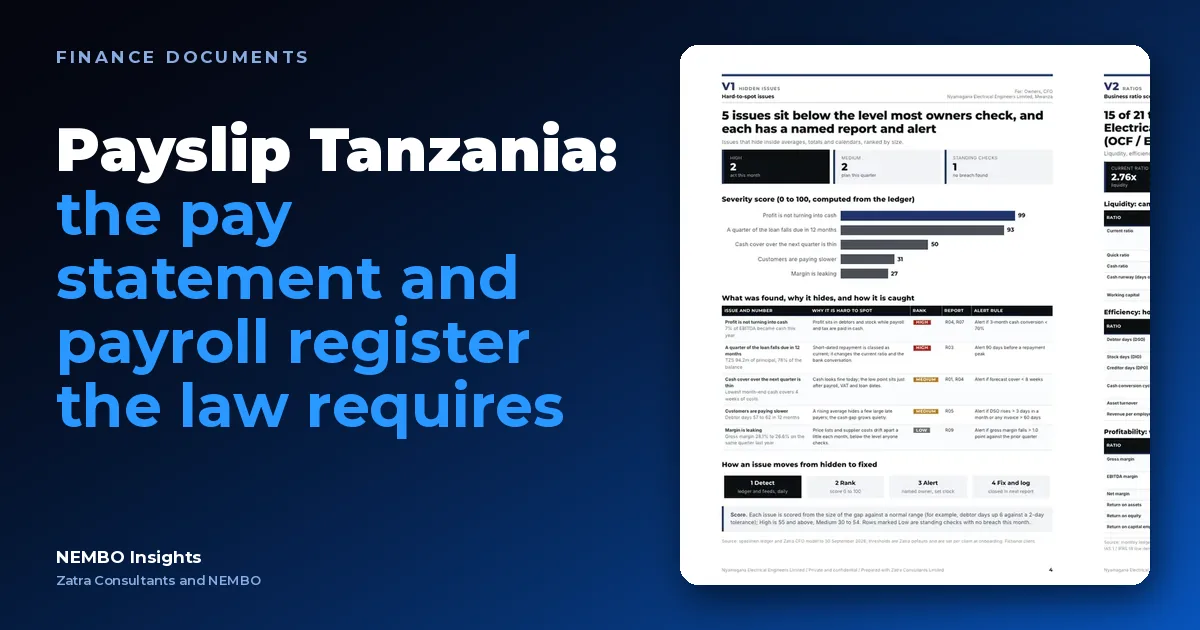
A payslip Tanzania employers issue must accompany every payment under section 28(2) of the Employment and Labour Relations Act and must show the eight items in regulation 13(3) of GN 47 of 2017: employee name, payment date, employer name or logo, employment number, statutory deductions, other deductions, gross or basic salary and net salary. PAYE, NSSF, WCF, SDL and HESLB figures sit behind it on the payroll register.
What the law says
A payslip Tanzania employers hand out each month is not a courtesy. It is a document the Employment and Labour Relations Act requires with every payment of remuneration. Section 28(2) of the Employment and Labour Relations Act, Cap. 366 (R.E. 2023, read on TanzLII) says every payment must be supported by a written statement of particulars in the prescribed form. The statement travels with the cash or cheque, or goes to the employee in a sealed envelope when pay is deposited to a bank account the employee designated in writing.
The Act does not list what the statement must contain. The list sits in regulation 13(3) of the Employment and Labour Relations (General) Regulations, 2017 (GN 47 of 2017, published 24 February 2017). Eight items are prescribed. They are the employee's name, the date of payment, the employer's name or logo, the employment or check number, statutory deductions, other deductions, gross or basic salary and net salary.
Section 29 of the Act governs deductions. An employer may deduct only what a written law, a collective agreement, a wage determination, a court order or an arbitration award requires or permits, or a debt the employee agreed in writing to repay. Deductions for loss or damage need fault in the course of employment, written notice of the cause and amount, and a chance to challenge, and the total under that subsection may not exceed one quarter of remuneration. Section 97 then requires the employer to keep records of the particulars and of remuneration paid for five years after termination. Section 103 attaches a fine of up to TZS 1,000,000 to offences under sections 28 and 29.
The tax and social fund layer sits on top. The Income Tax Act, Cap. 332 sets the PAYE bands the Tanzania Revenue Authority prints in its Taxes and Duties at a Glance 2025/2026. The NSSF contribution page sets the 20 percent joint contribution and the one-month remittance window. The WCF contribution page sets the 0.5 percent employer levy. The TRA SDL page sets the 3.5 percent levy for employers with ten or more employees. Each of those figures lands on the payslip or on the payroll register behind it.
Who should read this
This guide is for the owner, finance manager or HR officer of a Tanzanian company that pays ten or more people, and for the CPA who closes the monthly payroll. It also serves a foreign-owned company whose head office payroll template does not fit Tanzanian law. Any business preparing for a labour inspection, a TRA PAYE audit or a bank facility that asks for payroll evidence will find the same checks here. The Zatra guide to payroll compliance in Tanzania covers the registrations that come first.
What must a Tanzanian payslip show?
The prescribed eight items are a floor, not a ceiling. A payslip that carries only those eight will satisfy a labour officer but will not answer a TRA auditor, who wants to see how taxable pay was reached, or an NSSF inspector, who wants the member number against each contribution. The table below sets out the regulation 13(3) items, the reader each item serves and what NEMBO adds on the pay statement it designs.
| Item | Required by | Who reads it | NEMBO adds |
|---|---|---|---|
| Employee name | Reg 13(3)(a) | Labour officer, bank | TIN and NSSF member number |
| Date, month and year of payment | Reg 13(3)(b) | Labour officer, auditor | Pay period start and end |
| Employer name or logo | Reg 13(3)(c) | Bank, landlord, lender | Registered name, TIN, address |
| Employment or check number | Reg 13(3)(d) | HR, auditor | Job title and cost centre |
| Statutory deductions | Reg 13(3)(e) | TRA, NSSF, HESLB | PAYE, NSSF, HESLB shown separately with the base each is computed on |
| Other deductions | Reg 13(3)(f) | Labour officer, CMA | Reference to the written consent or order behind each one |
| Gross or basic salary | Reg 13(3)(g) | TRA, NSSF, WCF | Basic, each allowance, overtime hours and rate |
| Net salary | Reg 13(3)(h) | Employee, bank | Payment method and account last four digits |
| Employer contributions | Not prescribed | Auditor, lender | Employer NSSF, WCF and SDL as a memorandum block |
| Leave balance | Not prescribed | Employee, HR | Annual leave accrued and taken under section 32 |
Two design rules follow from section 28. A company paying a mid-month advance under section 28(3) issues a statement for the advance as well. And the statement must be readable by the employee, so NEMBO's template prints every label in English and Kiswahili on one A4 page.
Which deductions may an employer make?
Section 29 draws a hard line. Statutory deductions are PAYE under the Income Tax Act, the employee's NSSF share under the NSSF Act, the HESLB loan deduction under the Higher Education Students' Loans Board Act, and union dues under section 62 where the employee has signed the prescribed authorisation. Everything else needs the employee's written agreement to a specific debt, or a court order or arbitration award. A standing clause in the employment contract that allows "any deduction the employer deems fit" does not meet the section.
The loss and damage rule is the one that reaches the Commission for Mediation and Arbitration most often. A driver who damages a company vehicle may be charged only where the employer shows fault in the course of employment, gives written notice of the cause and the amount, and hears the employee's challenge. Even then the deduction under that subsection, together with any other loss deduction, is capped at one quarter of the month's remuneration. Section 29 also forbids any requirement that an employee acknowledge receipt of more than was paid, and permits recovery of an overpayment only where it arose from a calculation error.
Union dues carry their own clock. Section 62(2) requires the employer to remit deducted dues to the union within seven days after the end of the month, and section 62(3) charges 5 percent of the amount due for each day of unreasonable delay. The employer also sends the union a monthly list of members in the prescribed form. The Zatra note on trade union recognition for employers covers the recognition agreement that usually precedes check-off.
How is PAYE calculated on the payslip?
PAYE is computed on taxable pay, not on gross. The TRA PAYE page states that contributions to an approved retirement fund reduce the employee's gross pay before tax, up to the lower of the contribution and the statutory amount. The employee's 10 percent NSSF share is therefore taken off before the bands are applied. Benefits in kind, housing and motor vehicle benefits are added back under the TRA rules. The Court of Appeal confirmed in a January 2026 ruling reported by FB Attorneys that group life premiums and school fees paid for staff fall within PAYE.
| Monthly taxable income (TZS) | PAYE | Register ID |
|---|---|---|
| Up to 270,000 | Nil | F0176 |
| 270,001 to 520,000 | 8 percent of the amount above 270,000 | F0177 |
| 520,001 to 760,000 | 20,000 plus 20 percent of the amount above 520,000 | F0178 |
| 760,001 to 1,000,000 | 68,000 plus 25 percent of the amount above 760,000 | F0179 |
| Above 1,000,000 | 128,000 plus 30 percent of the amount above 1,000,000 | F0180 |
| Non-resident employee | 15 percent of total, final | F0182 |
The bands are those printed in the TRA Glance 2025/2026 and have applied since 1 July 2021. The TRA page adds three employer duties that belong on the payroll register rather than the payslip. Secondary employment income is taxed at the top rate. The employer reviews each employee's position every six months. And wage sheets, salary vouchers and related records are kept for five years from the end of the year of income, in paper or electronic form. The Zatra calculator note on PAYE and net salary walks through the same bands with more examples.
What goes to NSSF, WCF, SDL and HESLB, and when?
Four remittances leave the company every month, each to a different authority on a different day. The register IDs below are from the Zatra fee register at 26 September 2026.
| Remittance | Rate and base | Due | Return or form | Register ID |
|---|---|---|---|---|
| PAYE to TRA | Bands above, on taxable pay | On or before the 7th of the following month | Monthly PAYE return on IDRAS; half-year certificate | F0176 to F0180 |
| SDL to TRA | 3.5 percent of gross emoluments, employers with 10 or more staff | On or before the 7th of the following month | Combined employment taxes return; payment slip ITX 300.01.E | F0276 |
| NSSF, employer and employee | 20 percent of wage; employee share not above 10 percent | Within one month from the month of payment of salaries | Form NSSF/CON.5 with member particulars | F0279 |
| WCF, employer only | 0.5 percent of gross earnings including allowances paid with salary | Within the month or the following month; July due before 31 August | Monthly contribution on the WCF portal; annual income report | F0281, F0448 |
| HESLB loan deduction | Not less than 15 percent of basic salary of a confirmed beneficiary | Within 15 days after the end of the month, via GePG | Deduction schedule to HESLB; employee list within 28 days of hiring | NEW-04-53 |
| Union dues | As authorised by the employee | Within 7 days after month end | Form TUF.16 list to the union | Section 62 ELRA |
Penalties differ by authority. NSSF charges 5 percent of the unpaid amount for each month or part of a month (F0446). WCF charges interest of 2 percent of the delayed amount (NEW-02-29). TRA charges the higher of 2.5 percent of the tax or TZS 300,000 for a body corporate for each month a return or payment is late (NEW-02-06), plus interest at the statutory rate compounded monthly (NEW-02-08). HESLB charges a 10 percent penalty on amounts not remitted and makes the chief executive personally liable for money deducted but not paid over (NEW-04-53). The NSSF penalty amnesty that ran from 1 June to 31 December 2026 (F0447) does not change the rate going forward.
Worked example: a TZS 1,800,000 salary
This worked example takes a resident employee of a Dar es Salaam company with 24 staff. Basic salary is TZS 1,800,000 a month, there are no allowances, and the employee is a confirmed HESLB beneficiary. The figures use the PAYE bands, NSSF, WCF and SDL rates read on the authority pages cited above.
| Line | Computation | TZS |
|---|---|---|
| Gross and basic salary | Contract | 1,800,000 |
| Employee NSSF, 10 percent | 1,800,000 x 10 percent | 180,000 |
| Taxable pay | 1,800,000 less 180,000 | 1,620,000 |
| PAYE | 128,000 plus 30 percent of 620,000 | 314,000 |
| HESLB, 15 percent of basic | 1,800,000 x 15 percent | 270,000 |
| Net pay to the employee | 1,800,000 less 180,000 less 314,000 less 270,000 | 1,036,000 |
| Employer NSSF, 10 percent | 1,800,000 x 10 percent | 180,000 |
| Employer WCF, 0.5 percent | 1,800,000 x 0.5 percent | 9,000 |
| Employer SDL, 3.5 percent | 1,800,000 x 3.5 percent | 63,000 |
| Total employer cost | 1,800,000 plus 252,000 | 2,052,000 |
The remittance side reads as follows. TRA receives PAYE of 314,000 and SDL of 63,000, together 377,000, by the 7th of the following month. NSSF receives 360,000 on form CON.5 within one month. WCF receives 9,000 by the end of the following month. HESLB receives 270,000 through GePG with the deduction schedule before the 15th. Without the HESLB deduction, net pay would be 1,306,000. Had the employer not applied the NSSF relief, PAYE would have been 368,000, an overdeduction of 54,000 a month that the employee would have to reclaim through a return.
What is the payroll register and how long is it kept?
The payroll register is the ledger behind the payslips. One row per employee per month carries the gross build-up, each statutory and other deduction, net pay, the payment reference and the employer contributions. Its totals reconcile to three things: the PAYE and SDL return filed on IDRAS, the NSSF CON.5 schedule and the WCF portal return. An auditor tests the register by tracing a sample of rows to signed contracts, the written statements of particulars under section 16, bank payment files and authority receipts.
Retention runs on three clocks that happen to agree. Section 97 of the Act requires remuneration records for five years after termination. Section 16(5) keeps the written statement of particulars for five years after termination. The Tax Administration Act, Cap. 438 requires documents for five years from the end of the year of income, or longer while an objection, appeal or audit is pending, and the TRA PAYE page repeats the five years for wage sheets and vouchers. The NEMBO note on record retention in Tanzania places payroll beside the other registers, and the Zatra note on payroll records retention covers the inspection powers.
Minimum wage is a register check, not a payslip item. The Labour Institutions (Minimum Wage for Private Sector) Order, 2025, GN 605A of 2025, took effect on 1 January 2026 and revoked GN 687 of 2022. It sets TZS 175,000 a month for any other sector, 200,500 for trade and finance, 200,000 for industrial employers, 195,000 for one and two star hotels and restaurants, and 197,000 or 292,000 for domestic and international private security. Every basic salary on the register is tested against the sector line that applies.
Mainland and Zanzibar: which rules differ?
The Employment and Labour Relations Act, the General Regulations and the Wage Order apply to Tanzania Mainland. Zanzibar has its own Employment Act, 2005, whose section 48 requires employer records and returns to the Labour Commissioner and whose arrangement lists sections 98 to 106 on mode, time and place of payment and deductions. The operative text of those sections could not be read for this guide, so a Zanzibar employer should take the payslip rule from an advocate who holds the current Zanzibar text.
Tax treatment also splits. PAYE bands are a Union matter and the TRA Glance states that the monthly table applies in Mainland and Zanzibar alike, with PAYE for Zanzibar employees remitted to TRA. Skills and Development Levy is not. The Zanzibar rate is 3 percent of gross emoluments from 1 July 2026 for employers with four or more employees (F0278), against 3.5 percent and ten employees on the Mainland. Social security in Zanzibar runs through ZSSF rather than NSSF, at rates this guide did not verify on a primary source. The Zatra note on Zanzibar payroll taxes is the starting point for a Zanzibar payroll.
What a labour inspector, a TRA auditor and a bank read on the payslip
A labour inspector under the Labour Institutions Act asks for the written statements of particulars, the pay statements for a sample month, the deductions file and the leave register. Missing pay statements are a section 28 offence in their own right, before any question of underpayment arises. The Zatra note on labour inspections sets out the inspector's powers.
A TRA auditor reconciles the payroll register to the PAYE returns and to the expense line in the accounts. The three questions asked most often are whether allowances and benefits were taxed, whether the NSSF relief was limited to the statutory amount, and whether casual labour paid in cash appears on the register at all. A payslip that shows the taxable pay computation answers the first two on its face.
A bank reads payslips twice. For a personal loan it reads the employee's net pay and the employer's name against a bank statement. For a business facility it reads the employer's payroll register to test the staff cost line in the management accounts and the 13-week cash forecast. The NEMBO note on the 13-week cash forecast shows where payroll sits in that forecast.
What to do now
- Audit the template. Put the current payslip beside the eight items in regulation 13(3). Add any item that is missing, and add the taxable pay computation and employer contributions block even though they are not prescribed.
- Check every deduction against section 29. For each non-statutory deduction, file the written consent, court order or award that authorises it. Remove any standing authority clause that does not name a specific debt.
- Rebuild the register. One row per employee per month, with gross build-up, each deduction, net pay, payment reference and employer NSSF, WCF and SDL. Reconcile it to the last three PAYE, NSSF and WCF filings.
- Test against the Wage Order. Compare every basic salary with the GN 605A line for the sector, in force from 1 January 2026.
- Set the remittance calendar. TRA by the 7th, union dues within 7 days of month end, HESLB by the 15th, NSSF within one month, WCF by the end of the following month.
- Issue a statement with every payment. Including advances under section 28(3), in a language the employee reads, by sealed envelope or secure electronic delivery where pay is deposited to a bank.
- Fix the retention rule. Keep pay statements, the register, contracts and authority receipts for five years after termination or from the end of the year of income, whichever runs longer.
Key dates
| Date or period | What happens | Source |
|---|---|---|
| Every pay day | Written statement of particulars issued with the payment | ELRA s.28(2); GN 47 of 2017 reg 13 |
| 7th of the following month | PAYE and SDL returns and payment to TRA | TRA PAYE and SDL pages |
| 7 days after month end | Union dues remitted with the member list | ELRA s.62(2), (6) |
| 15th of the following month | HESLB remittance and deduction schedule | HESLB loan repayment page |
| One month after the salary month | NSSF contributions on form CON.5 | NSSF rate of contributions page |
| End of the following month | WCF contribution | WCF contribution page |
| Within 28 days of hiring | List of graduate employees to HESLB | HESLB; NEW-04-53 |
| Within 30 days of the first hire | WCF employer registration | WCF contribution page |
| 1 January 2026 | GN 605A of 2025 minimum wages in force | TanzLII |
| 31 December 2026 | NSSF penalty amnesty ends | F0447 |
| Five years | Retention of pay records, statements and returns | ELRA s.97; TAA Cap. 438 |
What the NEMBO desk prepares
NEMBO designs the pay statement and the payroll register as one controlled document set, bilingual, on the company's letterhead, with the taxable pay computation and employer contributions shown on every statement. The set sits inside the management accounts and CFO pack so that the staff cost line, the PAYE return and the register reconcile every month. Zatra Consultants prepares and checks the content: the section 29 deductions file, the Wage Order test, the remittance calendar and the five-year retention schedule. Every page of the finished work reads free online first, with a Customise for your brand option on the library page.
There are two cost buckets on every quotation. Government charges are paid at the official rate to the authority concerned: PAYE and SDL to TRA, contributions to NSSF and WCF, HESLB remittances through GePG, and any penalty or interest, with the register ID shown against each. NEMBO's and Zatra's fees are published on the pricing page and quoted in writing before work starts. NEMBO does not decide or guarantee any authority's outcome, and the same holds for any bank or tender panel. The process page sets out how a brief becomes a delivered document.
How Zatra helps
Zatra's payroll compliance service registers the employer with TRA, NSSF, WCF and OSHA, builds the monthly cycle and files the returns. The team is led on tax and reporting by CPA Altho Mwangoa. Where a deduction is disputed, a labour officer issues a compliance order or a matter reaches the Commission for Mediation and Arbitration, Zatra routes the file to an advocate, because representation and legal opinions sit outside what a consultancy may do. Start with the brief form or the answers page, and read the NEMBO notes on the monthly management accounts pack and the withholding tax certificate for the documents that sit beside payroll.
Payroll register and management accounts pack
Zatra Consultants prepares and checks the content on the details the Client shares. NEMBO designs and delivers it. Fees are published on the packages page and quoted in writing.
Open the desk pageSources and status
Accurate as at 18 November 2026. The Act, the 2017 Regulations, the Wage Order and the authority pages were read in full on the dates shown. The Zanzibar Employment Act 2005 sections on payment and deductions were not readable in the Gazette copy found, so the Zanzibar payslip rule is stated as unknown. The NSSF late-payment penalty rate is taken from the Zatra fee register and press reporting, not from the Act text. Figures are those printed on the sources at the access date.
- 1Employment and Labour Relations Act, Cap. 366, consolidated to 13 March 2025 (sections 16, 20, 28, 29, 62, 97, 103)TanzLII, consolidation as at 31 December 2023 with 2025 amendments. Accessed 18 November 2026.
- 2Employment and Labour Relations (General) Regulations, 2017, GN 47 of 2017, regulation 13Laws.Africa Commons, Gazette of 24 February 2017. Accessed 18 November 2026.
- 3Taxes and Duties at a Glance 2025/2026, PAYE monthly table and SDLTanzania Revenue Authority, July 2025. Accessed 18 November 2026.
- 4Pay As You Earn: employer obligations and recordsTanzania Revenue Authority, undated page read 18 November 2026. Accessed 18 November 2026.
- 5Skills and Development LevyTanzania Revenue Authority, undated page read 18 November 2026. Accessed 18 November 2026.
- 6Rate of contributionsNational Social Security Fund, page read 18 November 2026. Accessed 18 November 2026.
- 7Michango (contributions): rate, due date and interestWorkers Compensation Fund, page read 18 November 2026. Accessed 18 November 2026.
- 8About loan repayment: employer dutiesHigher Education Students' Loans Board, page read 18 November 2026. Accessed 18 November 2026.
- 9Labour Institutions (Minimum Wage for Private Sector) Order, 2025, GN 605ATanzLII, Gazette Special Supplement of 13 October 2025. Accessed 18 November 2026.
- 10Tax Administration Act, Cap. 438, maintenance of documentsTanzLII, consolidation as at 30 November 2019. Accessed 18 November 2026.
- 11Court of Appeal ruling on PAYE and employee benefitsFB Attorneys, 14 January 2026. Accessed 18 November 2026.
- 12Tanzania: individual, other taxesPwC Worldwide Tax Summaries, last reviewed 9 September 2026. Accessed 18 November 2026.
Figures to confirm before you act
- NSSF late contribution penalty of 5 percent per month (F0446): confirm against NSSF Act Cap. 50 s.14(3) before quoting it to an employer.
- Zanzibar SDL at 3 percent from 1 July 2026 for employers with four or more staff (F0278): confirm with ZRA; the TRA Glance still prints 4 percent.
- ZSSF contribution rates and due date: not verified on a primary source for this guide.
- The PAYE return form name on IDRAS: confirm on the portal; the TRA pages read do not print a form number.
- Statutory interest rate on late tax, 8.75 percent for the third quarter of 2026 (NEW-02-09): confirm the fourth quarter rate on the BoT site.
- Zanzibar Employment Act 2005 sections 98 to 106 on pay statements and deductions: take the current text from an advocate.
This article is general information based on official sources available at the date of publication. It is not legal, tax or financial advice. Laws and notices change. Verify with the issuing authority or consult Zatra before acting.
Frequently asked questions
Is a payslip compulsory in Tanzania?
Yes. Section 28(2) of the Employment and Labour Relations Act requires every payment of remuneration to be supported by a written statement of particulars in the prescribed form. Regulation 13 of GN 47 of 2017 prescribes the eight items. An employer who pays without a statement commits an offence under section 103, with a fine of up to TZS 1,000,000.
Is NSSF deducted before or after PAYE?
Before. The TRA PAYE page states that contributions to an approved retirement fund reduce gross pay for tax, up to the lower of the contribution and the statutory amount. On a TZS 1,800,000 salary the 10 percent employee share of 180,000 comes off first, so PAYE is computed on 1,620,000 and equals 314,000.
Can an employer deduct the cost of a damaged vehicle or missing stock?
Only under section 29 of the Act. The employer must show fault in the course of employment, give written notice of the cause and the amount, and hear the employee's challenge. The deduction for loss or damage, together with any other such deduction, may not exceed one quarter of the month's remuneration.
Who pays WCF, and is it shown on the payslip?
The employer alone pays 0.5 percent of gross earnings, including allowances paid with salary, and may not recover it from the employee. It is not a deduction, so it does not belong among the statutory deductions. NEMBO shows it in a memorandum block with employer NSSF and SDL so the total cost of employment is visible.
Does SDL apply to a company with eight employees?
No. The TRA SDL page limits the levy to employers with ten or more employees on the Mainland, at 3.5 percent of total emoluments including casual and part-time staff. In Zanzibar the threshold is four employees and the rate is 3 percent from 1 July 2026 under the Zanzibar Finance Act 2026, a figure to confirm with ZRA.
What is the minimum wage on a payroll register in 2026?
GN 605A of 2025 took effect on 1 January 2026 and revoked the 2022 order. For any other sector the monthly minimum is TZS 175,000. Trade and finance is 200,500, industrial employers 200,000, one and two star hotels and restaurants 195,000, and private security 197,000 for domestic firms or 292,000 for international firms.
How long must payslips and the payroll register be kept?
Five years. Section 97 of the Act requires remuneration records for five years after termination, and the Tax Administration Act requires documents for five years from the end of the year of income, or longer while an audit, objection or appeal is open. Keep the register, statements, contracts and authority receipts together for the longer period.
Does the same payslip rule apply in Zanzibar?
Not automatically. The Employment and Labour Relations Act and GN 47 of 2017 apply to Tanzania Mainland. Zanzibar's Employment Act 2005 has its own provisions on payment and deductions, which this guide could not read in full. PAYE is a Union tax remitted to TRA, while SDL and social security in Zanzibar follow Zanzibar law. Take the Zanzibar rule from an advocate.