On this page
- What the law or standard says about tender evaluation criteria in Tanzania
- Who should read this
- What does the panel check first: responsiveness?
- How is qualification judged, and when?
- How are goods and works bids priced and compared?
- How are consultancy proposals scored technically?
- How are financial proposals scored and combined?
- Which consultancy selection method applies?
- How should the technical and financial proposal be built?
- Worked example: a consultancy proposal scored on a weighted scorecard
- What happens after evaluation: post-qualification, negotiation and the award notice?
- How do you complain or appeal, and by when?
- Key dates
- What to do now
- What the NEMBO desk prepares
- How Zatra helps
- Sources and status
- Frequently asked questions
How are tenders evaluated in Tanzania?
A Mainland procuring entity checks each bid for responsiveness, then qualification, then scores it only against the criteria in the tender document. Goods and works go to the lowest evaluated price. Consultancy proposals are scored technically first, and only firms above the minimum mark have prices opened and combined.
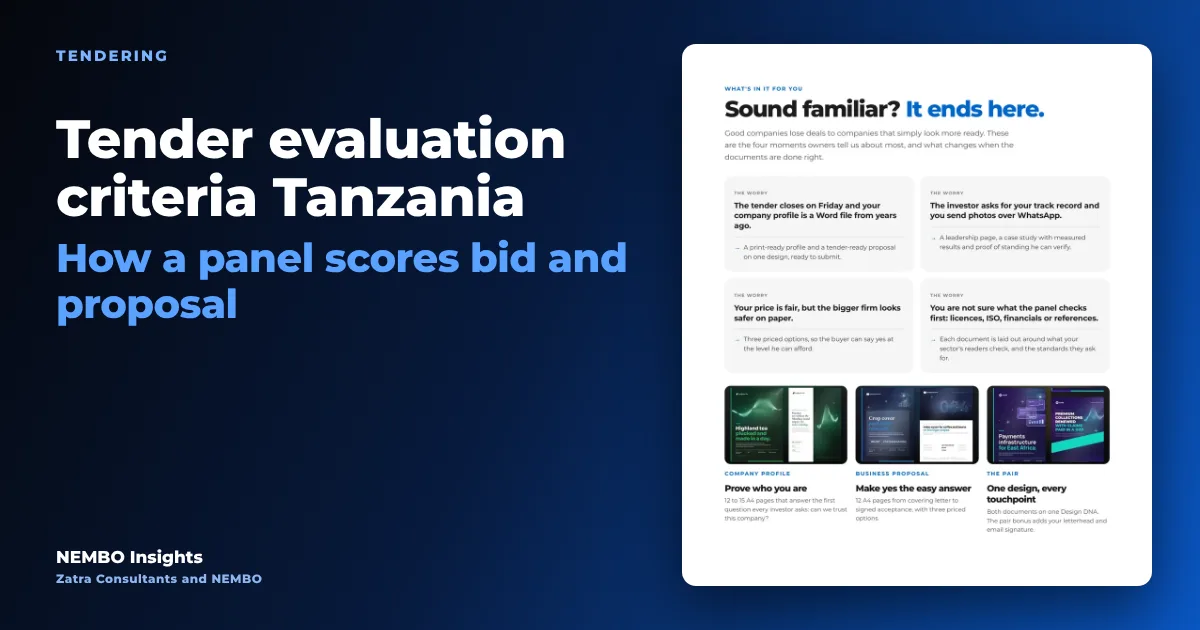
Many tenders are lost in a file review the bidder never sees: a missing signature, or a technical score under the minimum mark so the price is never opened.
This guide explains how a Mainland procuring entity evaluates bids and proposals under the Public Procurement Act, 2023 and the Public Procurement Regulations. It then shows how to build the proposal so each criterion is answered where the panel looks. It links to the guides on NeST registration and the tender file, tender security or a securing declaration and the letterhead that tender panels check, and covers evaluation.
What the law or standard says about tender evaluation criteria in Tanzania
Four layers decide how a panel scores. The Act sets principles and time limits. The Regulations set the steps and some numbers. The Authority's standard documents set formulas and blanks. Your tender document fixes the rest.
| Source | Layer | What it fixes |
|---|---|---|
| Act No. 10 of 2023, s.53 and s.55 | Law | Qualification criteria and post-qualification before award. |
| Act, s.69 | Law | Notice of intention to award and a five working day complaint window. |
| Act, ss.119 to 125 | Law | Review, appeal to PPAA and judicial review. |
| Regulations 209 to 242 | Regulations | Goods, works and services: evaluation and award. |
| Regulations 253 to 299 and Sixteenth Schedule | Regulations | Consultancy methods, scoring and guide weights. |
| Standard request for proposals, 2022 | Authority document | Score formulas, with the minimum mark and weights left blank. |
The Act took effect on 17 June 2024 under GN No. 455, as the PPRA announcement of 12 June 2024 records. The English text of the Act was published as GN No. 813 on 20 September 2024.
The English Regulations show GN No. 261 and 25 April 2025. The text lists GN Nos. 518 of 2024, 817 of 2024 and 42 of 2025 under the title and says the Regulations took effect on 1 July 2024. Regulation numbers below come from that text.
One rule runs through every method. Regulation 218 requires the entity to evaluate accepted tenders by the procedures and criteria in the tender documents. A criterion that is not in the document should not appear in the score sheet.
Who should read this
This guide is for consultants, contractors and suppliers who bid to Mainland public bodies, and for the person who assembles and signs the file. If you bid in Zanzibar, read the section on Mainland and Zanzibar first, because a different Act applies there.
What does the panel check first: responsiveness?
The accounting officer forms an evaluation committee of three or five members (regulations 209 and 289). Before detailed evaluation, the committee asks whether each tender is substantially responsive, whether the required securities are present and whether documents are properly signed.
A tender is substantially responsive when it meets all terms, conditions and specifications without material deviation. Regulation 211 lists commercial faults that justify rejection:
- The tender form or price schedules are not signed by the authorised person.
- The tender security is missing or not as specified.
- The tender is conditional or refuses the price adjustment formula.
- Major supporting documents are missing.
Regulation 212 adds technical faults: not tendering the full scope, leaving a major item unpriced, or presenting an unrealistic implementation plan. Under regulation 213 a non-responsive tender is rejected and cannot be made responsive later.
The panel may ask for clarification (regulation 214) but may not accept a change of substance, including price. It corrects purely arithmetical errors and tells the tenderer. A tenderer who rejects the correction is rejected under regulation 217.
How is qualification judged, and when?
Section 53 of the Act says tenderers qualify by meeting criteria that are made known and apply equally to all. Regulation 7 asks for evidence of technical eligibility, capacity, financial resources, equipment and personnel. It bars insolvent, debarred or suspended bidders.
If your registration and tax records are not current, the panel never reaches your technical answers. The tender evidence index is a one-page check for that file. Qualification is judged twice: on your documents, and again as post-qualification of the best-ranked bidder.
How are goods and works bids priced and compared?
The successful tender has the lowest evaluated price, not necessarily the lowest quoted price (regulation 219). Regulation 220 lets the entity count operating cost, delivery time, functional characteristics, payment terms and guarantees, if the tender document says so. Such factors are expressed in money terms (regulation 215).
Two price rules catch bidders out:
- A tender above the entity's pre-determined value is automatically disqualified (regulation 216(1)).
- An abnormally low tender may be rejected, but only after the entity asks for an explanation, weighs the evidence and verifies the price (regulation 16).
Margins of preference (regulations 228 to 230) group tenders and compare the lowest in each group. The 2025 preference guidelines were not read for this guide.
How are consultancy proposals scored technically?
Consultancy is judged on quality first. The committee has no access to financial proposals until technical evaluation is complete, including approvals (regulation 289(4)).
Regulation 290 scores each technical proposal out of 100 and ranks firms by merit. The rated criteria include relevant experience, reputation, knowledge of the project environment, understanding of the terms of reference, and the quality of the plan and methodology. The weights vary with the assignment, and the Sixteenth Schedule gives guide ranges.
| Criterion (Schedule part c) | Guide range | Illustrative weight below |
|---|---|---|
| Understanding of the terms of reference | 10% to 20% | 15 |
| Quality of offer, work and methodology | 20% to 30% | 25 |
| Qualifications and experience of experts | 40% to 60% | 50 |
| Inclusion of local experts | 5% to 15% | 10 |
Key personnel carry the most weight. Under regulation 290(9) each CV is signed by the holder and an authorised official of the firm, and rated on general qualifications, adequacy for the assignment and local familiarity. The committee keeps every evaluator's mark sheet until the project and its audit are complete.
The minimum qualifying mark is not fixed in the Regulations. Regulation 292 refers to it, and the request for proposals sets it. The 2022 standard request for proposals leaves it blank and suggests 70 to 80 points.
How are financial proposals scored and combined?
Firms below the minimum mark, or non-responsive, are told their financial proposals will not be opened (regulation 292(1)). Firms above it are told the opening date. Opening may not happen earlier than five working days after that notice, and the entity publishes the technical results first (regulation 293). The 2022 standard request for proposals says seven working days, so read the one you receive.
The committee checks the financial proposal against the technical proposal and converts prices to one currency at an official rate such as the Bank of Tanzania's (regulation 294). Arithmetic errors are corrected before scoring (regulations 255(3) and 256(4)). Then the formula applies.
- Financial score. The lowest price scores 100 and others fall in proportion (regulation 295(1)). The standard request for proposals gives Sf = 100 x Fm / F, where Fm is the lowest price and F the price scored.
- Combined score. S = St x T + Sf x P, with T + P = 1.
- Cost weight. Regulation 295(4), as the copy read shows it, puts the cost weight at ten to twenty out of 100. The standard request for proposals suggests T of 0.7 to 0.9 and P of 0.1 to 0.3.
The highest total score is invited to negotiate (regulation 295(5)).
Which consultancy selection method applies?
The method is chosen before the invitation and written into the request for proposals (regulation 253). It changes how much price matters.
| Method | Regulation | Role of price |
|---|---|---|
| Quality based | 254 | Best technical firm negotiates first; other prices stay unopened. |
| Quality and cost based | 255 and 295 | Price is scored and weighted with quality. |
| Least cost | 256 | Lowest price among firms above the minimum mark. |
| Fixed budget | 257 | Best technical proposal within the stated budget. |
| Consultant qualifications | 258 | Best-qualified firm submits a combined proposal. |
Auditors are selected with cost worth 40 to 50 points, or by least cost (regulation 264).
How should the technical and financial proposal be built?
The panel works from the scorecard, not from your brochure. A scorer should find the evidence for each criterion in under a minute. The PPRA guideline on preparing responsive proposals reports that more than 75 percent of firms drop out in the first two stages, administrative and technical conformity.
| Criterion | What the scorer looks for | Where the proof sits |
|---|---|---|
| Understanding of the terms of reference | Your reading of scope, risks and outputs | One page that restates the task in your words |
| Methodology and work plan | Steps that deliver each output on time | Activity table with dates and responsible expert |
| Key experts | Education, years and similar assignments | Signed CVs in the form the document sets |
| Local experts | Named national staff with real roles | Staffing table and the CVs |
| Financial consistency | Prices that match the staffing and plan | Staff-months in both volumes agree |
- Mirror the headings. Follow the order and numbering of the criteria in the data sheet, with a short compliance index at the front.
- Keep volumes separate. Amendments after the deadline are not accepted (regulation 287).
- Price the compliant offer. Quote any deviation separately from the compliant price (regulation 285).
- Sign what must be signed. The PPRA guideline lists unsigned or unstamped forms among rejection causes.
Worked example: a consultancy proposal scored on a weighted scorecard
This example is illustrative. The firms, scores and prices are invented, and the real weights come from your request for proposals. The weights sit inside the Sixteenth Schedule ranges above. Assume quality and cost based selection, a minimum technical mark of 75, and a cost weight of 20 percent, so T = 0.8 and P = 0.2.
Step 1: technical scoring. Each firm earns points on four criteria, adding to a score out of 100.
| Criterion (maximum) | Firm A | Firm B | Firm C | Firm D |
|---|---|---|---|---|
| Understanding of terms (15) | 12.0 | 13.5 | 14.0 | 10.0 |
| Methodology (25) | 21.0 | 20.0 | 23.0 | 15.0 |
| Key experts (50) | 41.0 | 38.0 | 44.0 | 30.0 |
| Local experts (10) | 8.0 | 9.0 | 9.0 | 6.0 |
| Technical score St (100) | 82.0 | 80.5 | 90.0 | 61.0 |
Firm A: 12.0 + 21.0 + 41.0 + 8.0 = 82.0. Firm D scores 61.0, below 75, so its financial proposal stays sealed and it is told so (regulation 292(1)).
Step 2: financial and combined scores. The lowest price is Firm B at TZS 150,000,000, so Fm = 150,000,000. Sf = 100 x 150,000,000 / F.
| Firm | St | Price (TZS) | Sf | 0.8 x St | 0.2 x Sf | Total | Rank |
|---|---|---|---|---|---|---|---|
| A | 82.00 | 180,000,000 | 83.33 | 65.60 | 16.67 | 82.27 | 3 |
| B | 80.50 | 150,000,000 | 100.00 | 64.40 | 20.00 | 84.40 | 2 |
| C | 90.00 | 200,000,000 | 75.00 | 72.00 | 15.00 | 87.00 | 1 |
| D | 61.00 | not opened | none | none | none | none | out |
Check the arithmetic. Firm A: Sf = 100 x 150 / 180 = 83.33, and 0.2 x 83.33 = 16.67, so 65.60 + 16.67 = 82.27. Firm C: Sf = 100 x 150 / 200 = 75.00, and 72.00 + 15.00 = 87.00.
Step 3: reading the result. Firm C is the dearest at TZS 200,000,000, and it still ranks first. Against Firm B, its price costs 5.00 combined points (0.2 x 25.00) and its technical lead earns 7.60 (0.8 x 9.50), a margin of 2.60. Under least-cost selection (regulation 256), the same three proposals would give Firm B the contract.
Firm C is then invited to negotiate and post-qualified. If it fails, the entity moves to Firm B.
What happens after evaluation: post-qualification, negotiation and the award notice?
The evaluation report goes to the Procurement Management Unit, then to the accounting officer or tender board (regulations 227, 291 and 297). Before the award is communicated, the entity checks that the best-ranked bidder has the legal capacity, capability and resources to perform (section 55 of the Act).
For goods and works, regulation 231 lets the entity test past performance, personnel, equipment, financial capability, current commitments and litigation record, and take references. The criteria must be in the tender document and not unduly restrictive. For consultants, regulation 296 verifies licences, permits, blacklist status and audited financial statements. A bidder that fails is rejected and the next is tested.
Regulation 238 then sets the notice. The accounting officer or tender board approves within three working days. The accounting officer issues a notice of intention to award to all tenderers within three days, giving them five working days to complain. The notice names the winner, the total cost and time, and why the others did not win.
- If no complaint arrives, a notice of acceptance goes to the winner (section 69(6)).
- A tenderer who lets the five days pass is treated as having waived the right to appeal (regulation 238(7)).
- The notice does not apply to national shopping, common-use items and services, single source and minor value procurement (section 69(5)).
The provisions read do not use the word standstill, but the five working day window does that job. The contract is signed within fourteen working days after the conditions are met (regulation 240). Section 69 speaks of tenders and proposals, and the 2022 standard request for proposals has its own notice stage, so check yours.
How do you complain or appeal, and by when?
The review route is short, and the clocks run in working days.
| Step | Where | Time limit |
|---|---|---|
| Complaint | Accounting officer, through the electronic system, copy to PPRA | 5 working days from awareness |
| Decision | Accounting officer, in writing with reasons | 5 working days; 7 days if a panel sits |
| Appeal | Public Procurement Appeals Authority | 5 working days from the decision |
| PPAA decision | Written decision, binding on the parties | 40 days |
| Judicial review | High Court | 14 days from the decision |
These limits come from sections 120, 121 and 125 of the Act and regulation 108. The complaint must set out the breach, the evidence and the remedy sought. Procurement is suspended while the accounting officer decides, unless the entity certifies an urgent public interest (section 124).
A bidder may go straight to PPAA if no decision comes in time, or if the contract is already in force (section 121(2)). The right of review does not cover the choice of procurement method (section 119(2)).
Take these steps to an advocate before the clock runs. The PPAA site lists contact details. The Citizen reported on 23 October 2026 that PPAA launched a mobile application for appeals. The desk read only the lead, so confirm the filing channel with PPAA.
Mainland Tanzania and Zanzibar: what differs?
Everything above is Mainland law. Zanzibar has its own statute and regulator.
| Point | Mainland | Zanzibar |
|---|---|---|
| Statute | Public Procurement Act, 2023 (Act No. 10 of 2023) | Public Procurement Act, 2025 (Act No. 2 of 2025) |
| Regulator | PPRA | Zanzibar Public Procurement Regulatory Authority |
| Complaint window | 5 working days | 3 working days from the notice of intention to award |
| Appeal | PPAA | The Zanzibar Authority |
These Zanzibar facts come from the Zanzibar Gazette supplement of 4 April 2025, which prints Act No. 2 of 2025, assented on 18 March 2025. It repeals the 2016 Act and says evaluation criteria must be in the bidding documents. The desk did not find regulations under the 2025 Act. Confirm weights, formulas and e-procurement steps with the Zanzibar Authority before you bid.
Key dates
No statutory deadline applies to this guide. These are the source dates and the main clocks inside a tender.
| Date or period | What it marks |
|---|---|
| 17 June 2024 | Public Procurement Act, 2023 takes effect (GN No. 455) |
| 1 July 2024 | Public Procurement Regulations, 2024 take effect |
| 4 April 2025 | Zanzibar Public Procurement Act, 2025 gazetted |
| 25 April 2025 | English Regulations published as GN No. 261 |
| 5 working days | Minimum gap before financial proposals open (Regulation 293) |
| 5 working days | Complaint window after the notice of intention to award |
| 14 working days | Contract signing after conditions are met (Regulation 240) |
What to do now
- Read the evaluation section first. Find the criteria, minimum mark, weights T and P, and formula in the data sheet before you write a line.
- Build a compliance index. List every requirement, the page that answers it and its owner.
- Score yourself. Have someone outside the bid team apply the scorecard to your draft.
- Align the two volumes. Staff, months and tasks must match in both.
- Prepare for post-qualification. Keep licences, audited accounts, references and signed CVs ready to verify.
- Diary the clocks. Note the complaint and appeal limits the day the notice arrives, and brief an advocate at the first sign of an unfair score.
What the NEMBO desk prepares
The Client shares the facts: the tender document, experience record, CVs, audited accounts and pricing basis. Zatra Consultants prepares and checks the content against the criteria. NEMBO designs and delivers the finished documents.
The document types are tender files and evidence indexes (investor and tender documents), a company profile (company profile package), financial report packs (CFO desk) and letterheads (letterhead desk). The process page shows how a job runs, and answers covers cost.
Two cost buckets apply. Government fees at the official rate are paid to the authority and are separate from NEMBO's and Zatra's fees. At 26 Sep 2026 the register lists NeST tenderer registration at TZS 100,000 a year (register ID F0174) and national tender participation at TZS 30,000 (register ID F0175). NEMBO and Zatra fees are published on packages and pricing and quoted in writing. To begin, share the details.
How Zatra helps
Zatra Consultants checks the facts in the file, the filings behind the qualification documents and the figures in the price schedule. It checks that the staffing table, the CVs and the financial proposal agree, and compares your draft against the criteria in the tender document. Read the Zatra posts on registering as a government supplier and qualifying before you bid, or see the tender and procurement advisory service.
The desk does not decide or guarantee any authority's outcome, whether that authority is a bank, a tender panel or a regulator. Legal opinions, complaints and appeals go to an advocate. Tax and reporting questions go to an accountant.
Investor and tender documents
Zatra Consultants prepares and checks the content on the details the Client shares. NEMBO designs and delivers it. Fees are published on the packages page and quoted in writing.
Open the desk pageSources and status
Accurate as at 6 November 2026. The Act and Regulations were read in full text from the publisher's PDFs, and the other sources were read as noted.
- 1The Public Procurement Act, 2023 (Act No. 10 of 2023), GN No. 813Public Procurement Regulatory Authority, English text published 20 September 2024. Accessed 6 November 2026.
- 2The Public Procurement Regulations, GN No. 261 of 2025, English versionMinistry of Finance, published 25 April 2025. Accessed 6 November 2026.
- 3New public procurement law to take effect on June 17, 2024Public Procurement Regulatory Authority, 12 June 2024. Accessed 6 November 2026.
- 4Standard Request for Proposals, Lumpsum ContractsPublic Procurement Regulatory Authority, February 2022. Accessed 6 November 2026.
- 5Guidelines for Preparing Responsive Proposals for Consultancy ServicesPublic Procurement Regulatory Authority, listed 6 February 2023. Accessed 6 November 2026.
- 6Zanzibar Public Procurement Act, 2025 (Act No. 2 of 2025)Zanzibar Government Gazette, 4 April 2025, archive copy. Accessed 6 November 2026.
- 7National e-Procurement System of Tanzania (NeST)Public Procurement Regulatory Authority, undated page. Accessed 6 November 2026.
- 8Public Procurement Appeals AuthorityPPAA, undated page. Accessed 6 November 2026.
- 9Tanzania's new Public Procurement Act: reforms or business as usual?The Chanzo, September 2023. Accessed 6 November 2026.
- 10PPAA digitalises procurement appeals to cut costs, delaysThe Citizen, 23 October 2026. Accessed 6 November 2026.
Figures to confirm before you act
- The minimum technical mark, T and P, and the financial score formula in your own request for proposals.
- The cost weight in regulation 295(4). The copy read has a word missing after "twenty", so check the gazetted original.
- Regulation 294(2) on arithmetic corrections. The copy read is garbled.
- Working days in the standard request for proposals (seven) against the Act and Regulations (five).
- Any Zanzibar regulations under the 2025 Act, and how PPAA accepts filings and fees, from the authorities.
- The version of the Regulations in force on the day you bid.
This article is general information based on official sources available at the date of publication. It is not legal, tax or financial advice. Laws and notices change. Verify with the issuing authority or consult Zatra before acting.
Frequently asked questions
Is the lowest bid always the winner?
No. For goods and works the winner has the lowest evaluated price, which can count factors such as delivery time. Under quality and cost selection the highest combined score wins, even if another firm quoted less.
What is the minimum technical score for a consultancy proposal?
The Regulations do not fix one. The request for proposals sets it, and the 2022 standard template leaves it blank with a suggested range of 70 to 80. Read your own data sheet.
Can I correct a mistake after I submit?
No. Amendments after the deadline are not accepted, and a non-responsive tender cannot be repaired later. The panel may correct purely arithmetical errors and must tell you.
Why was my financial proposal not opened?
Your technical score was probably below the minimum mark, or the proposal did not respond to the terms of reference. The entity must notify you that it was not opened. Ask for the technical result in writing.
How long do I have to complain after the notice of intention to award?
On the Mainland, five working days from the notice, or from when you knew of the problem. In Zanzibar, three working days from receipt of the notice. Missing the window can waive your right to appeal.
Can my bid be rejected for being too low?
Yes, but with process. The entity must ask you to explain the parts of concern, weigh your evidence and verify the price first. A price above the entity's pre-determined value is disqualified.
Who should handle a dispute over my score?
An advocate who knows procurement review, engaged as soon as the notice arrives, because the windows are short. Zatra can check the facts and figures in your file for that advocate.