On this page
- What the law says
- Who should read this
- What does a budget variance report contain?
- Static budget or flexed budget: which comparison is fair?
- Which thresholds trigger an explanation?
- How should the commentary be written?
- How do a board, a lender and a donor read the same report?
- Worked example: Kibaha Packaging Limited, October 2026
- The quarterly forecast update and the donor realignment request
- Controls: who prepares, who reviews, who signs
- Mainland and Zanzibar: which rules differ?
- What to do now
- Key dates
- What the NEMBO desk prepares
- How Zatra helps
- Sources and status
- Frequently asked questions
What must a budget variance report show in Tanzania?
A budget variance report sets each revenue and cost line against its approved budget for the month and year to date, shows the variance in TZS and per cent, adds a full-year forecast and explains every line that breaches the finance policy threshold. Public entities and NGOs present the comparison under IPSAS 24 as NBAA requires; a company shapes it for the board, the lender's covenants and donor flexibility limits.
What the law says
No Tanzanian statute prescribes the layout of a budget variance report for a private company. The duty behind it is older. The Companies Act Cap. 212 requires every company to keep accounting records that show and explain its transactions and disclose its financial position with reasonable accuracy, and it makes the directors answerable for accounts that give a true and fair view. The consolidated text is on TanzLII; a Zatra note of 10 October 2026 places the books of account duty at section 154 in the Revised Edition 2023 numbering.
For a Mainland public entity the duty is explicit. The Budget Act Cap. 439 (Revised Edition 2020) makes the accounting officer responsible for executing the approved budget, limits reallocation of funds under section 41, and requires quarterly reporting of actual revenue and expenditure to the Paymaster-General under section 55. Section 10 directs the Minister to publish budget execution progress every quarter.
The standard that turns the comparison into a financial statement is IPSAS 24, Presentation of Budget Information in Financial Statements, in the 2026 IPSASB Handbook. Paragraph 14 requires an entity that makes its approved budget public to present the original and final budget amounts, the actual amounts on a comparable basis and, by way of note, an explanation of material differences. Paragraph 29 requires an explanation of changes between the original and the final budget, and paragraphs 47 to 51 a reconciliation where the budget basis and the accounting basis differ.
NBAA sets who must apply it. Technical Pronouncement No. 1 of 2018 assigns IPSAS to public sector entities that finance themselves through taxes, transfers or fees and do not have profit as a primary objective. Technical Pronouncement No. 3 of 2020 extends IPSAS to all NGOs and associations for periods beginning on or after 1 July 2021. A commercial company applies IFRS, IFRS for SMEs or FRSME under the 2018 thresholds, and none of those frameworks requires a budget comparison in the annual accounts, so for a company the variance report is a management document.
Donor rules add a third layer. The EU general conditions for grant contracts for external actions (July 2019) let the coordinator move money between main budget headings without an addendum where the variation is 25 per cent or less of the amount originally entered. The change must not affect the expected results, and the contracting authority must be told in writing. The US rule in 2 CFR 200.308 lets a federal agency restrict transfers among direct cost categories once cumulative transfers exceed 10 per cent of the total budget. The USAID standard provisions for non-US NGOs (revised December 2022) carry the same trigger where the award specifies it.
Who should read this
This guide is for the finance manager who prepares the monthly pack, the managing director who signs it, the board member who reads it, and the project accountant who turns it into a donor financial report. It covers a Mainland company, a public entity under the Budget Act and an NGO reporting under IPSAS; Zanzibar public entities are covered below. The budget itself is covered in what a board and a lender expect from the annual budget.
What does a budget variance report contain?
A budget variance report is one table and one page of words. The table sets each revenue and cost line against its budget for the month and the year to date, shows the difference in shillings and in per cent, and ends with a full-year forecast. The words explain every line that breaches a threshold and name the action, the owner and the date. It sits inside the monthly pack described in the board pack guide, after the income statement.
| Column | What it holds |
|---|---|
| Line | The revenue or cost heading, in chart of accounts order |
| Budget, month | The approved figure for the month, phased rather than one twelfth |
| Actual, month | The closed ledger figure after accruals |
| Variance, TZS | Actual less budget, marked favourable or adverse; the absolute threshold test uses it |
| Variance, per cent | Variance divided by budget; the relative threshold test uses it |
| Year to date | Budget, actual and variance since the start of the year, separating a blip from a trend |
| Full-year forecast | Year-to-date actual plus the revised expectation for the remaining months; covenants and burn rate are tested here |
| Commentary and action | Cause, effect, action, owner and date for each breach |
Two conventions keep the table honest. Sign the variances the same way every month: adverse means profit is lower than budget, whether the line is revenue or cost. Show gross profit and operating profit as rows, so the reader sees how the line variances add up. A public entity adds a column for the final budget, because IPSAS 24 requires both the original and the final amounts and section 41 reallocations change the final figure during the year.
Static budget or flexed budget: which comparison is fair?
A static budget is the figure the board approved for the month. A flexed budget restates the variable lines at the actual level of activity. The ACCA technical article All about budgeting, part 1 by Steve Willis describes it as the answer to one question: what should the results have been at the actual activity level? Without it, a month of low sales shows a favourable cost of sales variance that nobody earned.
The practical rule is to flex cost of sales and any cost that moves with volume, such as commission and packaging, and to leave fixed lines such as rent and depreciation on the static budget. The CPA Ireland article Understanding Variance Analysis by Helen O'Brien Gately sets out the split that follows. The sales volume variance is the difference between actual and budgeted quantity multiplied by the standard margin; the sales price variance is the difference between actual and standard price multiplied by the actual quantity. The fix for lost volume is a sales action and the fix for a lower price is a pricing decision, so the board needs both.
Cash and accrual are the other trap. A donor budget is usually cash; the ledger is accrual, so a three-month rent prepayment lands in one month on one basis and in three on the other. IPSAS 24 requires the comparison on the budget basis with a reconciliation to the accrual statements. A company states its basis in the report header.
Which thresholds trigger an explanation?
A variance report that explains every line explains nothing. The finance policy sets a threshold, and the commentary covers only the lines that breach it. A double test works best: a percentage and a shilling floor, both of which must be met. The percentage catches a small line that has drifted; the floor stops a paragraph about a TZS 300,000 overspend on stationery. A third test catches a large line that moved by more money than the board would ignore.
| Reader | Typical threshold | Where it is written |
|---|---|---|
| Board of a mid-sized company | 10 per cent of the line and TZS 3,000,000, or any variance above TZS 15,000,000 | Finance policy, approved with the annual budget |
| Lender | Any movement that shifts a covenant ratio by more than an agreed margin, often 0.1 on DSCR | Facility letter and covenant certificate schedule |
| EU-financed NGO project | Cumulative movement between main headings approaching 25 per cent of the amount originally entered | General conditions, Article 9.4, and the grant budget annex |
| US-financed NGO project | Cumulative transfers among direct cost categories approaching 10 per cent of the total budget | 2 CFR 200.308 and the award's standard provisions |
| Public entity under the Budget Act | Any reallocation between line items, sub-votes or programmes, within the limits in section 41 | Budget Act Cap. 439 and the Budget Regulations |
The figures in the first row are a common pattern, not a rule. The board sets them with the annual budget and keeps them for the year, so that the finance team cannot move the line after a bad month. The threshold belongs in the finance procedure in the Business Operating Library, with a version number and an approval date.
How should the commentary be written?
"Fuel was over budget due to high prices" restates the table; it explains nothing. The standard that boards and donors expect has five parts, in order.
- Cause: what happened, with a quantity or a price. Twelve extra delivery rounds to Morogoro, not "more deliveries".
- Effect: timing, which reverses, or permanent, which changes the full-year forecast, and by how much.
- Action: the decision taken or proposed, such as consolidating deliveries to two days a week.
- Owner: one named person, by role, not a department.
- Date: the month in which the board will see the result, so the next report can say whether it worked.
Write the commentary for the breaching lines only, in table order, under 80 words each. A favourable variance gets the same treatment, because an underspend on maintenance in October may be a breakdown in February. The report ends with one paragraph on the full-year forecast: where it has moved since last month, and whether the assumptions in the business plan still hold.
How do a board, a lender and a donor read the same report?
The board reads the full-year forecast and the operating profit row: will the year land where the budget said, does the dividend or the capital programme still fit, and who owns the three largest variances. A board that receives the report within ten working days of month end can act in the same month. The tests behind that judgement are in the three tests behind a CFO verdict.
The lender reads the forecast against the covenants. A Tanzanian term loan commonly carries a minimum debt service coverage ratio, a maximum gearing ratio and a minimum current ratio, tested quarterly or half-yearly on management accounts and annually on audited accounts. No bank page read for this guide publishes its covenant template, so the ratios and test dates come from the facility letter. The variance report feeds the covenant compliance certificate: if forecast operating profit falls, forecast DSCR falls with it, and the lender wants to hear it before the test date. The 13-week cash forecast covers the months between tests.
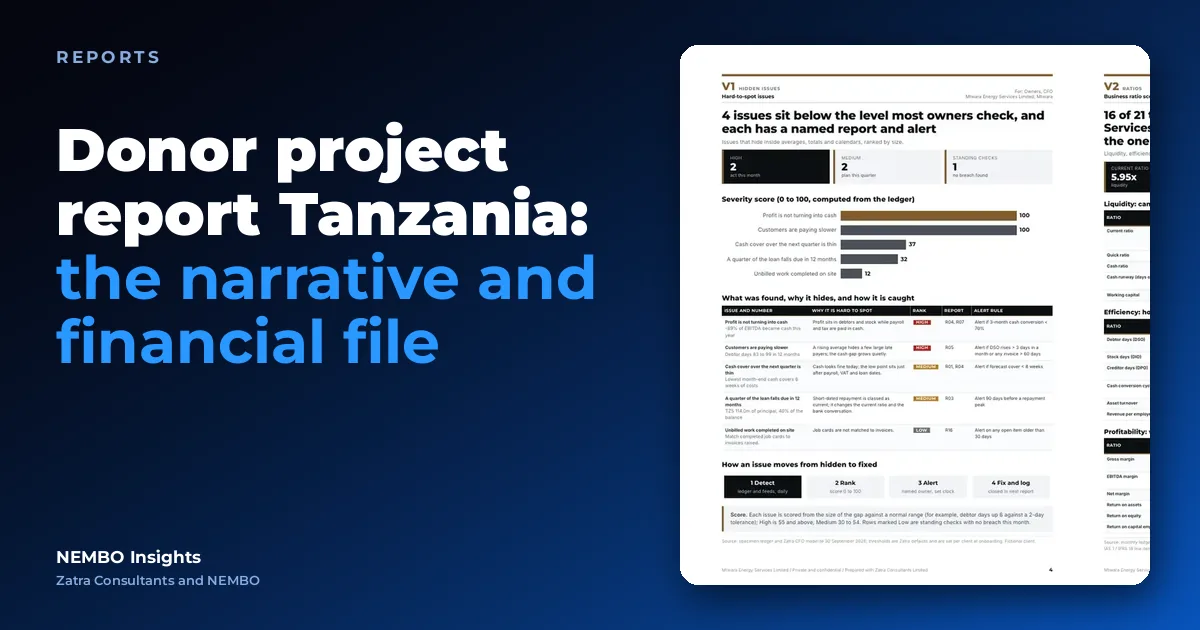
The donor reads the cumulative movement per budget heading against the amount originally entered, because the EU 25 per cent flexibility and the US 10 per cent trigger are both measured on that figure. The EU excludes the indirect cost and contingency headings. Both donors want the forecast spend per heading to the end of the action, so that a realignment request can be made while the money can still be moved. The file that goes with it is in the donor project report guide.
Worked example: Kibaha Packaging Limited, October 2026
Kibaha Packaging Limited is an illustrative Mainland manufacturer with a 30 June year end, a TZS 5,000,000,000 revenue budget and a term loan carrying a minimum DSCR of 1.25. Its finance policy requires commentary where a variance exceeds 10 per cent of the line and TZS 3,000,000, or exceeds TZS 15,000,000 on any line. Cost of sales is tested on a flexed basis. All figures are illustrative, in TZS, accrual basis.
| Line | Budget October | Actual October | Variance TZS | Variance per cent |
|---|---|---|---|---|
| Revenue | 420,000,000 | 371,700,000 | 48,300,000 adverse | 11.5 adverse |
| Cost of sales | 273,000,000 | 245,322,000 | 27,678,000 favourable | 10.1 favourable |
| Gross profit | 147,000,000 | 126,378,000 | 20,622,000 adverse | 14.0 adverse |
| Payroll | 48,500,000 | 49,100,000 | 600,000 adverse | 1.2 adverse |
| Rent | 9,000,000 | 9,000,000 | 0 | 0.0 |
| Fuel and transport | 14,000,000 | 17,920,000 | 3,920,000 adverse | 28.0 adverse |
| Electricity and water | 6,500,000 | 6,890,000 | 390,000 adverse | 6.0 adverse |
| Marketing | 8,000,000 | 12,400,000 | 4,400,000 adverse | 55.0 adverse |
| Repairs and maintenance | 5,000,000 | 4,300,000 | 700,000 favourable | 14.0 favourable |
| Insurance, licences and fees | 3,200,000 | 3,200,000 | 0 | 0.0 |
| Depreciation | 11,000,000 | 11,000,000 | 0 | 0.0 |
| Finance costs | 7,800,000 | 8,150,000 | 350,000 adverse | 4.5 adverse |
| Operating costs | 113,000,000 | 121,960,000 | 8,960,000 adverse | 7.9 adverse |
| Operating profit | 34,000,000 | 4,418,000 | 29,582,000 adverse | 87.0 adverse |
Which lines breach the threshold
Three lines cross the policy line: revenue, fuel and transport, and marketing. Cost of sales shows a favourable 10.1 per cent on the static budget, but the flexed budget at 65 per cent of actual revenue is TZS 241,605,000, so the flexed variance is TZS 3,717,000 adverse, or 1.5 per cent: a note on the margin is enough. Repairs and maintenance moved 14 per cent but by TZS 700,000, below the floor.
Commentary for the three breaches
Revenue, TZS 48,300,000 adverse. Cause: two supermarket chains delayed their promotion orders, 1,150 cartons at an average TZS 42,000, and the Mbeya distributor lost a week to a vehicle breakdown. Effect: TZS 30,000,000 is timing, expected in November; TZS 18,300,000 is lost volume. Action: confirm the November purchase orders in writing and trial a second Mbeya distributor. Owner: sales manager. Date: November report.
Fuel and transport, TZS 3,920,000 adverse. Cause: twelve additional delivery rounds to Morogoro at an average TZS 210,000, plus the October pump price. Effect: permanent if deliveries stay daily; the forecast adds TZS 2,000,000 per month. Action: consolidate Morogoro deliveries to two days a week and apply the delivery charge on orders under TZS 2,000,000. Owner: operations manager. Date: December report.
Marketing, TZS 4,400,000 adverse. Cause: the Q4 trade promotion budgeted for November was brought forward to October to hold shelf space. Effect: timing; November will be TZS 3,600,000 under budget and the full year is unchanged. Action: none beyond the rephasing. Owner: marketing manager. Date: closed in November.
Year to date and full-year forecast
Year to date, July to October 2026, revenue is TZS 1,558,400,000 against TZS 1,640,000,000, or 5.0 per cent adverse, and operating profit is TZS 96,300,000 against TZS 128,000,000. The full-year forecast is revenue of TZS 4,790,000,000 against the TZS 5,000,000,000 budget, down 4.2 per cent, and operating profit of TZS 336,000,000 against TZS 400,000,000, down 16.0 per cent. The forecast DSCR at 30 June 2027 is 1.31 against the covenant minimum of 1.25, down from 1.38 last month. One more month at October's run rate takes the forecast below the covenant, so the lender will be briefed before the December test.
For an NGO project, replace the income statement rows with the grant budget headings and add a column for cumulative spend against the amount originally entered. The report then shows whether a transport overspend has taken the travel heading past 25 per cent of its original figure and into addendum territory.
The quarterly forecast update and the donor realignment request
A budget is approved once; a forecast is revised every quarter. The quarterly update reworks the remaining months on the latest run rate, prices and volumes, and replaces the forecast column for the next three monthly reports without touching the budget column. The board sees the original budget, the latest forecast and the previous forecast side by side, with a bridge between the last two that uses the same drivers as a sensitivity analysis.
For a donor project the quarterly update is the moment to decide on realignment. A realignment request under the EU general conditions is a letter with a table: each main heading, the amount originally entered, spend to date, the forecast to the end of the action, the proposed revised amount and the movement in per cent of the original figure. Where every movement stays at or under 25 per cent and the indirect cost and contingency headings are untouched, the letter informs the contracting authority and no addendum is needed. Where any heading moves by more, or the change affects the expected results, the request asks for an addendum and waits for the signature. A US award follows its own standard provisions and 2 CFR 200.308, which asks the agency to respond within 30 days. A request made after the money is spent is a disallowance waiting to happen, and a disputed disallowance belongs with an advocate.
Controls: who prepares, who reviews, who signs
A variance report is a controlled document. It carries the period, a version number, the basis of preparation, the preparer, the reviewer and the approver, each with a date. If it is reissued after a late journal, the version changes and the board is told what moved.
| Step | Owner | Evidence | Timing after month end |
|---|---|---|---|
| Close the ledger and post accruals | Accountant | Closing checklist, bank reconciliation | Working day 5 |
| Run the variance table and apply the threshold test | Finance manager | Report version 0.1 with the flagged lines | Working day 6 |
| Collect cause, action, owner and date | Finance manager with line managers | Signed commentary sheet per flagged line | Working day 8 |
| Review arithmetic, phasing and forecast | Outsourced or in-house CFO | Review note, version 0.2 | Working day 9 |
| Approve and issue to the board | Managing director | Signed version 1.0 in the board pack | Working day 10 |
| Extract the lender and donor versions | Finance manager | Covenant certificate; donor heading table | Per facility letter or grant contract |
Two separations matter. The person who posts the journals does not sign the report, and the line manager who explains a variance does not decide whether it needs explaining. In a public entity the internal auditor reviews the quarterly report before it goes to the Paymaster-General. How NEMBO fits into that order of work is on the process page.
Mainland and Zanzibar: which rules differ?
For a company the frameworks are the same on both sides. NBAA's pronouncements apply across the United Republic, so a Zanzibar company applies IFRS, IFRS for SMEs or FRSME by the same thresholds, and a Zanzibar NGO or association applies IPSAS under Technical Pronouncement No. 3 of 2020. A Zanzibar company registered through BPRA keeps its records under the Zanzibar companies legislation, which was not read for this guide.
| Point | Mainland | Zanzibar |
|---|---|---|
| Public entity budget law | Budget Act Cap. 439, read in the 2020 revised edition | Public Finance Management Act No. 12 of 2016, named in the April 2019 PEFA assessment; text not read |
| Reporting framework for NGOs | IPSAS, NBAA TP 3 of 2020 | IPSAS, NBAA TP 3 of 2020 |
| Reporting framework for companies | IFRS, IFRS for SMEs or FRSME, NBAA TP 1 of 2018 | Same pronouncement |
| Quarterly budget execution reporting | Section 55, Budget Act | Recorded as not published for 2017/18 in the 2019 PEFA assessment; current practice not verified |
For a Zanzibar public entity, the PEFA assessment of April 2019 names the Public Finance Management Act No. 12 of 2016 as the governing law and rates in-year budget reporting at the lowest grade. A June 2026 report in The Citizen records a member of the House of Representatives pressing for a dedicated Zanzibar budget law; no such Act was read for this guide. An advocate confirms any point that turns on the Zanzibar text.
What to do now
- Fix the budget basis: confirm whether the approved budget is phased by month and whether it is cash or accrual, and say so in the report header.
- Write the threshold into the finance policy: a percentage, a shilling floor and an absolute ceiling, approved by the board and dated.
- Map the readers: list every lender covenant and donor flexibility limit with its test date.
- Build the template: line, budget, actual, variance in TZS and per cent, year to date, forecast, commentary, with subtotals as rows and a version block.
- Set the close calendar: ledger closed by working day 5, board report by working day 10, lender and donor extracts by contract dates.
- Take the forecast to the lender early: if the forecast DSCR is within 0.1 of the covenant, brief the bank before the test date.
- Route the specialist questions: the accountant signs the tax computation and audited figures; an advocate handles any donor contract dispute.
Key dates
A company with a June year end reports October 2026 by mid-November and closes the second quarter at 31 December 2026, a common covenant test date. A Mainland public entity reports to the Paymaster-General quarterly under section 55 of the Budget Act, within the time set in the Budget Regulations. NGOs and associations have applied IPSAS for periods beginning on or after 1 July 2021, so every annual report now carries the IPSAS 24 comparison where the budget is public. Donor realignment requests are due before the spend. The free reporting framework tool confirms the NBAA tier before the first report is built.
What the NEMBO desk prepares
NEMBO designs and delivers the budget variance report set: the monthly variance table with threshold flags, the commentary page, the quarterly forecast update, the lender extract, the donor heading table and realignment letter, and the finance procedure that fixes the thresholds and the sign-off chain. It sits on the financial reports and CFO packs desk. Zatra Consultants Limited prepares and checks the content on the details the Client shares, and CPA Altho Mwangoa reviews the arithmetic, the phasing and the flexed basis before the first issue. Two cost buckets apply: government, bank or regulator charges are paid at the official rate and are separate from NEMBO's and Zatra's fees, which are published on the packages page and quoted in writing. NEMBO does not decide or guarantee any authority's outcome. The order starts when the client shares the details: the approved budget, the last closed trial balance, the facility letter and any grant contract.
How Zatra helps
Zatra's management accounts and financial reporting service runs the monthly close and the variance report for companies without a finance manager, and its outsourced CFO service provides the reviewer who challenges the forecast and briefs the lender. Where the reporting tier is in doubt, the NBAA tiers guide and the first IPSAS report pack guide apply. Tax computations and audited figures are signed by the accountant. A donor dispute over a disallowed cost, a prosecution under the Budget Act or a legal opinion on a covenant breach goes to an advocate.
Budget variance report set
Zatra Consultants prepares and checks the content on the details the Client shares. NEMBO designs and delivers it. Fees are published on the packages page and quoted in writing.
Open the desk pageSources and status
Accurate as at 24 November 2026. IPSAS 24, NBAA Technical Pronouncements No. 1 of 2018 and No. 3 of 2020, the Budget Act Cap. 439 and 2 CFR 200.308 were read in full; the EU general conditions, USAID provisions, ACCA article and PEFA assessment in part. The Companies Act R.E. 2023 section number and the Zanzibar Act rest on secondary sources.
- 1IPSAS 24, Presentation of Budget Information in Financial StatementsIPSASB, 2024 Handbook text. Accessed 24 November 2026.
- 2NBAA Technical Pronouncement No. 1 of 2018NBAA, approved 26 September 2018. Accessed 24 November 2026.
- 3NBAA Technical Pronouncement No. 3 of 2020NBAA, approved 22 June 2020. Accessed 24 November 2026.
- 4Budget Act, Cap. 439, R.E. 2020Ministry of Finance, revised edition 2020. Accessed 24 November 2026.
- 52 CFR 200.308, Revision of budget and program planseCFR, current text read 24 November 2026. Accessed 24 November 2026.
- 6EU general conditions for grant contracts for external actionsEEAS, July 2019. Accessed 24 November 2026.
- 7USAID ADS 303mab, Standard Provisions for Non-US NGOsUSAID, revision of 29 December 2022. Accessed 24 November 2026.
- 8All about budgeting, part 1ACCA, Steve Willis, page dated 12 August 2022. Accessed 24 November 2026.
Figures to confirm before you act
- The 10 per cent, TZS 3,000,000 and TZS 15,000,000 thresholds are illustrative; set them in your finance policy.
- Covenant ratios and test dates: your facility letter; no bank template was read.
- Line-item reallocation percentage under section 41(6), Budget Act: in the Budget Regulations, not read.
- Zanzibar Public Finance Management Act No. 12 of 2016: text not read; confirm with the Zanzibar Ministry of Finance or an advocate.
- Companies Act R.E. 2023 section 154 for books of account: from a Zatra note, not read in the R.E. 2023 text.
- USAID provisions read at the December 2022 revision; confirm the clause in the current award.
This article is general information based on official sources available at the date of publication. It is not legal, tax or financial advice. Laws and notices change. Verify with the issuing authority or consult Zatra before acting.
Frequently asked questions
How often should a budget variance report be produced?
Monthly for a company with a bank facility, because a quarter is too long to correct a run rate. A Mainland public entity reports quarterly under the Budget Act; most donors ask for one with each payment request.
Should the variance be measured against the original or the revised budget?
Against the original approved budget, with the revised forecast in its own column. IPSAS 24 asks public entities for both the original and the final budget; measuring only against a revised figure hides the drift.
What is a material difference under IPSAS 24?
The standard fixes no percentage. The entity judges materiality by the size and nature of the difference and explains the material ones by note. A threshold in the accounting policy keeps the judgement consistent.
Can a company change its approved budget during the year?
Yes, by board resolution, but the report then carries three columns: original budget, revised budget and actual. A lender who approved the facility on the original budget will ask why it moved.
Who signs the variance report that goes to a lender?
The authorised signatory named in the facility letter, usually the managing director or finance director, with the covenant compliance certificate attached. The accountant signs the management accounts it is drawn from.
Will a donor accept the internal variance report instead of its own template?
Rarely. The donor template follows the grant budget headings and eligibility rules, so the internal report is mapped onto it, and the mapping table from ledger code to donor heading is a document the verifier asks to see.
Does a small business need a flexed budget?
Only where costs move with volume and the board judges performance on margin. A trader with a stable gross margin can run a static budget; a manufacturer with fuel, packaging and commission lines needs the flexed view.