On this page
- What the rules say
- Who should read this
- Which covenants do Tanzanian facility letters use?
- What does the certificate contain?
- How does the bank read it under the Bank of Tanzania rules?
- What do IAS 1 and ISA 570 make of a breach?
- Worked example: a 1.29 times DSCR against a 1.25 covenant
- How do you handle a breach or a waiver?
- Mainland and Zanzibar
- What to do now
- Key dates
- What the NEMBO desk prepares
- How Zatra helps
- Sources and status
- Frequently asked questions
What is a covenant compliance certificate and what must it show?
A periodic letter to the lender, signed by a director or finance head, stating each financial covenant in the facility letter, the required and actual levels with calculations, that no event of default has occurred, and any material change, with accounts attached. Under the Bank of Tanzania's 2014 Regulations a loan without current financial information drops a grade; under IAS 1 a breach at the reporting date makes it current.
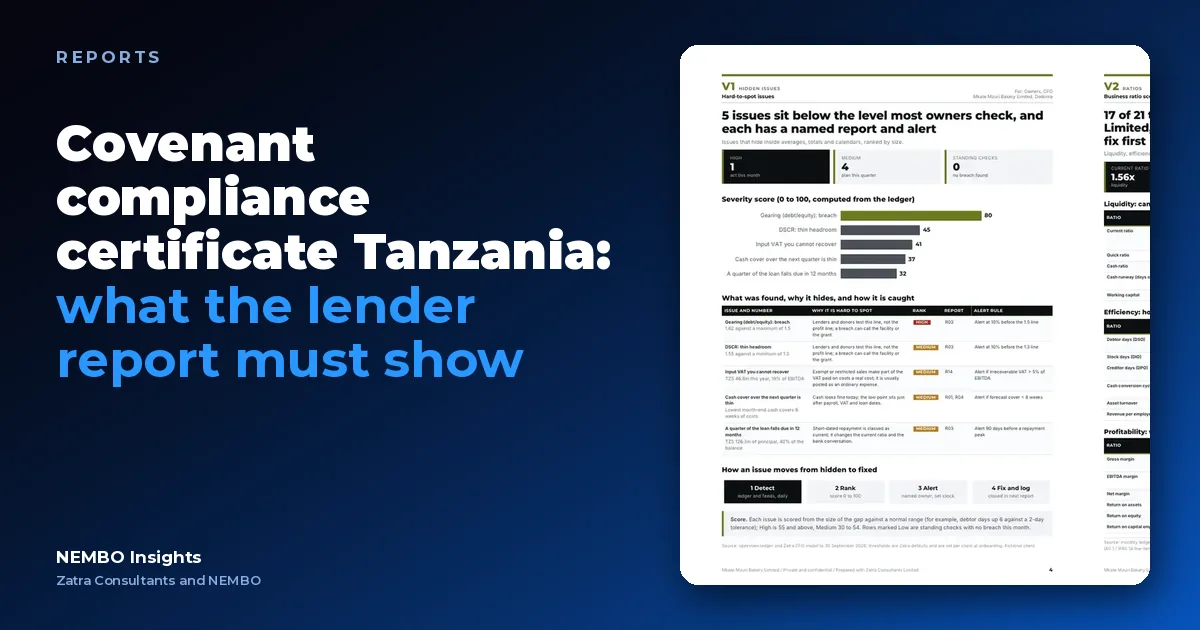
A covenant compliance certificate Tanzania lenders ask for each quarter is a one-page letter signed by a director or the finance head. It states that the borrower has met every financial covenant in the facility letter, shows the calculations, confirms there is no event of default, and attaches the management accounts the numbers come from. It is the document that keeps a performing loan classified as current at the bank and keeps the loan classified as non-current in the borrower's own balance sheet. This note sets out what the certificate contains and which covenants Tanzanian facility letters use. It then explains how the Bank of Tanzania's classification rules make the bank read it, what IAS 1 and the revised going concern standard make the auditor do with it, and how to handle a breach. It builds on the notes on the 13-week cash forecast, the monthly board pack and the going concern assessment.
What the rules say
Three sets of rules meet in the certificate. First, the facility letter, which is a contract: it defines each covenant, the test dates, the reporting deadline and what counts as an event of default. No statute prescribes the form, so the letter's own schedule governs. Second, the Bank of Tanzania's regulations for the lender. The Banking and Financial Institutions (Management of Risk Assets) Regulations, 2014 (GN 287 of 22 August 2014, made under section 71 of the Banking and Financial Institutions Act, Cap. 342) require every bank to classify each loan at least quarterly into current, especially mentioned, substandard, doubtful or loss, and to provision accordingly. Regulation 16(b) places in especially mentioned any credit not supported by up-to-date and adequate financial statements, including renewals or restructurings done without updated statements or income tax returns, and regulation 16(c)(iv) adds a borrower that has failed to comply with the conditions of the facility. A missed certificate therefore moves the loan down a grade before any payment is late. Third, the borrower's own accounting. The IFRS Foundation's IAS 1 page records that the Board issued Non-current Liabilities with Covenants in October 2022 to improve the information given when the right to defer settlement for at least twelve months depends on covenant compliance. The amendment's effective date of 1 January 2024 and its paragraph numbers were not on the pages the desk read and are tiered verify; the structural rule is settled and set out below.
Who should read this
Finance managers of companies with a term loan, overdraft or asset finance facility from NMB, CRDB, NBC, TADB, Stanbic, Exim, Azania or a microfinance lender. Directors who sign the certificate and carry its consequences. Boards receiving the quarterly pack. Auditors' clients preparing for the first year under ISA 570 (Revised 2024). Borrowers under a credit guarantee scheme, where the guarantor also reads the file. Zanzibar borrowers, whose banks are supervised under the same Bank of Tanzania rules.
Which covenants do Tanzanian facility letters use?
The names vary by bank, but the tests cluster. Every definition is the facility letter's, not a textbook's; the same ratio can be defined three ways across three banks. The table shows the usual set and the figure a borrower must know before each test date.
| Covenant | Usual definition | Where the facility letter bites |
|---|---|---|
| Debt service cover ratio (DSCR) | Cash available for debt service divided by principal plus interest due in the period | Minimum, often between 1.2 and 1.5 times |
| Debt to EBITDA (gearing) | Net debt divided by EBITDA | Maximum, often 2.5 to 3.5 times |
| Interest cover | EBIT divided by interest expense | Minimum, often 2 to 3 times |
| Current ratio | Current assets divided by current liabilities | Minimum, often 1.0 to 1.2 |
| Tangible net worth | Equity less intangibles | Minimum in TZS; no fall below opening level |
| Dividend and capex restrictions | Distributions and capital spending capped or subject to consent | Breach by a board resolution, not by a number |
| Negative pledge and cross-default | No new security to others; default elsewhere is default here | Triggered by a second lender's facility |
| Information covenants | Monthly or quarterly accounts, audited accounts within a set period, budget, compliance certificate | Deadline in days after period end |
| Change of control and key person | No change in shareholding or named managers without consent | Triggered by an investment or a resignation |
The definitions matter more than the thresholds. Cash available for debt service in one letter is EBITDA less tax paid less maintenance capex; in another it is operating cash flow before interest. Build the calculation in the management accounts exactly as the letter defines it, and keep the letter's schedule beside the working.
What does the certificate contain?
| Section | Content | Source in the file |
|---|---|---|
| Heading | Borrower, facility reference, test date and period covered | Facility letter |
| Compliance statement | Each covenant named, the required level, the actual level, pass or fail | Covenant workings |
| Calculations | Each ratio built from the management accounts, line by line, with the letter's definitions | Management accounts, loan schedule |
| Event of default statement | Confirmation that no event of default or potential event of default has occurred, or a description of one | Board minute, legal review |
| Material changes | Litigation, new borrowing, security given, change in shareholding or key persons | Company secretary |
| Attachments | Management accounts, bank statements where required, aged debtors and creditors, cash forecast | Finance pack |
| Signature | Authorised signatory per the facility letter, usually a director or the chief financial officer | Board resolution, specimen signatures |
The signature is personal. A director who certifies compliance that the accounts do not support exposes the company to an event of default and may breach the duty of care in section 188 of the Companies Act, Cap. 212. Where a ratio fails, the certificate says so and attaches the waiver request; it never rounds a 1.19 up to 1.2.
How does the bank read it under the Bank of Tanzania rules?
The credit officer files the certificate as the up-to-date financial information regulation 16(b) requires. Without it, or with stale accounts, the loan is a candidate for especially mentioned even while every instalment is paid, and the minimum provision moves from 1 percent to 3 percent under regulation 27. A covenant breach is a failure to comply with the conditions of the facility under regulation 16(c)(iv). Once an instalment is 91 days past due the loan is substandard with a 20 percent provision, doubtful at 181 days with 50 percent, and loss at 361 days with 100 percent, under regulations 13 and 27. A non-performing loan is one past due over 90 days or classified substandard or worse. Banks report their classification to the Bank of Tanzania quarterly within 15 days after quarter end under regulation 33, so a certificate that arrives late for a March test date reaches the file after the bank has already reported. The note on the overdraft file and the note on SME loan requirements show the information banks ask for at origination; the certificate is how that information keeps flowing.
| Classification | Loans: days past due or trigger | Minimum provision | Regulation |
|---|---|---|---|
| Current | Performing, with up-to-date financial information | 1 percent | Regs 11, 27 |
| Especially mentioned | Not supported by up-to-date financial statements; conditions of the facility not met | 3 percent | Regs 16(b), 16(c)(iv), 27 |
| Substandard | 91 to 180 days past due | 20 percent | Regs 13, 27 |
| Doubtful | 181 to 360 days past due | 50 percent | Regs 13, 27 |
| Loss | 361 days or more past due | 100 percent | Regs 13, 27 |
What do IAS 1 and ISA 570 make of a breach?
IAS 1 classifies a liability as current unless the entity has the right at the reporting date to defer settlement for at least twelve months. Where a covenant is breached on or before the reporting date so that the loan becomes repayable on demand, the loan is current. A waiver obtained after the reporting date does not restore the non-current classification; the waiver must be in hand at the reporting date. The October 2022 amendment adds that covenants to be tested within twelve months after the reporting date do not affect classification at that date but must be disclosed, with the risk that they may not be met. The desk did not read the paragraph text this session and routes the paragraph numbers to the auditor. The IFRS Foundation's going concern educational material and the IFRS 18 page are the current references; IFRS 18 replaces IAS 1 for periods beginning on or after 1 January 2027 and carries the classification rules forward, a date the desk marks verify against the standard.
The auditor's side changed in 2025. The IAASB released ISA 570 (Revised 2024), Going Concern on 9 April 2025, effective for audits of periods beginning on or after 15 December 2026. The auditor must evaluate management's going concern assessment whether or not events or conditions are identified, consider management bias, test the method, assumptions and data, and extend the evaluation period to at least twelve months from the date the financial statements are approved. A covenant breach is exactly the event the standard has in mind. The quarterly certificate and the forecast behind it become audit evidence, and the National Board of Accountants and Auditors adopts the ISAs for Tanzanian audits. The note on the going concern assessment covers the file.
Worked example: a 1.29 times DSCR against a 1.25 covenant
Worked example, illustrative figures. Mwenge Logistics Limited has a five-year term loan of TZS 1,200,000,000 from a commercial bank. The facility letter requires a DSCR of at least 1.25 times, tested quarterly on a rolling twelve months. It also requires a debt to EBITDA ratio of at most 2.5 times, a current ratio of at least 1.2, and a compliance certificate within 45 days of each quarter end. For the twelve months to 30 September 2026 the management accounts show EBITDA of TZS 480,000,000, tax paid of TZS 60,000,000 and maintenance capex of TZS 40,000,000, so cash available for debt service under the letter's definition is TZS 380,000,000. Principal due in the period was TZS 200,000,000 and interest TZS 95,000,000, a total of TZS 295,000,000. DSCR is 380,000,000 divided by 295,000,000, or 1.29 times, a pass with TZS 11,250,000 of headroom. Net debt is TZS 760,000,000 against EBITDA of TZS 480,000,000, so debt to EBITDA is 1.58 times, a pass. Current assets are TZS 520,000,000 and current liabilities TZS 470,000,000, a current ratio of 1.11, a fail against 1.2.
The certificate states all three results, shows the workings, declares a breach of the current ratio covenant and attaches a waiver request with the cause: a TZS 90,000,000 customer receipt that slipped from 29 September to 3 October. Because the breach exists at 30 September, the whole loan is a current liability in the 30 September accounts unless the bank's waiver is dated on or before 30 September, which it is not. The bank issues a waiver on 24 October. The year-end accounts at 31 December, if the ratio is then met, classify the loan non-current again, with disclosure of the covenants to be tested in 2027. A downside case in the 13-week forecast, revenue 10 percent lower, puts DSCR at 1.13 and tells the board to hold the dividend. NEMBO's fee for the certificate template and the lender pack, and Zatra's fee for the covenant model and the waiver letter, are quoted separately on the pricing page. Every figure is illustrative.
How do you handle a breach or a waiver?
Tell the bank before the test date, not after. A borrower that forecasts a miss from the 13-week forecast and writes to the relationship manager with the cause, the cure and a date is a different file from one that goes quiet. The waiver request states the covenant, the actual and required levels, the reason, the corrective action, and asks for the waiver to be dated on or before the reporting date where accounts are imminent. A waiver may come with a fee, a margin step-up or a tighter information covenant; each is a term the board approves. A reset of the covenant for future periods is an amendment to the facility letter and is signed by the authorised signatories, usually with an advocate's review. Keep the waiver letter in the audit file, because the auditor will ask for it under ISA 570 and the classification under IAS 1 turns on its date.
Mainland and Zanzibar
The Banking and Financial Institutions Act and the Bank of Tanzania's regulations apply to banks across the Union, so a Zanzibar borrower's loan is classified and provisioned under the same 2014 Regulations. The accounting and auditing standards are the same, since NBAA's adoption of IFRS and the ISAs applies to Tanzanian reporting entities. What differs is the security and the registries: a charge over Zanzibar land or a Zanzibar company's assets is registered under Zanzibar law at the Business and Property Registration Agency, and a facility letter governed by Mainland law with Zanzibar security needs an advocate on both sides of the channel.
What to do now
- Extract the covenant schedule from every facility letter: definitions, thresholds, test dates, reporting deadlines, events of default.
- Build the calculations into the monthly management accounts exactly as each letter defines them, with a covenant page in the board pack.
- Forecast the tests in the 13-week cash forecast and the annual budget, with a downside case, so a miss is known a quarter early.
- Draft the certificate template with the seven sections above and the signatory the letter names.
- Pass a board resolution authorising the signatory and requiring the certificate to be tabled before it is sent.
- Diarise each deadline at least ten days before the letter's date, so the bank files it before its quarterly report to the Bank of Tanzania.
- Where a miss is forecast, write to the bank early with the cause, the cure and a request for a waiver dated on or before the reporting date.
- Keep certificates, workings and waivers in the audit file for the auditor's going concern evaluation under ISA 570 (Revised 2024).
Key dates
| Date | Event | Source |
|---|---|---|
| 22 August 2014 | Banking and Financial Institutions (Management of Risk Assets) Regulations, GN 287, published | Bank of Tanzania |
| October 2022 | IASB issues Non-current Liabilities with Covenants, amending IAS 1 | IFRS Foundation, IAS 1 page |
| 1 January 2024 | Effective date of the IAS 1 covenant amendments (verify) | IFRS Foundation; not read this session |
| 9 April 2025 | IAASB releases ISA 570 (Revised 2024) | IAASB news release |
| 15 days after quarter end | Banks report loan classification to the Bank of Tanzania | GN 287 of 2014, regulation 33 |
| 15 December 2026 | ISA 570 (Revised 2024) effective for audits of periods beginning on or after this date | IAASB news release |
| 1 January 2027 | IFRS 18 replaces IAS 1 for periods beginning on or after this date (verify) | IFRS Foundation, IFRS 18 page |
What the NEMBO desk prepares
NEMBO designs and delivers the lender reporting set: the compliance certificate template on the company's letterhead, the covenant page of the board pack, the lender version of the management accounts, the waiver request letter and the covenant calendar as a controlled document. Zatra Consultants prepares and checks the content: the covenant model built to each letter's definitions, the forecast tests, the classification note under IAS 1, and the audit file, with an advocate for any amendment to the facility letter or an event of default notice. Bank fees for waivers or amendments are paid to the bank at its stated rate and are shown separately from NEMBO's and Zatra's fees, which are quoted in writing from the packages and pricing pages. NEMBO does not decide or guarantee any authority's outcome, and no bank's credit decision either. See the financial reports desk, the business plan desk and the process page, or share the facility letter.
How Zatra helps
Zatra's management accounts and financial reporting desk produces the monthly pack in board and lender versions, and its outsourced CFO desk owns the cash and forecast cadence, the controls priorities and the funding file. Where a facility is being negotiated, CRDB's SME loan page and the other banks' published terms are the starting point for the covenant conversation. CRDB lists amounts from TZS 50,000,000 to TZS 5,000,000,000 over 6 to 24 months, with a valid business licence and steady cash flow among its conditions. Zatra prepares, structures and coordinates; it does not lend and does not practise law.
Financial reports and CFO packs
Zatra Consultants prepares and checks the content on the details the Client shares. NEMBO designs and delivers it. Fees are published on the packages page and quoted in writing.
Open the desk pageSources and status
Accurate as at 14 November 2026. The paragraph text of IAS 1 as amended in October 2022 could not be opened on the IFRS Foundation site, so the 1 January 2024 effective date and the paragraph numbers are tiered verify; the classification rule is stated structurally. The Bank of Tanzania index shows no amendment to the 2014 Regulations but the desk did not search beyond it. Covenant thresholds in the tables are market ranges, not rules, and every facility letter governs its own.
- 1The Banking and Financial Institutions (Management of Risk Assets) Regulations, 2014, GN 287Bank of Tanzania, Government Notice No. 287 published 22 August 2014, regulations 8, 11, 13, 16, 27, 31 and 33 read 14 November 2026. Accessed 14 November 2026.
- 2Bank of Tanzania: regulations indexBank of Tanzania, bank supervision regulations list read 14 November 2026. Accessed 14 November 2026.
- 3IAS 1 Presentation of Financial StatementsIFRS Foundation, standard page with history noting the October 2022 amendment Non-current Liabilities with Covenants, read 14 November 2026. Accessed 14 November 2026.
- 4Classification of debt with covenants as current or non-current (IAS 1), completed projectIFRS Foundation, project page confirming the October 2022 issue, read 14 November 2026. Accessed 14 November 2026.
- 5Going concern: educational materialIFRS Foundation, 2025 educational material, linked 14 November 2026. Accessed 14 November 2026.
- 6IFRS 18 Presentation and Disclosure in Financial StatementsIFRS Foundation, standard page, effective 1 January 2027 as recorded in Zatra's reporting notes, linked 14 November 2026. Accessed 14 November 2026.
- 7IAASB strengthens auditor responsibilities for going concern through revised standardInternational Auditing and Assurance Standards Board, 9 April 2025, ISA 570 (Revised 2024) effective for periods beginning on or after 15 December 2026. Accessed 14 November 2026.
- 8National Board of Accountants and AuditorsNational Board of Accountants and Auditors, standard-setter adopting IFRS and the ISAs in Tanzania, read 14 November 2026. Accessed 14 November 2026.
- 9CRDB Bank: SME loanCRDB Bank, product page with amounts, tenor and eligibility, read 14 November 2026, copyright line 2026. Accessed 14 November 2026.
- 10Management accounts and financial reporting in TanzaniaZatra Consultants Limited, published 13 August 2026, lists board and lender versions. Accessed 14 November 2026.
- 11Outsourced CFO in TanzaniaZatra Consultants Limited, published 13 August 2026. Accessed 14 November 2026.
Figures to confirm before you act
- The exact covenant definitions, thresholds, test dates and reporting deadlines in your own facility letter, which govern over the ranges here.
- The paragraph numbers and effective date of the IAS 1 amendment Non-current Liabilities with Covenants, from the standard text, with the auditor.
- Whether the 2014 Regulations have been amended since the Bank of Tanzania index was read.
- IFRS 18's effective date and its treatment of covenant classification, from the standard.
- Any waiver fee, margin step-up or amended covenant the bank proposes, approved by the board in writing.
- Zanzibar registration of any security, with an advocate.
- Every figure in the worked example, which is illustrative.
This article is general information based on official sources available at the date of publication. It is not legal, tax or financial advice. Laws and notices change. Verify with the issuing authority or consult Zatra before acting.
Frequently asked questions
Who signs the covenant compliance certificate?
The person the facility letter names, usually a director or the chief financial officer, under a board resolution that authorises the signature and requires the certificate to be tabled first. The signature is personal: certifying compliance that the accounts do not support exposes the company to an event of default and the director to the duty of care in section 188 of the Companies Act.
What happens if we send the certificate late?
The bank may treat the loan as not supported by up-to-date financial statements under regulation 16(b) of the 2014 Regulations and classify it especially mentioned, with a 3 percent provision instead of 1 percent, even if every instalment is paid. A late certificate is also an information covenant breach under most facility letters.
If we breach a covenant at year end and get a waiver in January, is the loan still non-current?
Not under IAS 1 as the desk reads it. A breach at the reporting date that makes the loan repayable on demand classifies it as current, and a waiver dated after the reporting date does not restore non-current classification. Ask the bank for a waiver dated on or before the reporting date and have the auditor confirm the paragraph references.
Which covenant do Tanzanian SMEs breach most often?
In the desk's experience the current ratio and the information covenant, because receipts slip across a quarter end and management accounts arrive late. The DSCR breach is rarer but more serious, since it points to repayment capacity. Forecast all three in the 13-week cash forecast so a miss is known a quarter early.
Does the auditor need to see the certificates?
Yes. ISA 570 (Revised 2024), effective for audits of periods beginning on or after 15 December 2026, requires the auditor to evaluate management's going concern assessment and its assumptions whether or not problems are identified, over at least twelve months from approval of the accounts. Certificates, workings and waiver letters are the evidence.
Can we net cash against debt for the debt to EBITDA test?
Only if the facility letter's definition of net debt allows it, and most do, subject to the cash being unrestricted. Some letters exclude cash held as security or in a debt service reserve account. Read the definition, apply it the same way every quarter, and show the netting in the workings attached to the certificate.
How early should we warn the bank of a likely breach?
As soon as the forecast shows it, usually a quarter ahead. A letter stating the covenant, the expected shortfall, the cause and the cure, with a waiver request dated before the reporting date, is read as control. Silence followed by a failed certificate is read as the opposite and pushes the loan toward a lower classification.
Do the same rules apply to a Zanzibar borrower?
Yes for the bank and the accounting: the Banking and Financial Institutions Act and the 2014 Regulations govern banks across the Union, and NBAA's adoption of IFRS and the ISAs applies to Tanzanian entities. Security over Zanzibar assets is registered under Zanzibar law, so a cross-channel facility needs an advocate on both sides.