On this page
- What the bank publishes
- Who should read this
- How does an overdraft differ from a term loan in the file?
- What does a credit analyst read in twelve months of statements?
- Which forecast does the bank want, and what does it test?
- What security does a bank take for an overdraft, and what does it cost?
- Does the file differ in Zanzibar?
- Worked example: a TZS 150,000,000 overdraft for a distributor
- What goes wrong
- What to do now
- Key dates
- What the NEMBO desk prepares
- How Zatra helps
- Sources and status
- Frequently asked questions
What does a Tanzanian bank need to approve a business overdraft?
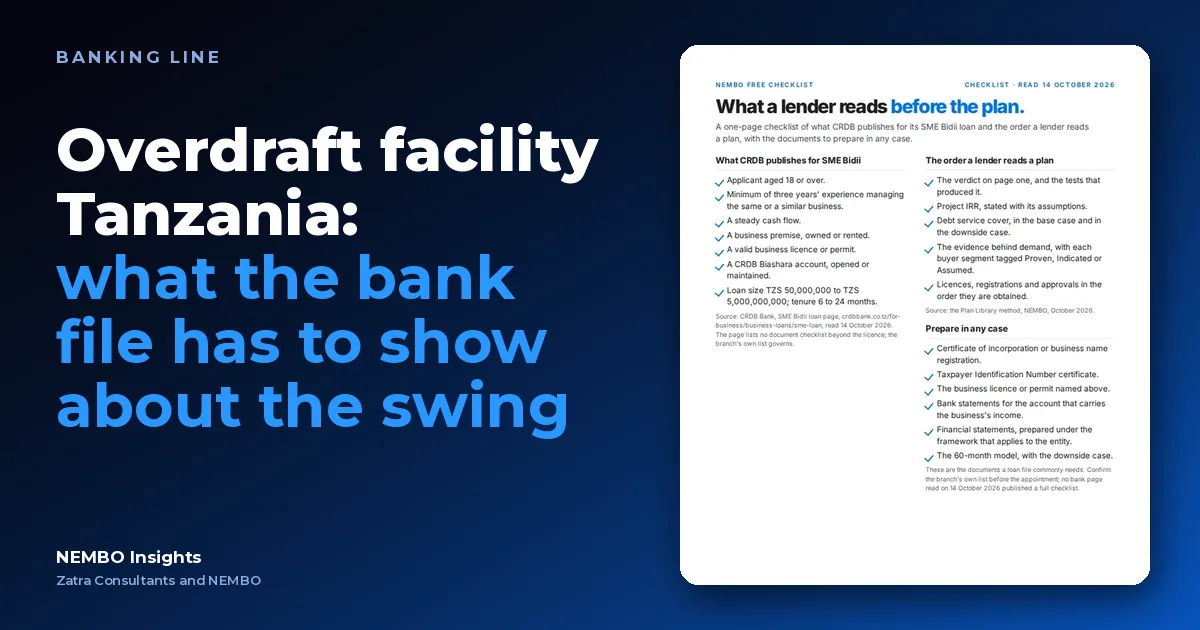
CRDB's published conditions are three years in the same or a similar business, steady cash flow, premises, a valid business licence and a business account with the bank. Behind those words sit twelve months of statements showing turnover through the account, a debtor ageing, and a cash forecast that shows the peak need and the months the account swings back to credit. Security the bank can register completes the file.
An overdraft facility Tanzania banks offer to business customers is the simplest credit product to describe and the hardest file to get right. A term loan is approved on a repayment schedule. An overdraft is approved on a pattern: the account is overdrawn when stock is bought and wages are paid, and back in credit when customers pay. A bank that cannot see that pattern in twelve months of statements and a cash forecast sees a term loan with no end date, and prices or declines it as one. This note reads what CRDB publishes for its overdraft and SME loan products, sets out the documents the desk prepares behind those conditions, and shows how a credit analyst reads the account history and the forecast. The SME loan comparison, the asset finance note and the credit guarantee note cover the term products that sit beside an overdraft.
What the bank publishes
CRDB Bank's overdraft facilities page describes the product as financial flexibility to meet working capital needs by overdrawing the account. It lists six conditions: the applicant must be at least 18; at least three years' experience operating the same or a similar business; a steady cash flow; a premise, owned or rented; the applicable business licence or permit; and a CRDB business account. It publishes no limit, no tenor or review period, no interest rate and no fee. The bank's SME loan page repeats the same six conditions and adds figures for the term product: amounts from TZS 50,000,000 to TZS 5,000,000,000 and repayment terms from 6 to 24 months. Its business account page lists the account opening documents, including a board resolution for a company. The business loans page lists thirteen products under borrow, of which the overdraft is one. The desk could not read NMB's or NBC's overdraft pages on 11 November 2026, because both sites refused the fetch, and does not state their terms.
| Published condition (CRDB) | What the bank is testing | Document that proves it |
|---|---|---|
| At least three years in the same or a similar business | The business has survived at least one full cycle of its own market | Certificate of incorporation or business name registration; business licence history; three years of accounts |
| Steady cash flow | Turnover passes through the account, month after month, and the account returns to credit | Twelve months of statements; a 13-week and 12-month cash forecast; debtor and creditor ageing |
| A premise, owned or rented | The business has a fixed place the bank can visit and, if owned, security it can register | Title or lease; the lease must have longer to run than the facility review date |
| A valid business licence or permit | The business may lawfully trade and has met TRA for the renewal | Business licence; TRA tax clearance certificate that accompanied the renewal (register line NEW-08-02) |
| A business account with the bank | The bank can see the cash and will be paid first | Account opening pack, board resolution, mandate |
| Applicant at least 18 | Capacity to contract | Identity of the directors and guarantors |
Who should read this
Owners and finance managers of trading, distribution, construction and agricultural businesses whose cash goes out before it comes in. Suppliers to government and corporates on 60 or 90 day terms, whose debtor book is the reason for the facility, as the invoice terms note explains. Companies whose current overdraft is up for annual review and whose last twelve months look different from the year before. Directors who will be asked for personal guarantees and want to know what the bank will read before it asks. Accountants preparing the management accounts and the forecast that carry the application.
How does an overdraft differ from a term loan in the file?
A term loan has a drawdown, a schedule and a final instalment, and the bank tests the schedule against forecast cash: the debt service cover that the CFO verdict note describes. An overdraft has a limit, a review date and a daily balance. Interest runs on the drawn balance each day at the bank's rate, which is why a reducing-balance comparison is the right way to read the cost, as the Zatra note on flat and reducing rates sets out. The bank tests three things a term loan file does not. First, the swing: the account must return to credit, or to a stated minimum, for a period each year, or the overdraft is funding a permanent shortfall. Second, the peak: the highest expected overdrawn balance, which sets the limit, must be explained by a stock or debtor build the forecast shows. Third, the turnover: the credits through the account over twelve months, which the bank compares to the limit as a multiple. A limit the account turns over every month is a working capital line; a limit it turns over twice a year is a loan.
What does a credit analyst read in twelve months of statements?
The statements are the file. The analyst builds a month-by-month table of credits, debits, closing balance and the lowest and highest balance in the month, and reads it for the pattern the forecast claims. Credits are tested against the declared turnover and the VAT returns, because a business that declares TZS 2,000,000,000 of sales and banks TZS 900,000,000 has either cash sales the bank cannot see or sales it does not have. Debits are read for the fixed outflows, wages, rent, statutory payments on the 7th and the 20th, and loan instalments to other lenders. Returned cheques, excesses over an existing limit, and round-sum transfers to related accounts are counted. The management accounts note shows how the same months look in the pack the bank also asks for, and the two must agree.
| Statement test | What the analyst computes | What a weak answer looks like |
|---|---|---|
| Turnover through the account | Twelve months of credits, net of transfers in from the company's own accounts | Credits below declared sales; large cash deposits with no invoice trail |
| Swing | Number of days in credit, and the lowest overdrawn balance each month | Never in credit; the lowest balance each month is close to the limit |
| Peak | Highest overdrawn balance and the month it occurs | Peak in a month the forecast does not explain |
| Limit cover | Annual credits divided by the requested limit | Below about four times, so the limit would take a quarter of a year's receipts to clear |
| Conduct | Returned items, excesses, unpaid standing orders | Any returned cheque in the year; excesses in three or more months |
| Other borrowing | Instalments to other lenders and mobile money lenders | Instalments the forecast omits |
Which forecast does the bank want, and what does it test?
Two. A 13-week direct cash forecast, receipts and payments by week, that shows the next quarter's peak and the week the account turns, built as the 13-week forecast note describes. And a 12-month forecast that shows the clean-up period and the seasonal pattern that justifies the limit. The analyst tests the receipts line against the debtor ageing and the sales pipeline, the payments line against the supplier ageing and the payroll, and the peak against the requested limit. A forecast whose peak exceeds the limit is a request for a larger facility; a forecast whose lowest balance never reaches credit is a request for a term loan. Both forecasts carry the assumptions on the page: days sales outstanding, days payable, stock days, and the month the big customer pays. The assumptions note lists the ten a lender tests.
What security does a bank take for an overdraft, and what does it cost?
The published pages do not say. In practice a bank secures a business overdraft with one or more of a debenture over the company's floating assets, a mortgage over landed property, a cash or fixed deposit margin, and personal guarantees from the directors. A debenture or charge created by a company is registered with the Registrar of Companies under Part IV of the Companies Act, Cap. 212, sections 99 to 109. The registration fee is set by the sum secured: TZS 22,000 up to TZS 100 million, TZS 50,000 from 100 to 500 million, TZS 100,000 from 500 million to 1 billion and TZS 150,000 above that (register line F0011). The instrument is chargeable to stamp duty under the Stamp Duty Act, Cap. 189 at the rate for the class of instrument, which the desk did not verify for a debenture and lists in the figures to confirm. A mortgage over land goes through the land registry as well, and the Zatra note on execution of documents explains how a company signs a deed. Where the gap is collateral rather than cash flow, the Bank of Tanzania's credit guarantee schemes may help. The bank applies for cover of up to 50 percent on an SME loan of TZS 50 million to 1 billion, with a tenor of one to five years, on principal only. Whether a scheme covers an overdraft is not stated on the page. A BoT analyst told a seminar on 5 November 2026, reported by The Respondent, that participating banks pay a guarantee fee of one percent of the amount covered and must follow their normal credit assessment.
Does the file differ in Zanzibar?
The bank's conditions are the bank's and apply on both sides of the channel. The documents behind them differ. A Zanzibar company is registered by the Business and Property Registration Agency, not BRELA, and registers a charge under the Zanzibar Companies Act, No. 15 of 2013, under BPRA's rules and fees, which the desk did not read. Its business licence and tax clearance come from Zanzibar authorities and the Zanzibar Revenue Authority, and its VAT returns, which the analyst compares to turnover, are at 15 percent with a TZS 100 million threshold (F0246). Land in Zanzibar is held under Zanzibar land law, so a mortgage follows a different registry. The statements, the forecast and the ageing are the same documents; the Zatra note on Mainland and Zanzibar setup lists the authorities behind each paper.
Worked example: a TZS 150,000,000 overdraft for a distributor
Bonde Distributors Limited, a Mainland company with four years of trading, supplies retailers on 45-day terms and buys from two manufacturers on 30-day terms. Annual sales are TZS 1,800,000,000, VAT exclusive. It asks CRDB for a TZS 150,000,000 overdraft. The interest rate and the arrangement fee in the table are assumptions for the example, because the bank publishes neither.
| Item | Figure | How the analyst reads it |
|---|---|---|
| Credits through the account, twelve months | TZS 2,050,000,000 | Above VAT-inclusive sales of TZS 2,124,000,000 less cash sales kept as float; consistent |
| Limit cover | 2,050,000,000 / 150,000,000 = 13.7 times | The limit clears in under a month of receipts; a working capital line |
| Debtors at month end | TZS 225,000,000, 45 days of sales | Matches the stated terms; ageing shows 8 percent over 60 days |
| Creditors at month end | TZS 110,000,000, 30 days of purchases | Suppliers paid on terms; no stretched creditors hiding the need |
| Peak overdrawn balance, forecast | TZS 138,000,000 in December, before the January retail payments | Within the limit; explained by the seasonal stock build |
| Months in credit, last year | Four: February, March, July, August | The account swings; the facility is not a permanent loan |
| Interest, assumed 18 percent a year on an average drawn balance of TZS 70,000,000 | TZS 12,600,000 a year | Cost of carrying 45-day terms; compare with a 2 percent prompt payment discount offered to retailers |
| Arrangement fee, assumed 1 percent of the limit | TZS 1,500,000 | Paid at drawdown; renewed annually at review |
| Debenture registration at BRELA, sum secured TZS 150,000,000 | TZS 50,000 (F0011) | Government fee at the official rate, paid against the control number |
The analyst's note reads: turnover verified against VAT returns, limit cover 13.7 times, four months in credit, peak within limit and explained, debtor ageing acceptable, one supplier concentration of 60 percent to monitor. Security: debenture over floating assets, personal guarantees of the two directors, no landed property. Recommendation: TZS 150,000,000 for twelve months, reviewed annually, with a condition that the account returns to credit for at least 30 consecutive days in the year. Without the four months in credit, the same figures would have produced a 24-month term loan of TZS 100,000,000 and a smaller overdraft, which is the outcome a file without a forecast usually gets.
What goes wrong
The first failure is turnover routed through three banks and mobile money wallets, so no single statement shows the business. The second is a forecast that never returns to credit, which tells the bank the need is permanent. The third is a requested limit set at the peak of a bad month rather than the peak of a normal one. The fourth is an ageing that shows the biggest debtor at 120 days, which the bank reads as a bad debt the overdraft would fund. The fifth is management accounts that disagree with the statements by more than the cash sales can explain. The sixth is a lease with eight months to run on a twelve-month facility. The seventh is a licence renewed late, with no tax clearance in the file. The eighth is a related-party loan in the statements that the directors did not mention. Each is fixable before the application; none is fixable after the decline.
What to do now
- Concentrate the banking. Route sales receipts through the account the facility will sit on for at least twelve months before applying.
- Build the statement table. Month by month: credits, debits, lowest balance, highest balance, days in credit. Read it before the bank does.
- Reconcile turnover. Agree the credits to the VAT returns and the management accounts, and write a one-line explanation for any gap.
- Prepare both forecasts. A 13-week direct forecast and a 12-month forecast with the assumptions stated, showing the peak and the clean-up months.
- Age the debtors and creditors. By customer and by days, with a collection action against each item over 60 days.
- Assemble the identity and licence pack. Incorporation certificate, licence, tax clearance, registered office evidence, directors' identities and the board resolution to borrow and to create security.
- List the security. Floating assets, property, deposits and guarantors, with the registration fee and stamp duty budgeted as government charges.
- Ask for the term sheet in writing. Limit, rate, fees, review date, covenants and the clean-up condition, before signing the facility letter.
Key dates
| Trigger | Period | Source |
|---|---|---|
| Facility review | Annual in practice; the facility letter governs | Bank's facility letter |
| Clean-up or minimum credit period | As the facility letter states; the forecast must show it | Bank's facility letter |
| Business licence validity | Twelve months from issue; renew within 21 days after expiry to avoid the penalty | Business Licensing Act, Cap. 101, s.7(1), s.11(1); NEW-08-01 |
| Tax clearance for licence renewal | Accompanies every renewal; no fee | Cap. 101 s.13(3), s.14(e); NEW-08-02 |
| Registration of a charge | Within the period the Companies Act sets after creation; the desk did not confirm the days | Cap. 212 ss.99 to 109 |
| VAT return the analyst compares to turnover | By the 20th of the following month | VAT Act, Cap. 148; F0245 |
| Credit guarantee application | Lodged by the bank after its own appraisal | Bank of Tanzania, Deepening page |
What the NEMBO desk prepares
The client shares the facts: the statements, the management accounts, the debtor and creditor lists, the licence and incorporation papers and the security on offer. Zatra Consultants prepares and checks the content: the statement table, the turnover reconciliation, the two forecasts with their assumptions, the ageing and the security schedule, against the bank's published conditions. NEMBO designs and delivers the documents. The desk prepares the overdraft application file inside the business plan and feasibility study service, and the monthly pack and the 13-week forecast in the CFO pack. The board resolution and facility correspondence go out on the letterhead, and the free SME loan file checklist is the starting list. Fees are published on /packages/ and /pricing/ and quoted in writing. Bank interest and fees are paid on the bank's tariff, and BRELA's charge registration fee and stamp duty at the official rate against the control number, separate from NEMBO's and Zatra's fees. See how a job runs, or share the details.
How Zatra helps
Zatra checks the facts, filings and figures: the turnover against the VAT returns, the forecast against the ageing, the licence and tax clearance dates, and the security registration. The outsourced CFO service builds and defends the forecast at the bank, and the bank readiness desk prepares the account and KYC pack the facility sits on. The desk does not decide or guarantee any authority's outcome, whether that authority is a bank's credit committee, the Bank of Tanzania or BRELA. The facility letter, the debenture and the guarantees go to an advocate before signature. The management accounts and the reconciliation go to an accountant.
Business plan and feasibility study
Zatra Consultants prepares and checks the content on the details the Client shares. NEMBO designs and delivers it. Fees are published on the packages page and quoted in writing.
Open the desk pageSources and status
Accurate as at 11 November 2026. CRDB's product pages were read on that date and quoted as published; NMB and NBC pages could not be read; the Bank of Tanzania page was read in Kiswahili; interest, fee and premium figures in the example are assumptions.
- 1Overdraft FacilitiesCRDB Bank Plc, page read 11 November 2026. Accessed 11 November 2026.
- 2SME LoanCRDB Bank Plc, page read 11 November 2026. Accessed 11 November 2026.
- 3Business loansCRDB Bank Plc, page read 11 November 2026. Accessed 11 November 2026.
- 4Biashara accountCRDB Bank Plc, page read 7 November 2026. Accessed 11 November 2026.
- 5The Companies Act, Cap. 212, Revised Edition 2023Business Registrations and Licensing Agency, 2023 edition. Accessed 11 November 2026.
- 6Tozo za kampuni (companies fees)Business Registrations and Licensing Agency, page read 11 November 2026. Accessed 11 November 2026.
- 7Mifuko ya udhamini wa mikopo (credit guarantee schemes)Bank of Tanzania, page undated, read 11 November 2026. Accessed 11 November 2026.
- 8BoT guarantees TZS 2.1 trillion in loans to businessesThe Respondent, 5 November 2026. Accessed 11 November 2026.
- 9The same loan, both ways: flat rate against reducing balance in TanzaniaZatra Consultants Limited, 2026. Accessed 11 November 2026.
- 10Company seal Tanzania: how a company signs, seals and executes deedsZatra Consultants Limited, 4 November 2026. Accessed 11 November 2026.
- 11Mainland vs Zanzibar company setup: two registrars, two tax filesZatra Consultants Limited, 2026. Accessed 11 November 2026.
Figures to confirm before you act
- CRDB's overdraft limit, rate, fees and review period, which the page does not publish; the bank's written term sheet governs.
- NMB's and NBC's overdraft conditions, which the desk could not read.
- The period for registering a charge under sections 99 to 109 of the Companies Act, and the stamp duty rate on a debenture under the Stamp Duty Act, Cap. 189.
- BRELA's charge registration fee bands (F0011) and the licence lines (NEW-08-01, NEW-08-02) at 26 September 2026.
- Whether a Bank of Tanzania guarantee scheme covers an overdraft, and the one percent fee reported from the seminar.
- The interest rate, arrangement fee and limit cover threshold in the example, which are assumptions.
- The Zanzibar charge registration rules and fees at BPRA.
This article is general information based on official sources available at the date of publication. It is not legal, tax or financial advice. Laws and notices change. Verify with the issuing authority or consult Zatra before acting.
Frequently asked questions
How much overdraft can a business get in Tanzania?
CRDB publishes no overdraft limit. Its SME term loans run from TZS 50,000,000 to TZS 5,000,000,000. In practice the limit follows the peak in the forecast and the turnover through the account; a limit the account clears in a month or two of receipts is the kind a bank approves as working capital.
What interest rate applies to an overdraft?
The bank's rate on the daily drawn balance, set in the facility letter; CRDB's page publishes none. Because interest runs only on the days and amounts drawn, read the cost on a reducing-balance basis and compare it with the discount you would give customers to pay sooner.
Does the account have to go into credit every year?
Most facility letters contain a clean-up or minimum credit condition, and every analyst looks for months in credit in the statements. An account that is never in credit is read as a permanent shortfall, which a bank funds with a term loan, not an overdraft.
Do I need audited accounts for an overdraft?
CRDB's published conditions do not name audited accounts. Banks ask for the latest accounts and management accounts to the most recent month, and test them against the statements. For a company past the audit threshold, audited accounts will be requested; for a smaller business, the statements and management accounts carry the file.
What security does the bank take?
A debenture over the company's floating assets, a mortgage over property where available, a cash margin, and the directors' personal guarantees, in the combination the credit committee sets. A debenture is registered at BRELA with a fee by sum secured (F0011) and attracts stamp duty, both paid as government charges.
Can a Bank of Tanzania guarantee support an overdraft?
The Bank of Tanzania page describes cover of up to 50 percent on SME loans of TZS 50 million to 1 billion with a tenor of one to five years, applied for by the bank. It does not say whether an overdraft qualifies. Ask the bank, which lodges the application after its own appraisal.
How long does an overdraft application take?
The bank publishes no time. A complete file, with twelve months of statements, both forecasts, the ageing, the licence pack and the security schedule, is decided faster than one assembled in reply to queries. Registering the debenture and perfecting any mortgage adds time after approval.
Should the forecast show the overdraft being used?
Yes. A forecast that never draws the facility does not justify the limit, and one that never repays it does not justify the product. Show the peak, the month it occurs, the receipts that clear it and the months in credit, with the assumptions stated on the page.