On this page
- What the law says
- Who should read this
- Why does the regulation drive what the bank asks for?
- Which forms of relief can a borrower ask for?
- What goes in the borrower's request file?
- How does a restructure appear on the credit report?
- What does the bank record under IFRS 9?
- Where the file fails
- Worked example: a TZS 500,000,000 term loan with six months' arrears
- Mainland and Zanzibar
- What to do now
- Key dates
- What the NEMBO desk prepares
- How Zatra helps
- Sources and status
- Frequently asked questions
What does a Tanzanian bank need before it approves a loan restructuring request?
Loan restructuring Tanzania turns on the Banking and Financial Institutions (Management of Risk Assets) Regulations, 2014: a non-performing loan may be restructured twice, is upgraded only after four timely instalments, and carries a 20 to 100 percent provision meanwhile. The bank therefore needs a request letter stating cause and ask, a reconciled 13-week cash forecast and 12-month projection, updated security valuation, board resolution and tax clearance.

What the law says
Loan restructuring Tanzania is governed less by the loan agreement than by the Bank of Tanzania rules the lender must obey. The Banking and Financial Institutions (Management of Risk Assets) Regulations, 2014 (GN 287 of 2014, read on bot.go.tz) were made under section 71 of the Banking and Financial Institutions Act, 2006. Regulation 3 defines a restructured credit accommodation as one whose terms have been modified "in terms of repayment period, repayable amount, installments or rate of interest" because of the borrower's financial difficulty.
Four rules shape every restructuring conversation. Regulation 7(1) requires each bank to hold a written policy on when a facility may be extended, renewed, rolled over or restructured. Regulation 7(4) bars a restructured non-performing loan from being upgraded until a term loan has "timely paid four consecutive installments", or an overdraft has performed for two consecutive quarters. Regulation 7(5) states that "a non-performing credit accommodation shall not be restructured more than twice". Regulation 27(1) sets minimum specific provisions of 1 percent (current), 3 percent (especially mentioned), 20 percent (substandard), 50 percent (doubtful) and 100 percent (loss).
The classification clock runs on days past due. Regulation 13 places a facility 91 to 180 days past due in substandard, 181 to 360 days in doubtful, and 361 days or more in loss. Regulation 31 puts those facilities on non-accrual with interest in suspense. Regulation 8(1) requires a quarterly review of every facility, and Regulation 9 a write-off after four consecutive quarters in loss.
Two later instruments matter. A BoT circular of 19 February 2018 temporarily allowed four restructurings and an upgrade after two instalments, according to a Clyde and Co note of 20 March 2018. That relief ended on 31 December 2020. In September 2026 the Bank published draft replacement regulations; according to Zatra's reading of the drafts, 12 October 2026, the draft keeps the two-restructure limit but allows more with the Bank's prior approval. It also caps interest and charges on a non-performing loan at the principal outstanding when it went non-performing. The drafts are not yet law.
Credit reporting is the second body of law. The Bank of Tanzania (Credit Reference Bureau) Regulations, 2012 (GN 416 of 2012, read on TanzLII) govern consent, access and disputes. The Credit Reference Databank Regulations, 2012 (GN 417 of 2012) require each bank to submit data on every facility monthly, by the tenth day of the following month (regulation 6). The BoT regulations index showed no 2024 or 2025 amendment to GN 287 on 17 November 2026.
Who should read this
This guide is for a director, finance manager or owner of a Tanzanian company with a term loan, overdraft or asset finance facility whose next instalments will not be met in full. It also serves the CPA or outsourced CFO who assembles the request and the advocate who drafts the supplementary agreement.
Why does the regulation drive what the bank asks for?
A credit officer reading a restructuring request is not asking whether the borrower deserves relief. The officer asks whether the file satisfies the bank's policy under Regulation 7(1), survives the quarterly review under Regulation 8, and defends the provision under Regulation 27.
The provision is the first pressure. A TZS 500,000,000 loan that slips from substandard to doubtful moves the minimum specific provision from TZS 100,000,000 to TZS 250,000,000, and Regulation 21 applies the classification "regardless of the type of security held". A restructure approved before the 181st day keeps the loan in substandard, and four timely instalments let the bank release provisions. The restructure count is the second pressure. Under Regulation 7(5) a non-performing loan may be restructured twice, and a bank will not spend one of those chances on a plan whose forecast shows a shortfall in month five.
The sector numbers explain why banks have room to agree. The Bank of Tanzania's Monetary Policy Committee statement of 3 July 2026 put the non-performing loans ratio at 2.9 percent in May 2026, against a tolerable level of 5 percent. The same meeting raised the Central Bank Rate from 5.75 to 6.25 percent. EY's Tanzania Banking Sub-Sector Report 2024 (September 2025) traces the ratio from 7.5 percent in 2020 to 3.2 percent in 2024. According to TanzaniaInvest, 3 August 2026, unaudited bank statements at 30 June 2026 aggregated to 4.7 percent; the BoT figure is the one supervisors use. No public return shows how many loans are restructured each year, so the count on a facility is unknown until the bank confirms it.
| What the bank must decide | Rule it answers to | What the file must show |
|---|---|---|
| Is the difficulty temporary or structural | Regulation 7(1) policy | Cause letter, order book, aged debtors |
| Can the borrower pay four instalments on time | Regulation 7(4)(b) | 13-week cash forecast, 12-month projection |
| What classification applies after the restructure | Regulations 8 and 13 | Arrears history, proposed first payment |
| Is the provision adequate | Regulation 27 | Updated valuation, security cover ratio |
| Has the loan been restructured before | Regulation 7(5) | Facility history, prior variation letters |
| Is interest to be capitalised or suspended | Regulation 31 | Arrears schedule, capitalisation proposal |
Which forms of relief can a borrower ask for?
The request should name one structure. A reschedule changes the instalment profile within the tenor. A tenor extension lengthens the loan and lowers each instalment. A moratorium suspends principal, or principal and interest, for stated months. A conversion turns a hard-core overdraft into a term loan with fixed amortisation. Arrears capitalisation adds unpaid interest and charges to principal so the account is current again. A covenant waiver asks the bank to overlook a breached ratio for a period.
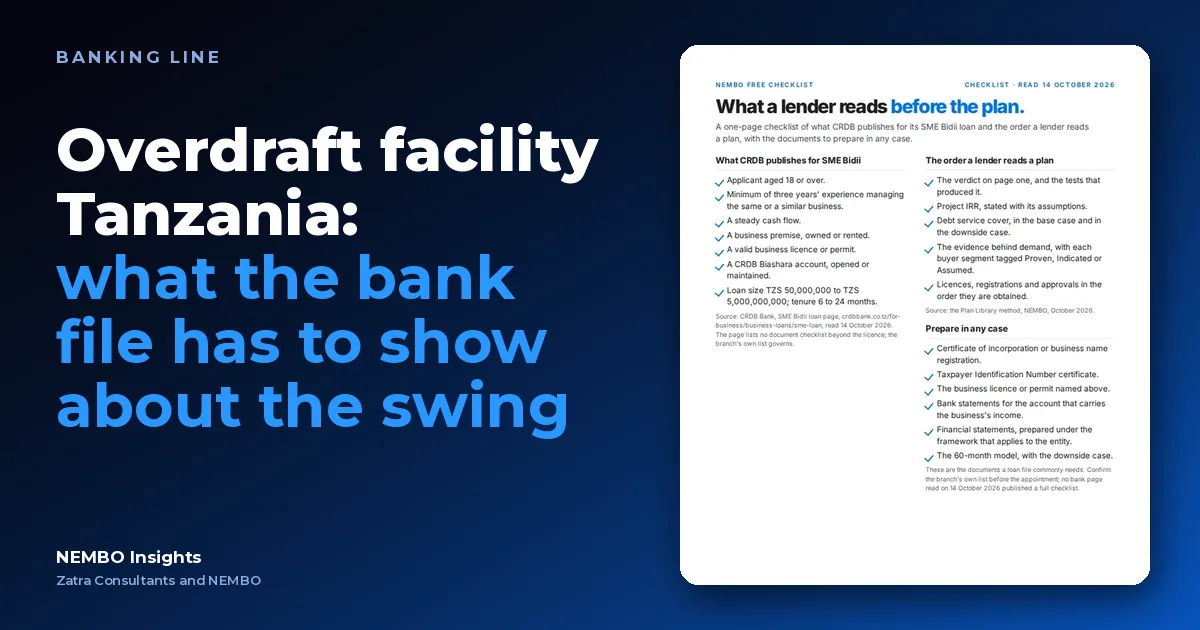
Each form has a regulatory consequence. Regulation 7(2) allows an overdraft roll-over to keep its classification only where there is no ever-greening and "all interest and charges due have been paid". Regulation 10(2) treats an overdraft as past due when it exceeds its limit or shows no movement. Converting it to a term loan is often the only route that satisfies the regulation. The NEMBO guide on overdraft facilities covers that file.
Pricing is set by the bank, not the regulation. CRDB Bank's Minimum Disclosure of Bank Fees and Charges 2026 lists a restructuring line among its facility fees and a penalty on unpaid instalments. No rate could be read against the restructuring line on 17 November 2026, so the borrower should ask the branch for it in writing. BoT consumer protection rules, as amended in 2025, require interest on a reducing balance and give the Bank 60 days to determine a complaint, according to Bowmans, 1 September 2025.
What goes in the borrower's request file?
The request letter states the cause in one paragraph, with a date and a number. "A TZS 240,000,000 contract payment due in June 2026 was received in October 2026" is a cause. "Market conditions" is not. The letter then states the ask in the bank's vocabulary: the structure, the moratorium length, the new tenor, the first payment date and the amount paid on signing, then any covenant waiver and the board's authority.
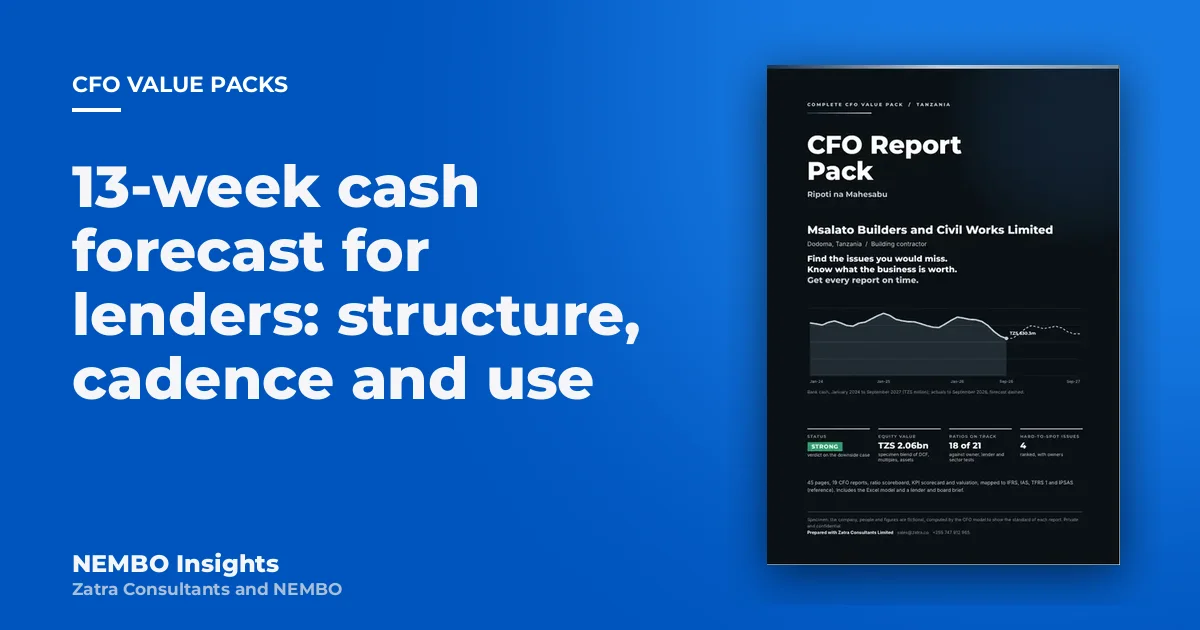
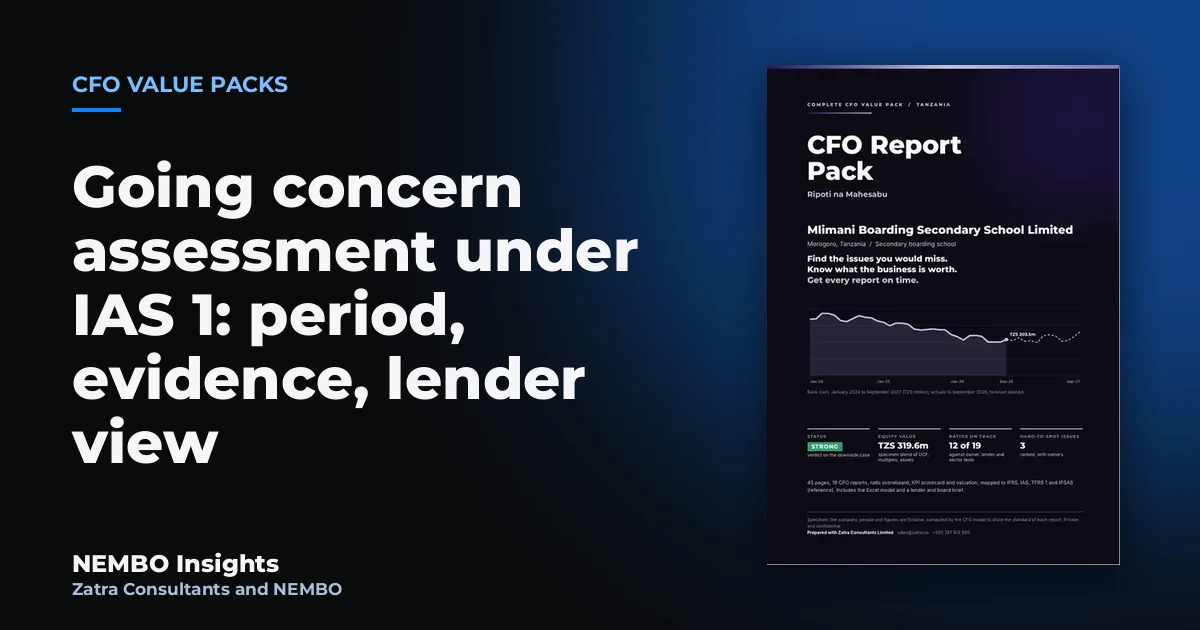
The cash evidence is a 13-week cash forecast, prepared weekly with opening balance, receipts by customer, payments by category and closing balance, plus a 12-month projection showing the new debt service line. Both must reconcile to the latest bank statement. The NEMBO guide to the 13-week cash forecast for lenders sets out the format credit teams accept, and the guide to going concern assessment under IAS 1 shows how the same forecast supports the directors' year-end assessment.
The legal and security layer carries the board resolution, an updated valuation of each mortgaged property, the draft supplementary agreement, the variation of mortgage or charge, and the tax status. A bank will not sign a variation until the tax clearance certificate (NEW-02-18, no fee published) or an arrears plan with TRA is on file. Where an assessment is disputed, the objection must be lodged within 30 days and admitted on payment of the greater of the undisputed tax or one third of the assessed tax (NEW-02-19). Interest on tax paid late runs at the statutory rate, 8.75 percent for the third quarter of 2026, compounded monthly (NEW-02-09, NEW-02-08). Zatra's note on tax arrears in Tanzania sets out the section 66 instalment application.
| Document | Authority or signatory | Fee and register ID |
|---|---|---|
| Request letter: cause, ask, first payment | Managing director | None |
| Board resolution approving the restructure | Board, company secretary | None |
| 13-week cash forecast and 12-month projection | CFO or CPA | None |
| Management accounts, aged debtors and creditors | CFO or CPA | None |
| Order book, contracts, offtake letters | Commercial director | None |
| Valuation report, Chief Valuer approval | Registered valuer, Chief Valuer | TZS 20,000 below TZS 100m; 0.02 percent above, for a mortgage (F0471) |
| Variation of mortgage | Registrar of Titles | TZS 20,000 (F0464) |
| Stamp duty on the varied mortgage deed | TRA | 1 percent, maximum TZS 10,000 (F0274) |
| Supplementary or restructuring agreement | TRA stamping | TZS 2,000 (F0267) |
| New or supplemental charge, if the sum secured changes | BRELA | TZS 22,000 to 150,000 by sum secured (F0011) |
| Tax clearance certificate | TRA | No fee published (NEW-02-18) |
| Covenant waiver request | Managing director | None |
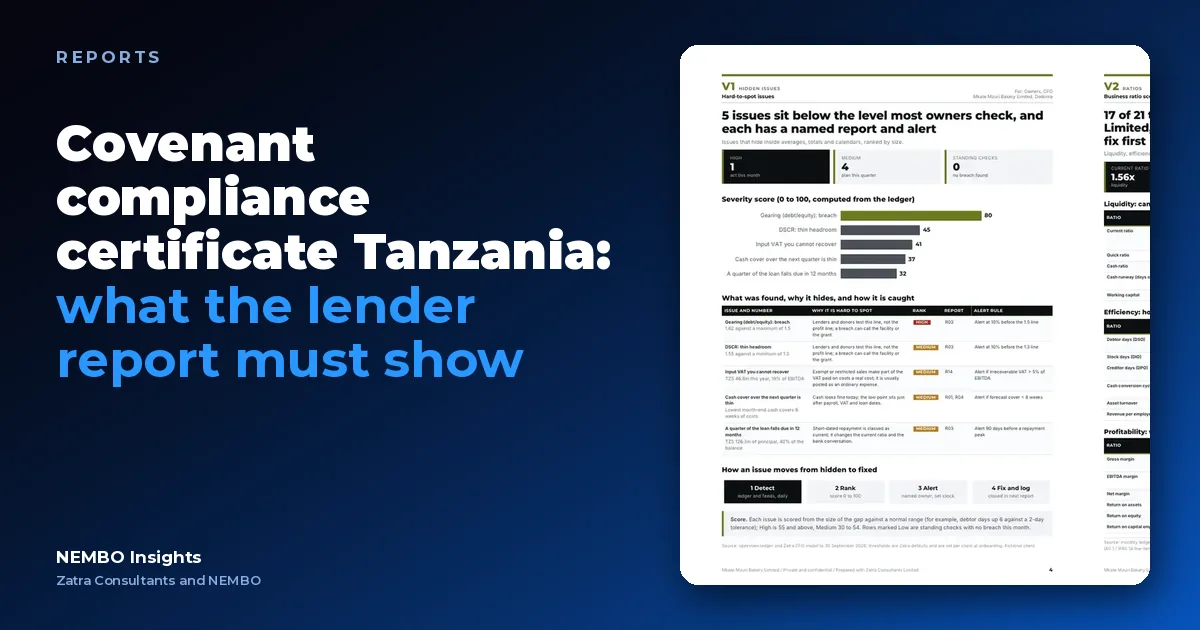
Where a fee is not listed, the authority's schedule applies. A board resolution a bank and a registry will accept names the facility, the new terms, the security to be varied and the signatories. The covenant compliance certificate sent with the waiver request must show the breached ratio, the cause and the date by which compliance returns.
How does a restructure appear on the credit report?
Every bank submits monthly data on every facility to the BoT Credit Reference Databank, which passes it to the licensed bureaus (GN 417 of 2012, regulations 5 and 6). The data fields are those the Bank prescribes under regulation 17(2) of GN 416, so the exact label a restructure carries is set by the Bank's reporting template, not by the regulations. The arrears months before the restructure are already on the record. A bureau may hold adverse information for up to six years after it was placed or last reaffirmed (GN 416, regulation 20(2)(g)), and credit information for six years from final repayment (regulation 36).
The borrower has rights that belong in the plan. A lender may only pull a report with the borrower's written consent (regulation 24(1)). The borrower may obtain one free copy of its own report every twelve months (regulation 28). A disputed entry must be investigated and corrected within fifteen working days where the bureau is at fault (regulation 29(3)).
What does the bank record under IFRS 9?
For the lender, a restructure is a modification of a financial asset. Where the modification does not lead to derecognition under IFRS 9 paragraph 3.2.3, paragraph 5.4.3 applies: the bank recalculates the gross carrying amount at the original effective interest rate and recognises a modification gain or loss at once. Paragraph 5.5.12 then governs whether the modified loan stays in stage 3 or reverts to a twelve-month expected credit loss. The IFRS Foundation's May 2026 staff paper restates these paragraphs. The BoT provision floors run alongside the IFRS 9 figure and the bank books the higher, so it asks for the four-instalment evidence twice: for the regulator and for its auditors.
Where the file fails
Credit committees refuse restructures for reasons that lie in the file, not the business.
| Failure | What the committee sees | Fix |
|---|---|---|
| Cause stated as "market conditions" | Structural decline, not temporary | Name the event, the date and the amount |
| Forecast does not reconcile to the bank statement | Figures cannot be trusted | Start week one from the statement balance |
| Instalment four funded by a receipt not yet contracted | Upgrade under Regulation 7(4) at risk | Size the moratorium to contracted receipts only |
| Valuation older than the bank's policy allows | Security cover unknown | Fresh report with Chief Valuer approval (F0471) |
| Tax arrears unaddressed | TRA may rank ahead and distrain | Section 66 plan or clearance (NEW-02-18) |
| Second restructure requested | Last chance under Regulation 7(5) | Show why the first plan failed and what changed |
A company already in recovery correspondence should read Zatra's guide to debt recovery before litigation, because the bank's demand letter and any Land Act notice run on their own clocks while the restructure is negotiated. Disputes over the security, the notice or the interest charged belong with an advocate, not in the restructuring letter.
Worked example: a TZS 500,000,000 term loan with six months' arrears
All rates in this example are illustrative. A company borrowed TZS 500,000,000 over 36 months at 18 percent a year on a reducing balance. The monthly instalment was TZS 18,076,198 and annual debt service TZS 216,914,373. After twelve instalments the principal was TZS 362,073,569. A delayed contract payment meant months 13 to 18 were missed. By the end of month 18 the oldest arrear is more than 150 days past due: the loan is substandard under Regulation 13, on non-accrual under Regulation 31, with a 20 percent minimum provision. One more month without a signed restructure takes the loan into doubtful at 50 percent.
The arrears arithmetic is as follows. Six unpaid instalments total TZS 108,457,187. Contractual interest accrued and unpaid over six months is TZS 32,586,621 (six months at 1.5 percent on TZS 362,073,569). Default interest at an illustrative 4 percent a year on the overdue instalments adds TZS 1,265,334. The unpaid principal is already inside the TZS 362,073,569, so only interest and charges are capitalised. New principal on signing: TZS 362,073,569 plus 32,586,621 plus 1,265,334, which is TZS 395,925,524.
The bank grants a three-month moratorium on principal and interest, with interest capitalised, followed by 45 equal monthly instalments, a 48-month tenor in all. Three months of interest at 1.5 percent compounds TZS 395,925,524 to TZS 414,010,758. The new instalment over 45 months is TZS 12,718,311 and new annual debt service is TZS 152,619,736, TZS 5,357,887 a month less than before.
Cash available for debt service in the twelve months before the request was TZS 170,000,000 against debt service of TZS 216,914,373, a ratio of 0.78. The 12-month projection after the restructure shows TZS 190,000,000 against TZS 152,619,736, a ratio of 1.24. The floor a bank applies sits in its credit policy and should be asked for in writing.
| Line | Before | After |
|---|---|---|
| Principal outstanding | TZS 362,073,569 | TZS 414,010,758 after capitalisation and moratorium |
| Monthly instalment | TZS 18,076,198 | TZS 12,718,311 |
| Annual debt service | TZS 216,914,373 | TZS 152,619,736 |
| Cash available for debt service | TZS 170,000,000 | TZS 190,000,000 (projection) |
| DSCR | 0.78 | 1.24 |
| Classification | Substandard, 20 percent provision | Substandard until 4 instalments paid, then eligible for upgrade |
On a mortgaged property valued at TZS 800,000,000, Chief Valuer approval is 0.02 percent, TZS 160,000 (F0471). Variation of the mortgage is TZS 20,000 (F0464) and stamp duty on the varied deed is 1 percent capped at TZS 10,000 (F0274). The supplementary agreement is stamped at TZS 2,000 (F0267). If the bank asks for a new charge over company assets for the increased sum, BRELA's fee in the TZS 100,000,000 to 500,000,000 band is TZS 50,000 (F0011), registered within 42 days of creation. Zatra's guides on registering a mortgage and registration of charges cover the sequence. The NEMBO comparison of SME loan requirements at NMB, CRDB and NBC shows how each lender documents security.
Mainland and Zanzibar
Banking is a Union matter. The Banking and Financial Institutions Act, 2006 and the BoT regulations under it bind every licensed bank in the United Republic. The classification, restructure and provisioning rules above therefore apply to a facility booked in Zanzibar as they do in Dar es Salaam; confirm the application section of the Act for the wording.
The security and tax layer differs. On the Mainland, a mortgage is varied at the Registrar of Titles under the Land Act, Cap. 113 and the Land Registration Act, Cap. 334, with fees under GN 485 of 2010 (F0464). In Zanzibar, land is held under Zanzibar's own land legislation and registered with the Zanzibar registry, company charges are filed with BPRA rather than BRELA, and tax clearance for Zanzibar-sourced income comes from ZRA rather than TRA. Zanzibar registry and BPRA fees are not in the register this guide draws on, so no amount is printed. Whether a Mainland Chief Valuer approval is accepted for Zanzibar property is unknown and should be confirmed with the bank's Zanzibar branch.
What to do now
- Count the days. Take the oldest unpaid instalment and compute the days past due at the next quarter end. If it crosses 180 days before a restructure can be signed, say so and propose a payment that resets the oldest arrear.
- Pull the credit report. Obtain the company's own report under regulation 28 of GN 416 and dispute any wrong entry before the bank runs its own search.
- Build the cash evidence. Prepare the 13-week forecast from the current bank balance and the 12-month projection with the proposed debt service line, reconciled to the management accounts and signed off by the company's CPA before it leaves the building.
- Write the request letter. State the cause with a date and a number, the structure sought, the first payment on signing and any covenant waiver, in two pages.
- Clear the tax position. Apply for the tax clearance certificate (NEW-02-18), or lodge a section 66 instalment application and, where an assessment is disputed, an objection within 30 days with the admission deposit (NEW-02-19).
- Update the security. Commission a registered valuer, obtain Chief Valuer approval (F0471), and brief an advocate to draft the supplementary agreement and the variation of mortgage or charge (F0464, F0274, F0267, F0011).
- Pass the board resolution. Name the facility, the new terms, the security varied and the signatories, and file a certified copy.
- Diarise the first four instalments. Deliver the covenant compliance certificate and a forecast refresh a week before each payment date, because those four payments decide the upgrade.
Key dates
| Event | Rule | Timing |
|---|---|---|
| Facility becomes non-performing | GN 287 of 2014, regulation 3 | More than 90 days past due |
| Substandard, doubtful, loss | Regulation 13 | 91 to 180, 181 to 360, 361 days and more |
| Upgrade after restructure | Regulation 7(4) | 4 consecutive instalments, or 2 quarters for an overdraft |
| Credit data submitted to the Databank | GN 417 of 2012, regulation 6 | Monthly, by the 10th of the following month |
| Dispute of a bureau entry | GN 416 of 2012, regulation 29(3) | Investigation within 15 working days |
| Adverse information retained | GN 416, regulation 20(2)(g) | Up to 6 years |
| Stamping of the agreement and deed | Stamp Duty Act, Cap. 189 | Within 30 days of execution |
| Registration of a new charge at BRELA | Companies Act, Cap. 212 | Within 42 days of creation |
| Draft BoT risk assets regulations | Published September 2026 | Comments closed 28 October 2026; not yet law |
What the NEMBO desk prepares
NEMBO's cash forecast and lender report pack is the document set in this guide, designed and delivered as one file: the request letter, the 13-week forecast, the 12-month projection with the new debt service line, the DSCR before and after, and the checklist with fee IDs. Where the bank asks for a fuller plan, the business plan desk prepares it. Zatra Consultants checks the arithmetic, the bank statement reconciliation, the classification position under GN 287 of 2014 and the fee lines before anything is sent.
There are two cost buckets, kept separate on every quotation. Government fees are paid at the official rate to the authority concerned: Chief Valuer approval (F0471), the Registrar of Titles (F0464), stamp duty (F0274, F0267) and BRELA (F0011). NEMBO's and Zatra's fees are listed on the pricing page and quoted by project. NEMBO does not decide or guarantee any authority's outcome, nor any bank's or tender panel's. A free SME loan file checklist covers the first draft.
How Zatra helps
Zatra's outsourced CFO service prepares the forecast and the request, attends the bank meeting with the directors, and tracks the first four instalments against the forecast so the upgrade is earned. Tax positions are handled by a CPA in practice, and the supplementary agreement, the security variation and any dispute with the bank or TRA are routed to an advocate. To begin, use the start page and attach the facility letter, six bank statements and the latest management accounts.
Cash forecast and lender report pack
Zatra Consultants prepares and checks the content on the details the Client shares. NEMBO designs and delivers it. Fees are published on the packages page and quoted in writing.
Open the desk pageSources and status
Accurate as at 17 November 2026. GN 287 of 2014, the 2006 Act, GN 416 and GN 417 of 2012 and the July 2026 Monetary Policy Committee statement were read in full on bot.go.tz and TanzLII. Two 2025 regulation PDFs on bot.go.tz and the Bowmans website refused automated fetches, so the 2025 consumer protection changes rest on a syndicated copy of the Bowmans note. The worked example uses illustrative rates and cash figures.
- 1Banking and Financial Institutions (Management of Risk Assets) Regulations, 2014Bank of Tanzania, 22 August 2014. Accessed 17 November 2026.
- 2Banking and Financial Institutions Act, 2006Bank of Tanzania, 2006 text as published. Accessed 17 November 2026.
- 3Bank of Tanzania (Credit Reference Bureau) Regulations, 2012TanzLII, version of 28 December 2012. Accessed 17 November 2026.
- 4Bank of Tanzania (Credit Reference Databank) Regulations, 2012Bank of Tanzania, 28 December 2012. Accessed 17 November 2026.
- 5Monetary Policy Committee Statement, MPC No. 244Bank of Tanzania, 3 July 2026. Accessed 17 November 2026.
- 6Bank of Tanzania Circular on NPLsClyde and Co via Mondaq, 20 March 2018. Accessed 17 November 2026.
- 7Tanzania Banking Sub-Sector Report 2024EY Tanzania, September 2025. Accessed 17 November 2026.
- 8Modification of financial instruments, staff paperIFRS Foundation, May 2026. Accessed 17 November 2026.
- 9Minimum Disclosure of Bank Fees and Charges 2026CRDB Bank Plc, 2026 schedule. Accessed 17 November 2026.
- 10Tanzania central bank tightens financial consumer protectionBowmans via Creamer Media, 1 September 2025. Accessed 17 November 2026.
Figures to confirm before you act
- Regulation 7(4) and 7(5) of GN 287 of 2014 (four instalments to upgrade; two restructures): confirm on bot.go.tz and check whether the September 2026 drafts have been gazetted.
- The lending bank's restructuring fee and unpaid instalment penalty: confirm in writing with the branch.
- Chief Valuer approval at 0.02 percent above TZS 100,000,000 for a mortgage (F0471): confirm on GN 136 of 2018.
- Variation of mortgage, TZS 20,000 (F0464): confirm on GN 485 of 2010, Third Schedule.
- Stamp duty on a mortgage deed, 1 percent capped at TZS 10,000 (F0274): confirm the cap on the Stamp Duty Act, Cap. 189 Schedule.
- Statutory interest rate on late tax, 8.75 percent for the third quarter of 2026 (NEW-02-09): confirm the fourth quarter rate on BoT published rates.
This article is general information based on official sources available at the date of publication. It is not legal, tax or financial advice. Laws and notices change. Verify with the issuing authority or consult Zatra before acting.
Frequently asked questions
How many times can a Tanzanian bank restructure a non-performing loan?
Regulation 7(5) of GN 287 of 2014 allows no more than two restructures of a non-performing credit accommodation. A 2018 circular raised this to four until 31 December 2020, and the September 2026 drafts would allow more only with the Bank of Tanzania's prior approval.
When can a restructured loan be classified as performing again?
Under regulation 7(4), a restructured term loan is upgraded only after four consecutive instalments are paid on time, and a restructured overdraft after two consecutive quarters of satisfactory performance. Until then the bank holds the provision and leaves accrued interest in suspense.
Does a moratorium stop the bank's classification clock?
No. Classification follows days past due on the contractual terms in force. A signed restructure resets those terms, so a moratorium written into the agreement creates no new arrears. Arrears that existed before signing stay on the record.
Will a restructure appear on the company's credit report?
Banks report every facility to the BoT Credit Reference Databank monthly, by the tenth of the following month, and the Databank passes the data to licensed bureaus. The arrears months before the restructure are already recorded, and adverse information may be held for six years.
Can arrears interest be capitalised into the new principal?
Yes, where the bank's credit policy under regulation 7(1) allows it and the committee approves. Capitalisation adds unpaid interest and charges to principal, so the borrower pays interest on interest. The 2026 drafts would cap accrued interest and charges at the principal outstanding when the loan went non-performing.
What is a realistic debt service cover ratio for a restructured loan?
The floor is set by each bank's credit policy and should be requested in writing. Any ratio below 1.0 means projected cash does not cover the new instalments. The ratio must come from a 12-month projection that reconciles to the 13-week forecast.
Does the company need a tax clearance certificate to restructure a loan?
Most banks ask for it before signing a variation, because unpaid tax can rank ahead of the bank and TRA can distrain on the same assets. The certificate carries no published fee. Where arrears exist, a written instalment application under section 66 of the Tax Administration Act is interim evidence.
Who signs the restructuring documents on the borrower's side?
The board passes a resolution naming the facility, the new terms, the security to be varied and the authorised signatories. Those signatories execute the supplementary agreement and the variation of mortgage or charge, stamped within 30 days, and any new charge is registered at BRELA within 42 days.
What happens if the company misses an instalment under the new schedule?
The bank may treat the restructure as failed, accelerate the facility and resume recovery, including a Land Act notice on mortgaged property. A second restructure uses the last chance under regulation 7(5). Warn the bank before the due date and route any dispute to an advocate.