On this page
- What the law says
- Who should read this
- What is the difference between a credit note and a debit note?
- What must the adjustment note carry?
- How is a credit note raised on an EFD?
- Which return does the adjustment go into?
- Worked example: a returned consignment and a late discount
- What goes wrong with credit notes?
- How do credit notes work in Mainland Tanzania and Zanzibar?
- What to do now
- Key dates
- What the NEMBO desk prepares
- How Zatra helps
- Sources and status
- Frequently asked questions
When must a Tanzanian seller issue a credit note or debit note, and what does VAT law call it?
The Value Added Tax Act calls it an adjustment note. Section 75 requires the supplier to issue one within seven days of becoming aware of an adjustment event, such as a cancelled sale, a price change or returned goods. Without a valid note the customer cannot reduce its VAT and the supplier cannot reduce its output tax.
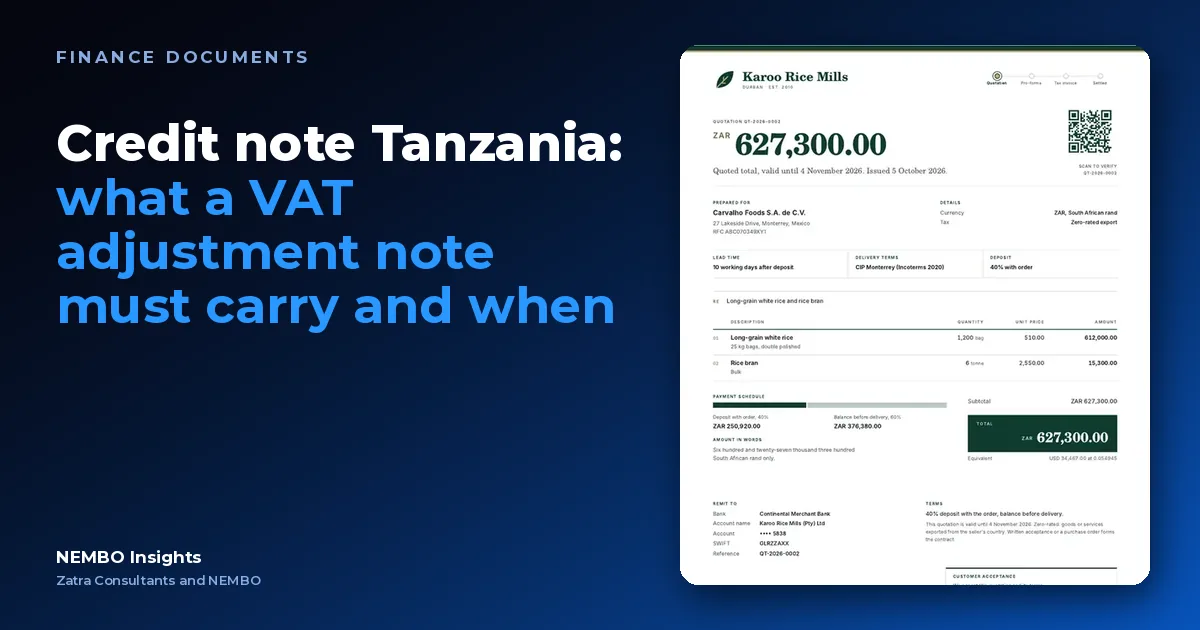
A credit note Tanzania sellers issue when a price drops or goods come back is, in VAT law, an adjustment note. The Value Added Tax Act, Cap. 148 sets out when it must be issued, who may adjust their VAT on the strength of it and in which return. The fiscal device rules decide how it is raised. This note reads the Act as revised in 2023, says what the desk could and could not confirm, and sets out the document itself: what it quotes, what it carries, who signs it and how it reaches the return. The companion notes on the EFD receipt or tax invoice and the three selling documents cover the papers that come before it.
What the law says
The Value Added Tax Act, Cap. 148, Revised Edition 2023, published on the Tax Revenue Appeals Board site, arranges the rules in Part V(d), "Other adjustments", and Part VI, "Documents and records". Section 75 covers post-supply adjustments for adjustment events, section 76 the limitations, section 77 the period, section 90 the tax invoice, section 91 adjustment notes and section 93 records. The Act's own definition of "tax invoice" cross-refers to a section number that no longer matches its heading in this edition, a sign of renumbering that the 2019 version on TanzLII confirms: there the same rules sat at sections 71 to 73, 86, 87 and 89. Cite the edition with the section.
| Section (R.E. 2023) | Rule, in the desk's reading | Status |
|---|---|---|
| s.75(1) | Where the tax accounted for is less than the tax properly payable, the supplier makes an increasing adjustment and issues a valid adjustment note within seven days of becoming aware of the event; a taxable customer gets a matching decreasing adjustment | Read through the PDF reader's extract; confirm against the print |
| s.75(2) | Where the tax accounted for exceeds the tax properly payable, the supplier may make a decreasing adjustment, subject to s.76, and must issue a valid adjustment note within seven days; a taxable customer makes an increasing adjustment | Same |
| s.75(3) | The customer's adjustment is the full difference where full input credit was taken, a proportion where partial credit was taken, and nil where none was taken | Same |
| s.76(1)(a) | A customer may make a decreasing adjustment only if it holds a valid adjustment note from the supplier when it files the return for that period | Same |
| s.76(1)(b) | A supplier may make a decreasing adjustment only if it issued the note and kept a copy; where the customer is unregistered, the supplier must also have repaid the excess tax in cash or as a credit | Same |
| s.76(2) | A refund is presumed to include tax equal to the tax fraction of the amount refunded, absent evidence otherwise | Same |
| s.77(1) and (2) | An increasing adjustment falls in the period the person becomes aware of the event. A supplier's decreasing adjustment falls in the period the note is issued. A customer's decreasing adjustment falls in the period it first became aware, or in any one of the following six periods | Same |
| s.91 | Adjustment notes: the heading is confirmed; the content requirements were not reached in the text read | Unknown; confirm in the print |
| s.70 | Return and payment by the 20th of the following month, even with nothing payable; amendment on application within three years | Confirmed on TRA's VAT page for the due date |
The Act's section 2 defines the adjustment events. The Zatra note on bad debt relief lists them as cancellation of a supply, a change in the consideration, return of goods and a change in the supply's tax status. It also records that regulation 31 of the Value Added Tax (General) Regulations, 2015 (GN 225 of 2015) sets the adjustment note on form ITX264.02.E within seven days. The same note explains why a bad debt is not an adjustment event: section 78 handles unpaid consideration after eighteen months, and section 78(5) says no adjustment note is needed for it.
Who should read this
Finance staff who raise invoices on an electronic fiscal device and accountants who prepare the monthly VAT return. Sales managers who agree discounts after the invoice has gone out. Buyers who claim input tax and must reverse part of it when a supplier credits them. Sellers in Zanzibar should read the Mainland and Zanzibar section first, because Zanzibar's VAT law is separate.
What is the difference between a credit note and a debit note?
| Document | Issued when | Effect on the supplier | Effect on a registered customer | Section |
|---|---|---|---|---|
| Credit note (decreasing adjustment note) | Price reduced, goods returned, supply cancelled after invoicing, or VAT charged on a supply that was exempt or zero-rated | May reduce output tax in the period the note is issued, if a copy is kept and, for an unregistered customer, the excess has been repaid | Must increase VAT payable by the tax on the credit, in the period it becomes aware | s.75(2), s.76(1)(b), s.77 |
| Debit note (increasing adjustment note) | Price increased after invoicing, or VAT undercharged | Must increase output tax in the period it becomes aware, and issue the note within seven days | May claim the extra input tax, in the period it first becomes aware or one of the six following periods, if it holds the note | s.75(1), s.76(1)(a), s.77 |
| Bad debt write-off | Consideration unpaid and overdue by more than eighteen months, written off | Decreasing adjustment under s.78, no note required | Increasing adjustment once eighteen months overdue | s.78 |
The names are commercial; the Act knows one document, the adjustment note, in two directions. A seller who issues a "discount letter" or an email has not issued an adjustment note, and neither side may adjust.
What must the adjustment note carry?
Section 91 prescribes the contents and the desk could not read it this week, so the list below is the desk's own, built from the Act's logic, the fiscal device rules and the form reference the Regulations give. Confirm it against section 91 and the form before adopting a template.
| Field | Why it is there |
|---|---|
| The words "credit note" or "debit note" and "adjustment note under section 75 of the VAT Act" | Identifies the document in law |
| Serial number and date of issue | Dates the seven days and the period of the supplier's adjustment |
| Supplier's name, address, TIN and VRN | Same identifiers as the tax invoice |
| Customer's name, address, TIN and VRN where registered | The customer's adjustment depends on holding a note addressed to it |
| Number and date of the original tax invoice or fiscal receipt | Links the adjustment to the supply |
| The adjustment event and the date the supplier became aware of it | Starts the seven-day clock and fixes the period |
| The original amount, the adjusted amount and the difference, excluding VAT | The base for the tax adjustment |
| The VAT adjusted, at the rate of the original supply, and the total | The figure both returns carry |
| For an unregistered customer, how the excess was repaid: cash, bank or credit against the account | Section 76(1)(b) condition |
| Fiscal device reference and verification code where raised on the device | So the note reaches the fiscal system |
| Signature of the person authorised in the delegation of authority matrix | Credit notes are a fraud route; the matrix note sets the limit |
How is a credit note raised on an EFD?
Tanzania Revenue Authority's EFD page states the duty to issue a receipt or invoice on each sale, the offence of issuing one that is false or incorrect in a material particular, and the duty to notify the Commissioner within 24 hours of a malfunction. It does not describe credit notes. The Zatra note on fiscal receipts records the practice: a correction is a fiscal credit note raised on the issuing device, quoting the original receipt number and date, which reaches the fiscal device management system and reduces output tax in the period raised, not the period of the original sale. A manual credit note against a fiscal receipt leaves the fiscal record uncorrected, and the return will not reconcile to the device's reports. For a supplier using a virtual fiscal device the same rule applies through the software.
The Tax Administration Act, Cap. 438, whose revised edition is listed on the TRAB site, carries the fiscal receipt duty and the record-keeping rule. The Zatra note cites sections 36 and 86 in the current print for the duty to issue through a device and the offence, and a five-year retention period. The desk has not read those sections this week and cites them as Zatra states them.
Which return does the adjustment go into?
TRA's VAT page confirms the frame. The standard rate is 18 percent and exports are zero-rated. A 16 percent rate applies to a buyer who is not registered and pays through a bank or an approved electronic system. Registration is mandatory at TZS 200 million of turnover in twelve months or TZS 100 million in six. The return and payment are due on or before the 20th of the following month. Input tax is not deducted after six months from the date of the tax invoice or EFD receipt. The fee register carries the same lines: F0239 for the 18 percent rate, F0240 for the 16 percent rate from 1 September 2025, F0242 for the threshold and F0245 for the 20th and the six months, at 26 September 2026.
| Who | Adjustment | Period | Condition |
|---|---|---|---|
| Supplier, credit note | Decreasing | Period in which the note is issued | Note issued and copy kept; unregistered customer repaid |
| Supplier, debit note | Increasing | Period in which it becomes aware of the event | Note issued within seven days |
| Registered customer, credit note received | Increasing | Period in which it becomes aware | None; the duty arises on awareness |
| Registered customer, debit note received | Decreasing | Period it first becomes aware, or any one of the next six | Holds a valid note when filing |
| Either, error in an earlier return | Amendment | Application within three years of the end of the period | Section 70(3), as read |
The six-period window for the customer's decreasing adjustment mirrors the six-month input tax window. A customer that receives a debit note late should file it in the next return rather than reopen an old one. The Zatra note on input VAT claims covers the evidence a claim needs, and the invoice terms note covers the debtor side the credit note changes.
Worked example: a returned consignment and a late discount
Tegeta Steel Traders Limited is a fictional VAT-registered distributor in Dar es Salaam. The figures are illustrative. Both customers are VAT-registered.
| Step | Document | Amount excluding VAT | VAT at 18 percent | Total |
|---|---|---|---|---|
| 12 October 2026: sale of 40 tonnes of reinforcing bar | Fiscal tax invoice 00987 | TZS 96,000,000 | TZS 17,280,000 | TZS 113,280,000 |
| 26 October 2026: 5 tonnes returned as off-specification | Fiscal credit note CN-0142, quoting 00987 | TZS 12,000,000 | TZS 2,160,000 | TZS 14,160,000 |
| Seven-day clock | Seller aware on 26 October; note issued 28 October | Within seven days | ||
| October return (filed by 20 November) | Seller's output tax | TZS 17,280,000 less TZS 2,160,000 = TZS 15,120,000 | ||
| October return | Customer's input tax | TZS 17,280,000 less TZS 2,160,000 = TZS 15,120,000 | ||
| 3 November 2026: price of a second sale raised after a freight error | Debit note DN-0017, quoting invoice 00991 | TZS 1,500,000 | TZS 270,000 | TZS 1,770,000 |
| November return | Seller's output tax increases by TZS 270,000; customer may claim TZS 270,000 in November or any of the six following periods |
The tax fraction check: the refund of TZS 14,160,000 to the first customer is presumed under section 76(2) to include VAT of 14,160,000 multiplied by 18 over 118, which is TZS 2,160,000, the same figure on the note. If the seller had refunded only TZS 12,000,000, the presumption would attribute VAT of TZS 1,830,508 to it, and the note would need to say otherwise with evidence. That is why the note and the refund should match.
What goes wrong with credit notes?
- A credit note raised in the period of the original sale, to "net it off". Section 77(2)(a) puts the supplier's decreasing adjustment in the period the note is issued.
- A manual credit note against a fiscal receipt. The device record stays wrong and the return will not reconcile.
- No copy kept. Section 76(1)(b) denies the supplier's adjustment without one.
- An unregistered customer credited on paper but never repaid. Section 76(1)(b) requires the repayment in cash or as a credit.
- Credit notes used to hide sales. The exception report in the delegation of authority matrix should list every credit note above a limit by customer and approver, and the Zatra note on TRA audits explains what an auditor reads them for.
- Penalties. A false or misleading statement in a return carries a penalty of 50 percent of the shortfall, or 75 percent where knowing or reckless (fee register NEW-02-11, Tax Administration Act s.90). A late return costs the higher of 2.5 percent of the tax or 15 currency points, TZS 300,000, a month for a body corporate (NEW-02-06, s.89). Both are at 26 September 2026.
How do credit notes work in Mainland Tanzania and Zanzibar?
| Point | Mainland | Zanzibar |
|---|---|---|
| Law | Value Added Tax Act, Cap. 148; TRA | Zanzibar VAT Act and Regulations; Zanzibar Revenue Authority |
| Rate and threshold | 18 percent; TZS 200 million in 12 months (F0239, F0242) | 15 percent; TZS 100 million a year (F0246) |
| Adjustment note | Within seven days of awareness, s.75 | The Zatra bad debt note records a twelve-month window for a credit note under regulation 10 of the Zanzibar VAT Regulations, 2012, unverified by the desk |
| Fiscal device | EFD or VFD under TRA rules | Zanzibar fiscal device rules; confirm with the Zanzibar Revenue Authority |
| Return | 20th of the following month | Confirm the Zanzibar due date |
The Zanzibar Revenue Authority's site could not be read by the desk this week, so every Zanzibar line above is to be confirmed there. The Zatra note on Zanzibar VAT against Mainland VAT sets out the two regimes.
What to do now
- Name the event. Cancellation, price change, return or tax status change. A bad debt is not one.
- Issue within seven days. Count from the day the seller becomes aware, and record that date on the note.
- Raise it on the device. Quote the original fiscal receipt number and date so the fiscal system is corrected.
- Repay unregistered customers. Cash, bank transfer or a credit on the account, recorded on the note.
- Keep the copy. The supplier's adjustment depends on it; file it with the original invoice for five years.
- Post it in the right period. Supplier: the period of issue. Customer: the period of awareness, or one of the six that follow for a decreasing adjustment.
- Control the approvals. Set a credit note limit in the delegation of authority matrix and read the monthly exception list.
- Route the rest. An objection, an audit finding or a dispute with a customer goes to an advocate; the return, the apportionment and the section 91 contents go to an accountant.
Key dates
| Date or period | Event | Source |
|---|---|---|
| 1 July 2015 | Value Added Tax Act, 2014 commenced | Act, as read on the TRAB copy |
| 30 November 2019 | Version on TanzLII with the older numbering | TanzLII |
| 2023 | Revised Edition with the current numbering | TRAB copy |
| 1 September 2025 | 16 percent rate for unregistered buyers paying electronically | Fee register F0240; TRA VAT page |
| 26 September 2026 | Fee register edition date for the rates and penalties quoted | Zatra fee register |
| Seven days | From awareness to issue of the adjustment note | s.75 |
| 20th of the following month | VAT return and payment | s.70; TRA VAT page |
| Six periods | Customer's window for a decreasing adjustment | s.77(2)(b) |
| Three years | Amendment of a return on application | s.70(3), as read |
What the NEMBO desk prepares
The client shares the facts: the invoices, the device reports, the customer ledger and the approvals. Zatra Consultants prepares and checks the content, including the period, the tax fraction and the section cited. NEMBO designs and delivers the documents. The desk prepares the quotation, pro-forma, tax invoice and credit note set on one numbering scheme, the credit note procedure as a controlled document, and the monthly VAT reconciliation page in the CFO pack. The Invoice Library holds the specimen set.
Two cost buckets apply. Government fees and taxes at the official rate are paid to the authority against its control number and are separate from NEMBO's and Zatra's fees. NEMBO and Zatra fees are published on /packages/ and /pricing/ and quoted in writing. See how a job runs, or share the details.
How Zatra helps
Zatra checks the facts, filings and figures in the set: the adjustment event, the seven days, the period of each adjustment, the tax fraction and the device reconciliation. The accounting and bookkeeping service keeps the ledger the return is drawn from, and the tax advisory service answers the harder questions on section 91 and apportionment. The desk does not decide or guarantee any authority's outcome, whether that authority is TRA, the Zanzibar Revenue Authority or an appeals board. Objections and disputes go to an advocate. Returns and reconciliations go to an accountant.
Quotation, pro-forma and tax invoice
Zatra Consultants prepares and checks the content on the details the Client shares. NEMBO designs and delivers it. Fees are published on the packages page and quoted in writing.
Open the desk pageSources and status
Accurate as at 7 November 2026. The Act was read through the TRAB PDF, with sections 75 to 77 through the reader's extract and section 91 not reached; TRA pages were read on that date; Zanzibar sources could not be read.
- 1The Value Added Tax Act, Cap. 148, Revised Edition 2023Tax Revenue Appeals Board copy, 2023 edition. Accessed 7 November 2026.
- 2The Tax Administration Act, Cap. 438, Revised Edition 2023Tax Revenue Appeals Board copy, 2023 edition. Accessed 7 November 2026.
- 3Legislation listingTax Revenue Appeals Board, page read 7 November 2026. Accessed 7 November 2026.
- 4Value Added Tax Act, 2014, as at 30 November 2019TanzLII, 2019 version. Accessed 7 November 2026.
- 5Value Added Tax (VAT)Tanzania Revenue Authority, page read 7 November 2026. Accessed 7 November 2026.
- 6E-Fiscal Devices (EFD)Tanzania Revenue Authority, page read 7 November 2026. Accessed 7 November 2026.
- 7Public noticesTanzania Revenue Authority, latest VAT notice dated 6 August 2026. Accessed 7 November 2026.
- 8Value Added Tax: scopeTanzania Revenue Authority, page read 7 November 2026. Accessed 7 November 2026.
- 9VAT bad debt relief Tanzania: the 18-month ruleZatra Consultants Limited, 6 November 2026. Accessed 7 November 2026.
- 10EFD receipts in Tanzania: what a fiscal receipt must showZatra Consultants Limited, 14 September 2026, reviewed 28 October 2026. Accessed 7 November 2026.
- 11Input VAT claim Tanzania: evidence, limits, blocked inputsZatra Consultants Limited, 6 November 2026. Accessed 7 November 2026.
Figures to confirm before you act
- The contents of an adjustment note prescribed by section 91 and form ITX264.02.E, which the desk did not read; the field list above is the desk's own.
- Sections 75 to 77 as read through the PDF reader's extract; confirm the subsection numbers against the print.
- The Tax Administration Act sections for the fiscal receipt duty and the offence, cited as the Zatra note states them.
- Whether a fiscal credit note may be raised in a later period on the device for an invoice issued before the device was commissioned.
- The Zanzibar credit note window, rate, threshold and return date, which the desk could not read at the source.
- The penalty figures, which follow the fee register at 26 September 2026 and move with each Finance Act.
This article is general information based on official sources available at the date of publication. It is not legal, tax or financial advice. Laws and notices change. Verify with the issuing authority or consult Zatra before acting.
Frequently asked questions
Is a credit note the same as an adjustment note?
In Tanzanian VAT law, yes. The Act uses "adjustment note" for the document a supplier issues after an adjustment event. A credit note is the decreasing kind and a debit note the increasing kind; the legal name and the seven-day rule are the same for both.
Can I reduce my output VAT on a discount agreed by email?
No. Section 76(1)(b), as read, allows the supplier's decreasing adjustment only where it has issued a valid adjustment note and kept a copy. An email, a letter or a ledger entry is not an adjustment note.
What if the customer is not VAT-registered?
The supplier may still issue the credit note and adjust, but only if it has repaid the excess tax to the customer, in cash or as a credit, as section 76(1)(b) requires. Record the repayment on the note itself.
Which month does the credit note go into?
For the supplier, the month the note is issued. For a registered customer that receives it, the month it becomes aware of the event, because its adjustment is increasing. A customer's decreasing adjustment on a debit note may fall in any one of the six following periods.
Do I need an adjustment note to write off a bad debt?
No. Section 78 handles consideration that remains unpaid for more than eighteen months, and section 78(5) says no adjustment note is needed. The Zatra note on bad debt relief sets out the evidence TRA expects instead.
How is a credit note raised against an EFD receipt?
On the same device, as a fiscal credit note quoting the original receipt number and date, so the correction reaches the fiscal device management system. A manual note leaves the device record unchanged and the return will not reconcile to the Z-reports.
What is the seven-day rule?
Section 75 requires the supplier to issue the adjustment note within seven days of becoming aware of the adjustment event. Record the date of awareness on the note, because it fixes both the deadline and, for increasing adjustments, the return period.
Does the same rule apply in Zanzibar?
No. Zanzibar has its own VAT Act at 15 percent with a TZS 100 million threshold, and the Zatra note records a twelve-month credit note window under its 2012 Regulations. Confirm the current rule with the Zanzibar Revenue Authority before adjusting a Zanzibar return.