On this page
- What the law says
- Who should read this
- What must a delegation of authority matrix contain?
- How does the matrix connect to the bank mandate?
- What does ISO 9001 add?
- Worked example: a four-level matrix for a TZS 3 billion trading company
- How is an approval workflow built on the matrix?
- What goes wrong without a matrix?
- Does the same matrix work in Mainland Tanzania and Zanzibar?
- What to do now
- Key dates
- What the NEMBO desk prepares
- How Zatra helps
- Sources and status
- Frequently asked questions
What is a delegation of authority matrix, and why does a Tanzanian SME need one before it automates approvals?
It is a board-approved table that states who may commit the company to what, up to which amount, and who must approve above it. The Companies Act leaves management to the directors and makes the company bound by people acting with authority, so the matrix is the record of that authority. An approval workflow only enforces what the matrix states.
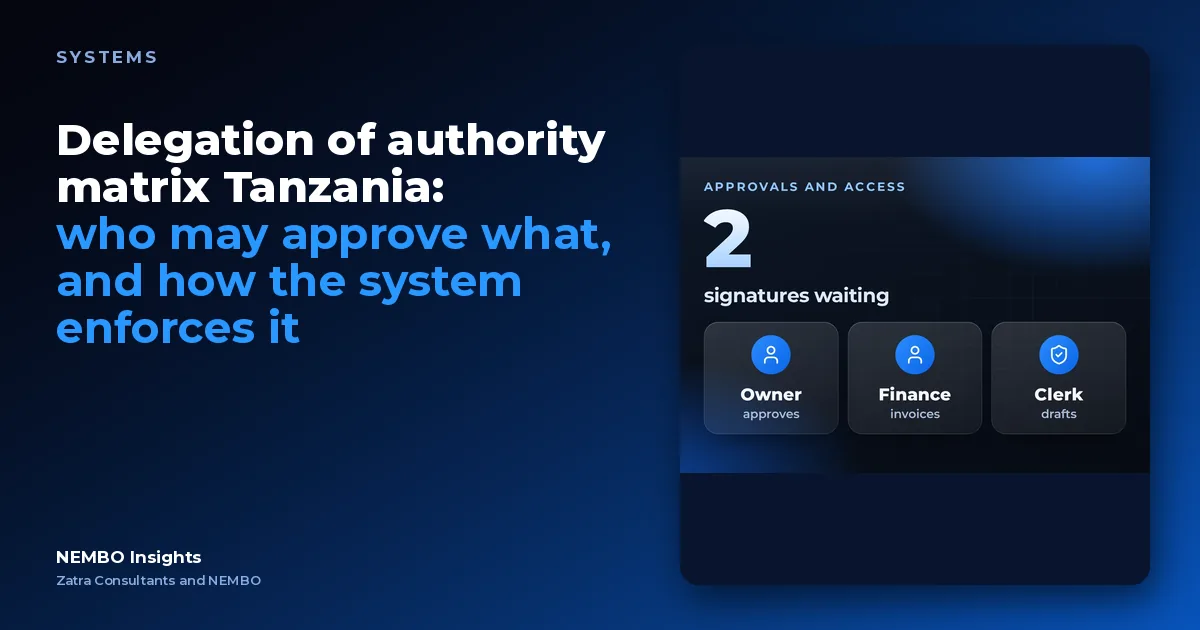
A delegation of authority matrix Tanzania companies adopt is the one document that sits between a board resolution and a payment. Without it, a manager approves what feels right, a bank mandate says one thing and the purchase ledger another, and an auditor finds no rule to test. With it, every purchase order, contract, payment, hire and write-off has a named approver and a limit, and a workflow can enforce the rule without a person remembering it. This note sets out what the law leaves to the directors, what the matrix must contain, how it joins the bank mandate and the fiscal receipt rules, and how an approval system is built on it.
What the law says
The Companies Act, Cap. 212 (Revised Edition 2023) does not prescribe a delegation of authority matrix. It does three things that make one necessary. Section 184 places the management of the company with the directors. Section 38 makes the board's power to bind the company, or to authorise others to bind it, free of any limitation in the company's constitution for a person dealing with the company in good faith, and good faith is presumed. Section 40 lets a contract be made on the company's behalf by a person acting under express or implied authority, and section 41 lets a document be executed by a director and the secretary or by two directors, without a seal. The practical result is that the company is bound by what its officers sign, whether or not an internal limit was respected. The matrix is how the board states the express authority, and the workflow is how it stops the implied kind.
Four further sections shape the content. Sections 185, 187 and 188 set the directors' duties of good faith, proper purpose and care, which a board discharges in part by setting limits and reviewing them. Section 203 prohibits loans to directors and connected persons, so the matrix must carry a line that no approver can override. Section 212 requires a director to disclose an interest in a contract, so the matrix must route interested transactions to the board. Section 151 requires minutes of directors' proceedings, so the resolution adopting the matrix is minuted and kept. The Zatra note on board resolutions covers the paper, and the note on directors' duties covers the standard the limits serve.
Tax law adds a document rule. Under the Income Tax Act, Cap. 332, as amended by the Finance Act 2024, expenditure must be supported by a fiscal receipt to be deductible, and the Tax Administration Act, Cap. 438 requires documents to be kept for five years. An approval that releases a payment without a fiscal receipt on file is an approval of a non-deductible cost. The Zatra note on fiscal receipts sets out what the receipt must show.
Who should read this
Owners and managing directors of companies with more than one person who can spend money. Finance managers who sign bank instructions. Company secretaries who keep the resolutions. Anyone about to buy or build an approval system, an ERP module or a WhatsApp approval bot. Boards of NGOs and cooperatives, whose constitutions set the same question in different words. Companies in Zanzibar should read the Mainland and Zanzibar section before copying the law references.
What must a delegation of authority matrix contain?
The matrix is a table with one row per decision type and one column per level of authority. Every cell holds a limit in TZS or the word "board". It is adopted by board resolution, dated, numbered as a controlled document and reviewed once a year or when the organisation changes. The controlled documents note explains the numbering and the revision record.
| Decision type | What the row states | Law or standard it serves |
|---|---|---|
| Purchase commitments | Who may raise and approve a purchase order at each value band; who approves a supplier that is new | Companies Act s.184 and s.188; COSO control activities |
| Contracts and signatures | Who may sign contracts by value and term; who executes deeds | Companies Act s.40 and s.41 |
| Payments and bank instructions | Single and dual signatory limits; who may add a payee; who releases online payments | Bank mandate; Companies Act s.41 |
| Sales terms | Who may grant credit terms, discounts and credit notes, and up to what amount | VAT adjustment rules; debtor policy |
| People | Who may hire, set pay, approve overtime, leave and termination | Employment and Labour Relations Act, Cap. 366; payroll statutory filings |
| Assets and write-offs | Who may buy, dispose of or write off assets, stock and debts, by value | Companies Act s.300+ books of account; audit evidence |
| Related parties | Board approval for any transaction with a director or connected person; loans to directors prohibited | Companies Act s.203 and s.212 |
| Statutory filings and tax | Who signs returns, who approves tax payments, who files with BRELA | Tax Administration Act, Cap. 438; Companies Act filings |
| Borrowing and guarantees | Board approval for all borrowing, charges and guarantees; registration of charges | Companies Act charges provisions; lender covenants |
| Policies and the matrix itself | Board approval for the matrix and every revision | Companies Act s.151 minutes |
Two rules keep the table honest. No person approves their own expense, pay or supplier. And every limit is the limit for one transaction, with a stated rule against splitting a purchase to stay under it. The COSO Internal Control, Integrated Framework, refreshed in 2013, names control activities and the control environment among its five components, and a matrix with those two rules is the smallest control activity a company can document.
How does the matrix connect to the bank mandate?
The bank does not read the matrix. It reads its own mandate, signed when the account was opened and amended by board resolution. CRDB's Biashara account page, read on 7 November 2026, asks a company for an application letter, a board resolution to open the account, the company registration documents, the business licence, the taxpayer identification number and photographs and identification of the signatories. The resolution names the signatories and their limits. If the matrix says payments above TZS 5,000,000 need two signatures and the mandate allows one, the bank will pay on one. The two documents must say the same thing, and a change to one is a change to both, minuted under section 151 and lodged with the bank.
Banks apply the same discipline to themselves under the Bank of Tanzania's Banking and Financial Institutions (Corporate Governance) Regulations, 2021 and the Internal Control and Internal Audit Regulations, 2014, listed on the Bank's regulations page. Those regulations bind banks, not their customers, and the desk has not read their text for this note. They are cited as the standard a lender's credit committee will have in mind when it reads a borrower's governance.
What does ISO 9001 add?
ISO 9001:2015, the quality management system requirements standard published in September 2015, asks an organisation to control the documented information its processes need. A delegation of authority matrix is documented information of that kind: identified, approved, version-controlled, available where it is used and protected from unintended change. ISO's overview notes that over one million organisations in more than 170 countries hold certification. For a company seeking certification, the matrix, the approval records and the review minutes are evidence an auditor asks for on the first day. The standard does not set approval limits. It asks that the company set them, follow them and keep the record.
Worked example: a four-level matrix for a TZS 3 billion trading company
Kariakoo Hardware Supplies Limited is a fictional building materials trader in Dar es Salaam with annual turnover of TZS 3,000,000,000, 28 staff, a managing director, a finance manager, two branch managers and a board of three. The limits below are illustrative. A company sets its own from its cash position and risk appetite.
| Decision | Level 1: branch manager | Level 2: finance manager | Level 3: managing director | Level 4: board |
|---|---|---|---|---|
| Purchase order, approved supplier | Up to TZS 2,000,000 | Up to TZS 20,000,000 | Up to TZS 100,000,000 | Above TZS 100,000,000 |
| New supplier onboarding | Proposes | Verifies TIN, VRN and bank details by call-back | Approves | Informed quarterly |
| Payment release | None | Single signature up to TZS 5,000,000 | Second signature from TZS 5,000,001 | Above TZS 100,000,000 by resolution |
| Credit terms to a customer | Up to TZS 3,000,000 for 30 days | Up to TZS 30,000,000 for 45 days | Up to TZS 100,000,000 for 60 days | Above TZS 100,000,000 |
| Credit note | None | Up to TZS 2,000,000 with the original invoice reference | Above TZS 2,000,000 | Above TZS 20,000,000 |
| Hiring and pay | Casual labour within budget | Recommends | Approves hires and pay up to TZS 3,000,000 a month | Above TZS 3,000,000 a month; all executive pay |
| Asset disposal or write-off | None | Up to TZS 1,000,000 | Up to TZS 10,000,000 | Above TZS 10,000,000 |
| Borrowing, guarantees, charges | None | None | None | All, by resolution |
| Related party transaction | None | None | None | All, with the interested director abstaining; no loans to directors |
In the month of October 2026 the company processed 1,240 payments. Of these, 1,031 fell at or under TZS 2,000,000 and were approved at level 1, 176 fell between TZS 2,000,001 and TZS 20,000,000, 29 between TZS 20,000,001 and TZS 100,000,000, and 4 above TZS 100,000,000 went to the board. The finance manager signed 1,180 payment instructions alone and 60 with the managing director. The board saw four papers. That distribution is what a workable matrix produces: the board approves the few decisions that can hurt the company, and the branch runs without waiting. The board pack note shows the page on which these counts are reported each month.
How is an approval workflow built on the matrix?
A workflow is the matrix expressed as rules a system applies. The desk builds it in five parts, whether the system is an ERP module, a web app or a WhatsApp bot with a person in the loop.
- A request record: who asked, for what, for how much, with the quotation or invoice attached and the fiscal receipt field mandatory before payment.
- A routing rule per row of the matrix: the value band and the decision type decide the approver; the system refuses to route to the requester or to a person on the related-party list.
- A second-approver rule for payments above the single-signature limit, mirrored exactly in the bank mandate.
- An audit trail: who approved, when, from which device, and what the record looked like at the time; no deletion, only reversal with a reason.
- A monthly exception report: approvals over limit, split purchases detected by supplier and date, new payees, and changes to the matrix itself.
The systems desk page describes the ledgers and approval screens the studio builds, and the AI automation page covers the person-in-the-loop design where an agent prepares and a person approves. The WhatsApp agent note is clear about one limit: an agent can collect, check and route a request; it cannot be an approver in the matrix.
What goes wrong without a matrix?
| Failure | What it looks like | Row that prevents it |
|---|---|---|
| Split purchases | Three orders of TZS 1,900,000 to one supplier in one week | Purchase order row with the anti-splitting rule and the exception report |
| Payee change fraud | A supplier's "new bank details" accepted by email | New supplier and payee row: verification by call-back on a known number |
| Self-approval | A manager approves his own travel claim | Rule that no one approves their own expense |
| Non-deductible spend | Payments released without a fiscal receipt on file | Mandatory fiscal receipt field before payment |
| Mandate drift | The bank pays on one signature while the policy says two | Payment release row mirrored in the mandate |
| Undisclosed interest | A director's relative becomes a supplier | Related party row; disclosure under s.212 |
| Unrecorded borrowing | An overdraft extended on a manager's signature | Borrowing row: board only, charge registered |
Does the same matrix work in Mainland Tanzania and Zanzibar?
| Point | Mainland | Zanzibar |
|---|---|---|
| Company law | Companies Act, Cap. 212 (R.E. 2023) | Zanzibar has its own companies law and registrar; section numbers above do not apply |
| Fiscal receipt rule | Income Tax Act and Tax Administration Act, TRA | Zanzibar Revenue Authority rules for Zanzibar taxes; TRA for Union taxes |
| Bank mandate | Bank's own form | Same bank form; same board resolution |
| Record retention | Five years under Cap. 438 | Confirm the Zanzibar period |
| Employment rows | Employment and Labour Relations Act, Cap. 366 | Zanzibar employment law |
The matrix itself works anywhere. The law column changes. A Zanzibar company should have an advocate restate the references before the board adopts it.
What to do now
- List the decision types. Purchases, contracts, payments, sales terms, people, assets, related parties, filings, borrowing and the matrix itself.
- Set the limits. Use last year's payment distribution so the board sees the few large decisions and the branches run.
- Write the two rules. No self-approval; no splitting.
- Adopt by board resolution. Minute it under section 151, number the document and date the next review.
- Align the bank mandate. Lodge the resolution with every bank and check the mandate limits match the payment row.
- Build the workflow. Routing by row, second approver by band, mandatory fiscal receipt, audit trail, exception report.
- Review quarterly. Read the exception report at the board and amend the matrix when the business changes.
- Route legal and tax questions. Contested authority, a related-party dispute or a Zanzibar restatement goes to an advocate; deductibility and record rules go to an accountant.
Key dates
| Date | Event | Source |
|---|---|---|
| 1992, refreshed 2013 | COSO Internal Control, Integrated Framework | COSO guidance page |
| September 2015 | ISO 9001:2015 published, fifth edition | ISO standard page |
| 2014 and 2021 | BoT internal control and corporate governance regulations for banks | BoT regulations page |
| 2023 | Companies Act, Cap. 212, Revised Edition 2023 section numbering | Zatra legal desk references |
| 1 July 2024 | Finance Act 2024 fiscal receipt condition for deductibility | Zatra fiscal receipt note |
| Annual | Matrix review and bank mandate check | This note |
What the NEMBO desk prepares
The client shares the facts: the organisation chart, the bank mandates, last year's payment list and the board's appetite for risk. Zatra Consultants prepares and checks the content, including the law references and the limits. NEMBO designs and delivers the documents and builds the system. The desk prepares the delegation of authority matrix and the approval procedure as controlled documents, the board resolution that adopts them, and the approval workflow that enforces them, with the monthly exception page in the CFO pack. The policy library at /library/ holds the procedure templates the matrix cites.
Two cost buckets apply. Government fees at the official rate are paid to the authority against its control number and are separate from NEMBO's and Zatra's fees. Where a resolution must be registered with BRELA, the filing fee is TZS 22,000 per document (fee register F0005, Companies Act s.458, at 26 September 2026); an ordinary board resolution adopting the matrix is not filed. NEMBO and Zatra fees are published on /packages/ and /pricing/ and quoted in writing. See how a job runs, or share the details.
How Zatra helps
Zatra checks the facts, filings and figures in the matrix: the section references, the related-party rules, the fiscal receipt condition and the match between the matrix and each bank mandate. The internal controls and risk advisory service designs the control set, and the business process and SOP service writes the procedures around it. The desk does not decide or guarantee any authority's outcome, whether that authority is a bank, a regulator, an auditor or a certification body. Disputes over authority and related-party transactions go to an advocate. Tax deductibility and record keeping go to an accountant.
Company policies, SOPs and controlled documents
Zatra Consultants prepares and checks the content on the details the Client shares. NEMBO designs and delivers it. Fees are published on the packages page and quoted in writing.
Open the desk pageSources and status
Accurate as at 7 November 2026. The Companies Act references use the Revised Edition 2023 numbering as recorded in the Zatra legal desk references; the ISO, COSO, CRDB and Bank of Tanzania pages were read on that date. The Bank of Tanzania regulations are cited by title from the Bank's listing and were not read.
- 1ISO 9001:2015 Quality management systems, RequirementsInternational Organization for Standardization, September 2015. Accessed 7 November 2026.
- 2ISO 9001 Quality managementInternational Organization for Standardization, page read 7 November 2026. Accessed 7 November 2026.
- 3Guidance on internal controlCommittee of Sponsoring Organizations of the Treadway Commission, framework 1992, refreshed 2013. Accessed 7 November 2026.
- 4COSO Internal Control, Integrated Framework: principlesCommittee of Sponsoring Organizations of the Treadway Commission, 2013. Accessed 7 November 2026.
- 5Biashara accountCRDB Bank Plc, page read 7 November 2026. Accessed 7 November 2026.
- 6RegulationsBank of Tanzania, page read 7 November 2026. Accessed 7 November 2026.
- 7The Banking and Financial Institutions (Corporate Governance) Regulations, 2021Bank of Tanzania, 2021. Accessed 7 November 2026.
- 8The Banking and Financial Institutions (Internal Control and Internal Audit) Regulations, 2014Bank of Tanzania, 2014. Accessed 7 November 2026.
- 9Board meetings and resolutions: what Cap. 212 requires on paperZatra Consultants Limited, 2026. Accessed 7 November 2026.
- 10Directors duties Tanzania: care, conflicts and liabilityZatra Consultants Limited, 2026. Accessed 7 November 2026.
- 11EFD receipts in Tanzania: what a fiscal receipt must showZatra Consultants Limited, 14 September 2026, reviewed 28 October 2026. Accessed 7 November 2026.
Figures to confirm before you act
- The Companies Act section numbers, which follow the Revised Edition 2023; older material cites the 2002 numbering.
- The text of the Bank of Tanzania corporate governance and internal control regulations, cited by title only.
- Each bank's current mandate form and the documents it asks for, which banks change without notice.
- The five-year retention period under the Tax Administration Act and the fiscal receipt condition in the Income Tax Act, with an accountant.
- The worked example limits, which are illustrative and not a recommendation for any company.
- Zanzibar company law references, which an advocate should restate.
This article is general information based on official sources available at the date of publication. It is not legal, tax or financial advice. Laws and notices change. Verify with the issuing authority or consult Zatra before acting.
Frequently asked questions
Does the Companies Act require a delegation of authority matrix?
No. It places management with the directors and binds the company by acts of people with authority. The matrix is how a board records the authority it has given, so that a workflow, a bank and an auditor can test it.
Can a WhatsApp bot or an AI agent be an approver?
No. An agent can collect a request, check the attachments, apply the routing rule and remind the approver. The approval itself is a named person's act, recorded with time and device, because the person carries the duty under the Act.
What happens if a manager exceeds the limit and signs anyway?
The company is usually still bound, because section 38 protects a counterparty dealing in good faith. The manager answers to the board under the matrix and the employment contract. That is why the workflow should make the breach impossible rather than merely prohibited.
How often should the limits change?
Review them once a year and whenever turnover, structure or bank facilities change. Read the monthly exception report at each board meeting. A limit that produces hundreds of board papers a year is too low; one that lets a branch commit a year's cash is too high.
Should the bank mandate copy the matrix word for word?
The payment release row and the signatory list must match the mandate exactly. The rest of the matrix is internal. Lodge the adopting resolution with each bank and check the mandate on the bank's own form after any change of signatory.
Where do related-party transactions sit?
At board level only, with the interested director disclosing under section 212 and abstaining, and with no loan to a director or connected person at any level, because section 203 prohibits it. The workflow should block routing to any approver on the related-party list.
Does a sole director company need a matrix?
A smaller one. Even with one director, staff raise orders and release goods, and the bank may hold more than one signatory. A two-level matrix with a fiscal receipt rule and an exception report gives the auditor and the lender the record they ask for.
Is the matrix enough for ISO 9001 certification?
It is one piece of documented information. Certification needs the quality management system as a whole, with processes, records and internal audits. The matrix and its approval records are among the first documents an auditor requests.