On this page
- What changed
- Who should read this
- Which of my sales are caught by the Schedule?
- What must the receipt and the tax invoice now show?
- How do quotations, booking pages and fee schedules change?
- What does the payment SOP and the cash policy say?
- How does the Order sit with the EFD rules and the Tax Administration Act?
- Worked example: a Dar es Salaam day school and a Zanzibar lodge
- Where the files fail
- Mainland and Zanzibar
- Is there a penalty for taking cash after the deadline?
- What to do now
- Key dates and deadlines
- What the NEMBO desk prepares
- How Zatra helps
- Sources and status
- Frequently asked questions
What must a Tanzanian business change in its receipts and systems under GN 158C?
From 1 January 2027 an existing business in the nine scheduled sectors should receive every listed payment by mobile money, bank transfer, card, POS or the Government payment system, and its fiscal receipt should show the channel and the reference. Invoices, quotations, booking pages and fee schedules lose the cash option. A written cash policy and a daily reconciliation tie fiscal receipts to bank and wallet statements.
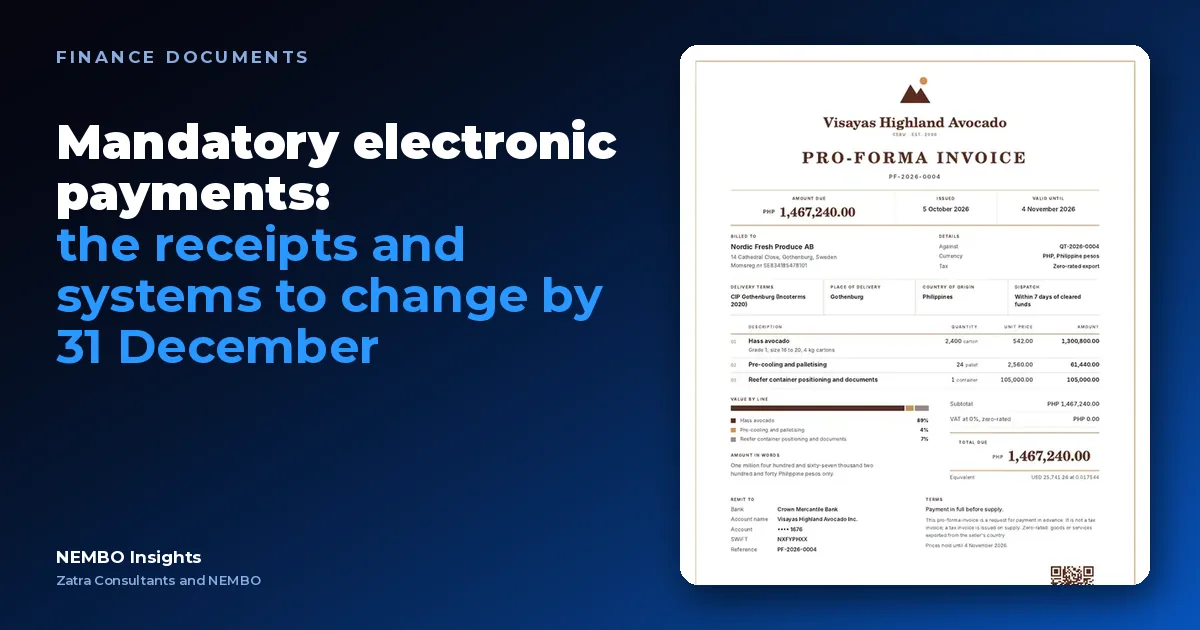
The mandatory electronic payments Tanzania Order, Government Notice No. 158C of 2026, gave businesses that already received payments for nine listed transactions six months to move those payments off cash. That period ends on 31 December 2026 on every reading the desk has seen. The law itself is covered in Zatra's note on GN 158C and section 13(2) of the Electronic Transactions Act. This note is about the paper and the systems. It sets out what the receipt, the tax invoice, the quotation, the booking page, the POS set-up and the cash policy must look like by the end of December. It also shows how each ties to the fiscal receipt rules in the notes on EFD receipts and tax invoices, quotations, pro-forma and tax invoices and credit notes.
What changed
On 30 June 2026 the Minister for Finance signed the Electronic Transactions (Mandatory Electronic Payments for Specified Transactions) Order, 2026, published as Government Notice No. 158C and hosted by the Tanzania Revenue Authority. It came into operation on 1 July 2026. The power to make it is section 13(2) of the Electronic Transactions Act, Cap. 442, inserted by section 6 of the Finance Act, 2026. The same Finance Act added section 13(3), which makes proof of electronic payment a mandatory requirement before an authority approves a transfer of land, a building or a motor vehicle. The Zatra fee register records both subsections under F0482.
Paragraph 2(1) of the Order says a person who makes or receives payment for a transaction in the Schedule shall make or receive it through electronic means. Paragraph 2(2) defines electronic means by an open list: mobile money, bank transfer and electronic funds transfer, payment cards, electronic wallets, point of sale devices, internet or mobile banking, and the Government electronic payment system. Paragraph 3 gives a person who was receiving such payments before 1 July 2026 six months to put electronic means in place, and says the Order does not affect arrangements or contracts made before it came into force. EY's alert of 14 August 2026 and Bowmans' note of 2 August 2026 both read the six months as ending on 31 December 2026. The Order prints no end date, so the desk tiers that date verify.
The desk opened the TRA copy of the Order, but the file rendered without readable text. The paragraph numbers come from Zatra's reading of the gazetted text on 6 October 2026 and agree with EY and Bowmans. The Order contains no penalty paragraph and names no enforcing authority. Both law firms say so, as does LEX Africa's note of 3 August 2026, and the desk has found nothing since that changes it.
Who should read this
Bursars and school accountants (Schedule item 3). Hotel, lodge, restaurant and cafe owners (item 5). Tour operators (item 6). Filling stations, mall tenants, gyms, cinemas, event venues and exhibitors (item 2). Bus, ferry, online taxi, airline, railway and parking operators (item 1). Landlords, estate agents, property sellers and car dealers (items 7 and 8). Cooperative unions, AMCOS and input dealers (item 9). Anyone outside the nine items is outside the Order, though the fiscal receipt rules still apply.
Which of my sales are caught by the Schedule?
Bowmans notes that the Order does not define shopping mall, tourism-related services or renting of a building, so the edges are open. The table gives the nine items as EY and Bowmans print them and the document issued at payment.
| Item | Payments covered | Document issued at payment | Where the payment reference goes |
|---|---|---|---|
| 1 | Fees, charges, levies, tolls or fares for bus rapid transit, ferries, bridges, long-distance buses, online taxi services, air, rail and parking | Ticket or fiscal receipt | Transaction ID printed on the ticket or receipt |
| 2 | Goods or services in shopping malls, gyms, cinemas, filling stations, conference and event venues, sports arenas and international trade exhibitions | Fiscal receipt from the EFD or VFD | POS or mobile money reference on the receipt or on a stapled slip |
| 3 and 4 | Fees and contributions for education at every level | Fee invoice, then official receipt | Bank or control number reference on the receipt against the invoice number |
| 5 | Accommodation, food and beverages in hotels, restaurants and cafes | Folio or bill, then fiscal receipt | Card or till reference on the folio and the fiscal receipt |
| 6 | Tourism-related services | Booking confirmation, invoice, fiscal receipt | Transfer or card reference on the invoice |
| 7 | Renting, sale or purchase of a building, plot or farm | Rent receipt, sale agreement, transfer file | Bank reference in the agreement and the receipt, kept for the transfer authority |
| 8 | Motor vehicle sale or purchase | Sale agreement, invoice, fiscal receipt | Bank reference in the agreement, kept for the registration transfer |
| 9 | Cooperative union and AMCOS payments for strategic crops, inputs and pesticides | Purchase note or payment voucher | Mobile money or bank reference on each voucher |
A business with mixed revenue lists every stream and marks it inside or outside the Schedule. A high street hardware shop is outside unless it trades inside a mall. Where a stream sits on the edge, an advocate's written view is cheaper than a licence refusal.
What must the receipt and the tax invoice now show?
The Order changes how money moves. It does not change the fiscal receipt rules. Section 97(1) and (3) of the Tax Administration Act, Cap. 438, make failing to issue a fiscal receipt an offence. The fine is 20 percent of the value of the goods or services or TZS 2,000,000, whichever is greater, capped at TZS 4,000,000, or up to three years' imprisonment, or both, plus twice any tax evaded (NEW-02-13). Section 97(4) fines a buyer who fails to demand one 20 percent of the tax evaded or TZS 40,000, whichever is greater (NEW-02-14). An electronic fiscal device is mandatory where annual turnover is TZS 11,000,000 or more (NEW-02-24), and VAT registration is mandatory at taxable turnover of TZS 200,000,000 in twelve months or TZS 100,000,000 in six months (F0242). Input tax on a receipt or invoice lapses six months from its date (F0245).
So the receipt a customer holds after 31 December does two jobs: it is the fiscal receipt the TRA rules require, and it shows that the payment arrived electronically. The second job is a layout decision.
| Field | On the fiscal receipt | On the tax invoice | Why |
|---|---|---|---|
| Seller name, TIN and VRN | Printed by the device | In the header block | Section 97 and the VAT Act particulars |
| Payment channel | Till, POS, transfer, card or GePG, as a line under the total | Bank details, till number and control number instructions in the footer | Shows the sale was settled under paragraph 2(1) |
| Payment reference | Mobile money or POS transaction ID | Left blank at issue, completed on the receipt | Ties the sale to the bank or wallet statement |
| Date and time | Device time stamp | Invoice date | The six-month input tax limit runs from this date |
| Fiscal reference | Receipt number and verification code | Signature number from the signature device | The buyer's auditor checks it on the TRA verification page |
| Cash line | Absent for scheduled sales from 1 January 2027 | Absent; "cash" removed from payment terms | A cash line on a scheduled sale invites the question |
How do quotations, booking pages and fee schedules change?
A quotation or pro-forma invoice for a scheduled transaction carries the electronic channels and nothing else: the bank account in the business's own name, the merchant till or lipa number registered to the business, the card option, and, for schools and public bodies, the control number route. A quotation that still says "cash or cheque on delivery" is out of date. A cheque is not in the Order's list and Zatra's note treats it as not covered, so the desk removes it and tiers that reading verify.
A booking page or fee portal is the same document in another form. The note on what an investor checks on a company website already asks for a payment page that matches the invoice. A lodge's booking confirmation states the amount, the channel, the reference to quote and the fiscal receipt the guest will receive. A school's fee schedule states the invoice number format, the bank and control number route, and that the official receipt is issued against the bank reference, not cash at the gate.
What does the payment SOP and the cash policy say?
The one document most businesses do not have is the written rule for the cashier. The note on how to write a standard operating procedure gives the format. The payment SOP covers six situations. The normal sale: channels offered in a fixed order, the sale entered with the matching payment method, the reference written or scanned. The customer who offers cash: the Order explained, a till or POS offered, and an escalation to the supervisor who logs the exception with date, amount and reason. A network outage: the sale parked and a second channel offered, with no failed transaction treated as paid until the operator confirms. A refund: back by the channel it arrived on, with a credit note where a fiscal receipt was issued. A deposit or part payment: each instalment electronic, because Bowmans reads the duty as attaching to each payment. The daily close: till, POS and bank reports matched to the Z report and filed under the rules in the note on how long to keep each document.
The cash policy itself is one page. It states that from 1 January 2027 the business takes no cash for scheduled transactions, lists the channels, names the exception approver, and bars staff from taking payment into a personal wallet or account.
How does the Order sit with the EFD rules and the Tax Administration Act?
Three records now describe one sale: the fiscal receipt, the payment record from the bank or wallet, and the entry in the books. The Value Added Tax (General) (Amendment) Regulations, 2025, moved the VAT return to a form that separates sales recorded in EFDMS from sales keyed by hand, as the EFD note explains. A sale that reaches the bank but not the fiscal device is visible to TRA from January as a gap between the two.
The daily reconciliation therefore becomes the control: a three-column sheet of fiscal receipts by payment method, settlements by channel from each provider, and the difference with a reason. Unexplained differences above a stated threshold go to the finance manager the same day. The sheet is kept with the tax records for the retention period in the Tax Administration Act, which the desk tiers verify.
Worked example: a Dar es Salaam day school and a Zanzibar lodge
Figures are illustrative. Bank, card and mobile money charges are each provider's commercial tariffs, not government fees, and are shown as assumptions.
Tumaini Day School, a fictional private primary school in Dar es Salaam, has 420 pupils paying TZS 1,500,000 a term. Term fees are TZS 630,000,000. Before July 2026 the bursar took about 35 percent of fees in cash, TZS 220,500,000 a term. From January 2027 each fee invoice carries the invoice number, the bank account, a till number and the instruction that the official receipt is issued against the bank reference. If the bank charges a flat TZS 1,000 a deposit and 180 parents pay by bank, the school pays TZS 180,000. If 240 parents pay TZS 1,500,000 by mobile money at an assumed 0.5 percent merchant tariff, the school pays TZS 7,500 a payment, TZS 1,800,000 in total. The channel cost of TZS 1,980,000 is 0.31 percent of term fees. Against it, the school stops paying TZS 450,000 a term for cash-in-transit collection and ends the weekly cash count.
Kijani Lodge, a fictional ten-room lodge in Zanzibar, bills a guest TZS 480,000 for two nights and TZS 95,000 for meals, TZS 575,000 in all. The guest pays by card on the POS at check-out. The POS provider settles TZS 575,000 less an assumed 2.5 percent, TZS 14,375, into the lodge's bank account two days later, so TZS 560,625 arrives. The fiscal receipt shows TZS 575,000, the payment method as card, and the POS reference. The VAT line is at the Zanzibar rate of 15 percent, TZS 75,000 on TZS 500,000 net (F0246), because Zanzibar VAT belongs to the Zanzibar Revenue Authority. The reconciliation sheet shows the gross on the receipt, the net on the statement and the TZS 14,375 as a bank charge. Whether the Order itself reaches the lodge is the open question under Mainland and Zanzibar below.
Where the files fail
| Fault | What the auditor or authority sees | Fix |
|---|---|---|
| Till number registered to a director, not the company | Payments for the business land in a personal wallet; turnover unmatched to the books | Register a merchant till in the company name, close the personal route, record the change in the SOP |
| Fiscal receipt says "cash" for a card sale | Payment method on the receipt contradicts the POS report | Train cashiers to select the real channel; spot check the Z report weekly |
| Refund paid in cash from the drawer | Credit note with no matching outflow on any statement | Refund by the original channel; attach the operator confirmation to the credit note |
| Lease signed in 2024 still paid in cash | Rent receipts with no bank trail; transfer office asks for proof under section 13(3) | Vary the lease to electronic rent with an advocate's wording |
Mainland and Zanzibar
The Order and section 13 sit in the Electronic Transactions Act, a Union statute, but section 2 of Cap. 442 excludes Part III from Zanzibar, and Zatra's note could not confirm which Part the restored section 13 now sits in. The desk therefore treats the Order's application in Zanzibar as unconfirmed. What is confirmed is that Zanzibar VAT, at 15 percent with a registration threshold of TZS 100,000,000 a year (F0246), is administered by the Zanzibar Revenue Authority through its Virtual Fiscal Management System, not by TRA. A Zanzibar hotel's receipt therefore follows ZRA's rules. A group trading on both sides keeps two receipt templates, two reconciliation sheets and one cash policy, and takes an advocate's written view on Zanzibar before telling guests that cash is refused by law. Zatra's notes on Union and non-Union taxes and the Zanzibar hotel software rule set out the islands' side.
Is there a penalty for taking cash after the deadline?
The Order prints none. Bowmans says it does not set out any penalty, and Zatra found no offence in Part III of the Finance Act, 2026 either. The exposure comes from elsewhere. Section 13(3) stops a land, building or motor vehicle transfer being approved without proof of electronic payment. Daily News reported on 5 August 2026 that the Business Licensing Regulations were amended to require proof of a digital payment system, including Lipa Namba or TANQR, from applicants for new and renewed business licences, quoting the Office of the Chief Parliamentary Draftsman. The desk has not found that amendment in the Zatra fee register or in any Government Notice it could read, and tiers it verify. If a licensing officer refuses a renewal on that ground, ask for the instrument in writing and take the letter to an advocate. The fiscal receipt offences in section 97 of the Tax Administration Act apply regardless of the Order and are the real teeth.
What to do now
- Map revenue streams to the Schedule and record, stream by stream, whether the Order applies, with the item number.
- Register channels in the company's name: a merchant till with each mobile operator, a bank POS, transfer details and, where relevant, a control number route, with each provider's tariff in writing.
- Change the fiscal device settings so that cashiers select the real payment method and the device or a stapled slip carries the transaction reference.
- Reissue the invoice, quotation and receipt templates with the payment channels in the footer, "cash" removed from scheduled transaction terms, and a reference line for the payment ID.
- Update the website, booking page and fee schedule so the amount, channel, reference instruction and receipt promise match the invoice.
- Write the payment SOP and the one-page cash policy, name the exception approver, and open the exception log.
- Vary contracts that still say cash, including leases, fee agreements and vehicle sale terms, with an advocate's wording.
- Run the daily reconciliation of fiscal receipts, provider settlements and bank statements from the first day, and keep the sheets with the tax records.
- Brief the staff before the festive peak, because the deadline falls inside the busiest month for hotels and transport.
Key dates and deadlines
| Date | What it governs | Source and tier |
|---|---|---|
| 30 June 2026 | GN 158C signed and published; Finance Act, 2026 assented | TRA copies of both instruments; settled |
| 1 July 2026 | Order in operation; section 13(2) and (3) of Cap. 442 in force | Order paragraph 1; Finance Act, 2026 section 6; settled |
| 31 December 2026 | End of the six months for existing payees, on the EY, Bowmans and Zatra count | Order paragraph 3 prints "within six months" and no date; verify |
| 1 January 2027 | First day on which an existing business should take no cash for scheduled sales | Desk reading; verify |
| 20th of each month | VAT return and payment, with EFDMS and non-EFDMS sales separated | F0245; settled |
| Six months from receipt date | Last day to claim input tax on a receipt or invoice | F0245; settled |
What the NEMBO desk prepares
NEMBO designs and delivers the finance documents the Order touches: the tax invoice and quotation templates with the channel footer and reference line, the receipt layout, the booking confirmation and fee schedule, and the till signage. It also lays out the payment SOP and the one-page cash policy as controlled documents, and the daily reconciliation sheet. Zatra Consultants prepares and checks the content: which streams fall inside the Schedule, the fiscal receipt and VAT positions, the reconciliation design, the contract variations with an advocate, and the Zanzibar position. Government charges, where a related filing carries one, are paid to the authority at the official rate against its control number. They are never part of NEMBO's or Zatra's fees, which are quoted in writing from the packages and pricing pages. Bank, card and mobile money tariffs are the provider's and are shown as such. NEMBO does not decide or guarantee any authority's outcome. See the invoice desk, the policies and SOPs desk and the process page, or share your revenue streams.
How Zatra helps
Zatra's tax and regulatory compliance desk maps each stream against the Schedule and designs the receipting and reconciliation plan. Its corporate bank account and KYC desk prepares the file a bank asks for before it issues a POS terminal or a merchant account. Its business process and SOP desk writes the cashier procedure and trains the staff. Zatra prepares, structures and coordinates. A threatened sanction, a licence refusal or a contract dispute goes to an advocate; the tax treatment of a particular stream is a position for the accountant, CPA Altho Mwangoa, who authors Zatra's note on the Order.
Quotation, pro-forma and tax invoice
Zatra Consultants prepares and checks the content on the details the Client shares. NEMBO designs and delivers it. Fees are published on the packages page and quoted in writing.
Open the desk pageSources and status
Accurate as at 16 November 2026. The desk opened the TRA copy of GN 158C but the file rendered without readable text in the session's viewer; paragraph numbers are taken from Zatra's reading of 6 October 2026 and agree with EY and Bowmans. The Order prints no end date and no penalty. The reported amendment to the Business Licensing Regulations requiring proof of a digital payment system was not found in any instrument the desk could read. Zanzibar application of the Order is unconfirmed. Channel tariffs in the worked examples are assumptions.
- 1GN No. 158C: Electronic Transactions (Mandatory Electronic Payments for Specified Transactions) Order, 2026Minister for Finance, published 30 June 2026, hosted by the Tanzania Revenue Authority; opened 16 November 2026 but the viewer rendered no text. Accessed 16 November 2026.
- 2The Finance Act, 2026 (Act No. 2 of 2026), Part III amending section 13 of Cap. 442Parliament of Tanzania, assented 30 June 2026, hosted by the Tanzania Revenue Authority; cited through Zatra's reading and register line F0482. Accessed 16 November 2026.
- 3The Electronic Transactions Act, Cap. 442 R.E. 2022Ministry of Finance, revised edition 2022; section 2 application clause cited through Zatra's reading of 6 October 2026. Accessed 16 November 2026.
- 4Tanzania introduces mandatory electronic payment for specific identified transactionsEY Global Tax News, 14 August 2026, document 2026-1753, read 16 November 2026. Accessed 16 November 2026.
- 5Tanzania: Electronic payments mandated for specified transactionsBowmans, 2 August 2026, read 16 November 2026. Accessed 16 November 2026.
- 6Tanzania: Cash Payments BannedLEX Africa, 3 August 2026, read 16 November 2026. Accessed 16 November 2026.
- 7Tanzania mandates digital payments for key transactionsDaily News, 5 August 2026, quoting the Office of the Chief Parliamentary Draftsman, read 16 November 2026. Accessed 16 November 2026.
- 8Tanzania Revenue AuthorityTanzania Revenue Authority, home page and EFD pages, read 16 November 2026. Accessed 16 November 2026.
- 9Mandatory Electronic Payments Tanzania 2026: What GN 158C Requires of Your BusinessZatra Consultants Limited, 6 October 2026, read 16 November 2026. Accessed 16 November 2026.
- 10Union vs non-Union taxes: Tanzania and ZanzibarZatra Consultants Limited, published 2026, read 16 November 2026. Accessed 16 November 2026.
- 11Zanzibar hotel VFMS software rule 2026Zatra Consultants Limited, published 2026, read 16 November 2026. Accessed 16 November 2026.
- 12Tax and regulatory compliance in TanzaniaZatra Consultants Limited, service page read 16 November 2026. Accessed 16 November 2026.
- 13Corporate bank account KYC in TanzaniaZatra Consultants Limited, service page read 16 November 2026. Accessed 16 November 2026.
- 14Business process and SOP consulting in TanzaniaZatra Consultants Limited, service page read 16 November 2026. Accessed 16 November 2026.
Figures to confirm before you act
- The end of the six-month period, which the Order states as within six months and EY, Bowmans and Zatra count to 31 December 2026, with the Ministry of Finance or TRA.
- Whether the Business Licensing Regulations now require proof of a digital payment system at licence application and renewal, from the Gazette or BRELA, before relying on the Daily News report.
- Whether section 13 of Cap. 442 sits in Part III and so whether the Order reaches Zanzibar, with an advocate.
- The record retention period for tax records under the Tax Administration Act, from the Act, before setting the reconciliation archive.
- Your providers' merchant till, POS and transfer tariffs, in writing, because the figures in the worked examples are assumptions.
This article is general information based on official sources available at the date of publication. It is not legal, tax or financial advice. Laws and notices change. Verify with the issuing authority or consult Zatra before acting.
Frequently asked questions
Can a customer still pay cash into our bank account at a branch counter?
The Order's list names bank transfer and electronic funds transfer, not a cash deposit at a counter. Zatra's note treats the counter deposit as a harder case the Order does not answer. The safe course is to steer the customer to a transfer, a till number or a card, and to log any counter deposit as an exception with the deposit slip attached.
Does a mobile money confirmation SMS replace the fiscal receipt?
No. The Order changes how money moves and leaves the Tax Administration Act's receipt rules intact. A sale by till number still needs a fiscal receipt from the EFD or VFD, and failing to issue one is an offence under section 97. Treat the SMS as the payment reference that goes on the receipt, not as the receipt.
Our school opened in September 2026. Do we get the six months?
No. Paragraph 3 protects a person who was receiving scheduled payments immediately before 1 July 2026. A school that opened later had to receive fees electronically from its first term. Issue the fee invoice with the bank and till details from the start and keep the official receipt tied to the bank reference.
What goes on the till signage at reception or the pump?
The registered business name, the merchant till or lipa number in that name, the card option, and one line saying that payment for this service is made electronically under GN 158C of 2026. NEMBO lays it out to match the invoice footer so the customer sees the same channels in both places.
How do we handle a refund to a guest who paid by card?
Reverse it through the POS provider or transfer it to the guest's account, never from the cash drawer. Where a fiscal receipt was issued, raise a credit note that refers to it and attach the provider's confirmation. The credit note note on this desk gives the EFD adjustment steps.
Does the Order apply to rent under a lease we signed in 2024?
The Order says it does not affect contracts made before 1 July 2026, but Bowmans reads the duty to pay electronically as attaching to each payment rather than to the contract. The point is unsettled. Agree a written variation to electronic rent with the tenant, which also protects a later transfer under section 13(3).
What does a Zanzibar hotel do?
Go electronic anyway, because card and transfer payments are already the norm for guests, and issue receipts under the Zanzibar Revenue Authority's VFMS rules at the 15 percent rate. Whether GN 158C itself applies in Zanzibar is unconfirmed, so take an advocate's written view before telling guests that cash is refused by law.
Is there a government fee for setting any of this up?
No. The Order sets no fee, and registering a till number or a POS terminal is a commercial arrangement with the operator or the bank at its own tariff. Fiscal devices are bought from TRA-approved suppliers at market price. NEMBO's design fee and Zatra's checking fee are quoted separately in writing from the pricing page.