On this page
- What the standard says
- Who should read this
- Which entities must report, and from when?
- What must the Sustainability Disclosures section contain?
- What does the readiness assessment have to cover?
- When does ISSA 5000 assurance start in Tanzania?
- Worked example: a listed miller's first Scope 1 and Scope 2 table
- How should the section be laid out in the annual report?
- Does this apply in Mainland Tanzania and Zanzibar?
- What to do now
- Key dates
- What the NEMBO desk prepares
- How Zatra helps
- Sources and status
- Frequently asked questions
Where do sustainability disclosures sit in a Tanzanian annual report, and what must the section contain?
From periods beginning 1 January 2027, NBAA Technical Pronouncement No. 1 of 2026 places them after the report by those charged with governance, under the heading "Sustainability Disclosures", for the same period as the financial statements. The content follows IFRS S1 and IFRS S2: governance, strategy, risk management, and metrics and targets, with climate reported under S2.
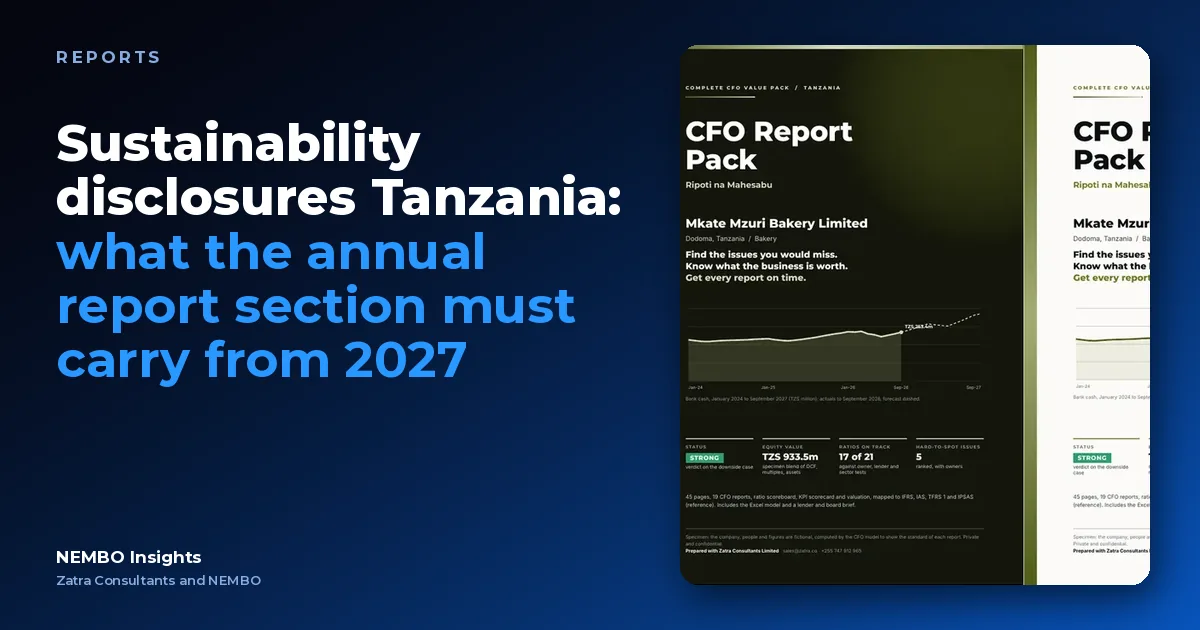
Sustainability disclosures Tanzania now requires are a fixed part of the annual report, not an optional brochure. The National Board of Accountants and Auditors issued Technical Pronouncement No. 1 of 2026 in August 2026. It settles where the disclosures go, how a stand-alone report may be added, and what reporting entities and audit firms must do before assurance under ISSA 5000 arrives. The law and the standards are covered on zatra.co in the note on NBAA sustainability reporting rules from 2027. This note is about the document: the pages, the tables and the evidence file a board signs off.
What the standard says
NBAA's Technical Pronouncement No. 1 of 2026 amends Technical Pronouncement No. 1 of 2024. The Governing Board approved it at its 202nd ordinary meeting on 30 July 2026, the document is dated August 2026, and the announcement is dated 21 August 2026. Section 6 makes it effective for annual financial reporting periods beginning on 1 January 2027, with early adoption encouraged.
| Section | Who | Requirement |
|---|---|---|
| 2.1 | All reporting entities | Sustainability disclosures stay in the report by those charged with governance, placed after it under the heading "Sustainability Disclosures". Same reporting period as the general purpose financial reports. Cross-referenced to other sustainability information to avoid duplication. |
| 2.2 | Optional, any reporting entity | A separate stand-alone sustainability report may be prepared, provided the 2.1 disclosures are not omitted, diminished or replaced; it follows IFRS S1 and S2 and any standard NBAA later adopts; its period and publication timing match the financial statements. |
| 3 | Public sector entities | Continue to apply IFRS S1 and S2 and comply with section 2 until public sector sustainability standards are issued and effective, then adopt the IPSASB standards. |
| 4 | All | Technical Pronouncement No. 1 of 2024 otherwise stays in force, including the auditor responsibilities and the implementation roadmap; read with No. 1 of 2018 and No. 1 of 2024. |
| 5 | Auditors, entities, audit firms | Pending NBAA's announcement of the Tanzanian assurance effective date: auditors keep applying ISA 720; reporting entities, including public sector, conduct a comprehensive readiness assessment; audit firms conduct a comparable one. |
| 6 | All | Effective for annual periods beginning 1 January 2027; early adoption encouraged. |
The pronouncement builds on Technical Pronouncement No. 1 of 2024, issued on 1 July 2024. That document made IFRS S1 and IFRS S2 mandatory for all public interest entities, as defined in Technical Pronouncement No. 1 of 2018, and for all public sector entities, for periods beginning on or after 1 January 2025. Other entities were encouraged to comply. It amended TFRS 1 so that sustainability and climate disclosures sit in the report by those charged with governance, and it made sustainability disclosures "other information" for the auditor under ISA 720. NBAA acts under the Accountants and Auditors (Registration) Act, Cap. 286, section 4, as its mandatory functions page states.
Who should read this
Boards, audit committees and finance leads of public interest entities: listed companies, banks, insurers, pension funds, securities brokers, collective investment schemes and other fiduciary holders, and companies with gross capital of TZS 50 billion or more that have significant influence over essential goods and services. Public sector accounting officers. NGOs and private companies that report to lenders or donors who ask for the same information. Report writers and designers who lay out the annual report. Entities in Zanzibar should read the Mainland and Zanzibar section before relying on the dates.
Which entities must report, and from when?
Technical Pronouncement No. 1 of 2018 sets the tiers that the 2024 and 2026 pronouncements rely on. It took effect for periods beginning on or after 1 April 2019.
| Tier under TP 1 of 2018 | Test | Sustainability disclosures | From |
|---|---|---|---|
| Public interest entity, category I | Debt or equity traded on a public market; or fiduciary holder of assets for a broad group (banks, credit unions, insurers, brokers, mutual funds, investment banks); or gross capital of TZS 50 billion or more with significant influence over essential goods and services | Mandatory, IFRS S1 and S2 | Periods beginning on or after 1 January 2025 (TP 1 of 2024) |
| Public interest entity, category II | Public commercial entities | Mandatory, IFRS S1 and S2 | Periods beginning on or after 1 January 2025 |
| Public sector entities | IPSAS reporters | IFRS S1 and S2 until IPSASB standards are effective | Encouraged under TP 1 of 2024; section 3 of TP 1 of 2026 applies |
| IFRS for SMEs reporters | Not a PIE; turnover of TZS 800 million or more and total assets of TZS 400 million or more | Encouraged, not mandatory | Not set |
| FRSME reporters | Not a PIE; two of: turnover of TZS 800 million or less, total assets of TZS 400 million or less, ten or fewer employees | Encouraged, not mandatory | Not set |
The placement rule in section 2.1 of the 2026 pronouncement applies to all reporting entities, so an SME that chooses to disclose should put the section in the same place. The note on NBAA's four tiers explains the tests in detail, and the free reporting framework checklist helps a finance lead place the entity.
What must the Sustainability Disclosures section contain?
IFRS S1 sets the general requirements and IFRS S2 the climate requirements. Both are issued by the International Sustainability Standards Board, and the IFRS Foundation's S1 page states that S1 is effective for annual reporting periods beginning on or after 1 January 2024, with earlier application permitted only if S2 is applied at the same time. Both standards are built on four content areas. The section in the annual report should follow them in that order, so a reader can find each one.
| Content area | What the pages carry | Evidence the desk asks for |
|---|---|---|
| Governance | Which board committee oversees sustainability risks and opportunities, how often it meets, how management reports to it, and how skills are maintained | Board charter, committee terms of reference, minutes, training record |
| Strategy | The sustainability and climate risks and opportunities that could affect the entity's prospects, their effect on the business model and value chain, the financial effects, and the resilience of the strategy | Risk register, scenario analysis, capital expenditure plan, insurance review |
| Risk management | How the risks are identified, assessed, prioritised and monitored, and how that process joins the entity's overall risk management | Risk policy, risk appetite statement, assessment worksheets |
| Metrics and targets | The metrics used, the targets set and progress against them; for climate, Scope 1, Scope 2 and Scope 3 greenhouse gas emissions and the targets | Fuel and electricity records, supplier data, emission factor sources, calculation workings |
| Compliance statement | An explicit and unreserved statement of compliance with IFRS Sustainability Disclosure Standards, only where every requirement is met | Checklist signed by the preparer and reviewed by the audit committee |
The 2024 pronouncement is clear on the compliance statement: it cites paragraph 72 of IFRS S1 and says the governance report may carry the statement only if all requirements are met. An entity in its first years should expect to say where it falls short rather than claim full compliance. The annual report note sets out where the governance report sits in the whole document, and the TFRS 1 note covers the report by those charged with governance that this section follows.
What does the readiness assessment have to cover?
Section 5 of the 2026 pronouncement asks every reporting entity, including public sector entities, to conduct a comprehensive readiness assessment before ISSA 5000 assurance applies in Tanzania. It lists the areas: governance, internal controls, systems, data quality, reporting processes, policies, competencies and other areas. The desk reads that list as a document in its own right, with one page per area, a gap rating, an owner and a date. Audit firms must do a comparable assessment of technical competence, quality management, methodologies, tools and manpower, so an entity should expect its auditor to ask for the entity's own assessment during planning.
The implementation roadmap attached to the 2024 pronouncement lists nine items across 2025 to 2029: a sustainability assessment, positioning against peers, a framework and policy, a strategic plan with targets, IFRS S1 disclosures, IFRS S2 disclosures, Scope 1 emissions, Scope 2 emissions and Scope 3 emissions by category. The year in which each item falls is shown by shading in the PDF, which the desk could not read as text. Open the roadmap and read the shaded cells before setting the entity's own timetable.
When does ISSA 5000 assurance start in Tanzania?
Not yet. Section 5 records that the IAASB set the effective date of ISSA 5000 at periods beginning on or after 15 December 2026, with early application permitted, and that NBAA will announce the Tanzanian assurance effective date separately. The IAASB's ISSA 5000 page carries the standard. Until NBAA's announcement, the auditor's duty is the ISA 720 duty: read the sustainability disclosures as other information, consider whether they are materially inconsistent with the financial statements or with the auditor's knowledge, and report under ISA 720. The Zatra note on statutory audit covers the audit obligation the section sits inside.
Worked example: a listed miller's first Scope 1 and Scope 2 table
Mwanza Grain Mills PLC is a fictional company with equity listed on the Dar es Salaam Stock Exchange, so it is a public interest entity under category I. Its year ends on 31 December, and its first mandatory period began on 1 January 2025. The activity data are illustrative. The emission factors are assumptions stated for the example, not published Tanzanian factors; the entity must cite the source it uses.
| Line | Activity data | Factor (assumed) | Emissions |
|---|---|---|---|
| Scope 1: diesel in boilers and trucks | 120,000 litres | 2.68 kg CO2e per litre | 321.6 tonnes CO2e |
| Scope 1: petrol in light vehicles | 18,000 litres | 2.31 kg CO2e per litre | 41.6 tonnes CO2e |
| Scope 2: grid electricity, location-based | 2,400 MWh | 0.40 tonnes CO2e per MWh | 960.0 tonnes CO2e |
| Scope 1 and 2 total | 1,323.2 tonnes CO2e | ||
| Intensity | 48,000 tonnes of flour | 27.6 kg CO2e per tonne of flour | |
| Target stated | Reduce intensity by 10 percent by 2029 | 24.8 kg CO2e per tonne | |
| Scope 3 | Purchased wheat, outbound transport | Not yet measured | Disclosed as not measured, with the plan |
The arithmetic is simple. The evidence is not. Fuel litres come from supplier invoices and fleet logs, electricity from TANESCO bills, and tonnage from production records, each reconciled to the ledger. The factor source is cited on the page. Where Scope 3 is not measured, the section says so and gives the year it will be. That honesty is what the ISA 720 reading, and later the ISSA 5000 engagement, will test. The board pack note shows how the same data can be tracked monthly rather than assembled once a year.
How should the section be laid out in the annual report?
The 2026 pronouncement fixes the position: after the report by those charged with governance, under its own heading. Within it, the desk uses one spread per content area, a metrics table, a targets table and a compliance statement page. Cross-references replace repetition. Where the entity also publishes a stand-alone sustainability report under section 2.2, the annual report section remains complete on its own and the stand-alone report carries the detail, with page references both ways and the same period and publication date. A design that hides the section in a marketing annex, or publishes it later than the financial statements, breaks the rule.
Does this apply in Mainland Tanzania and Zanzibar?
| Point | Mainland | Zanzibar |
|---|---|---|
| Issuing body | NBAA under Cap. 286 | NBAA pronouncements are addressed to entities reporting under its standards; whether a Zanzibar-registered entity is bound depends on its regulator and listing |
| Public interest test | TP 1 of 2018 | Same test where NBAA standards apply; confirm with the entity's regulator |
| Effective date | 1 January 2027 for TP 1 of 2026; 1 January 2025 for PIE adoption | Same where NBAA standards apply |
| Public sector | Section 3 of TP 1 of 2026 | Zanzibar public entities: confirm with the Zanzibar authorities |
The desk found nothing in the pronouncements that limits them to the Mainland, and nothing that addresses Zanzibar. A Zanzibar entity whose financial statements are prepared under NBAA standards should treat the dates as applying. Anything else is unknown and should be confirmed in writing with the entity's regulator and auditor.
What to do now
- Place the entity. Apply the TP 1 of 2018 tests and record whether the entity is a public interest entity, a public sector entity or an encouraged reporter.
- Fix the position of the section. Agree with the auditor that the Sustainability Disclosures section follows the governance report and covers the same period.
- Run the readiness assessment. One page per area in section 5, with a gap rating, an owner and a date, approved by the audit committee.
- Build the data file. Fuel, electricity, production and supplier records reconciled to the ledger, with the emission factor source cited.
- Draft the four content areas. Governance, strategy, risk management, metrics and targets, with climate under IFRS S2.
- Decide the compliance statement. Claim full compliance only when every requirement is met; otherwise state the gaps.
- Read the roadmap's shaded years. Set the entity's own timetable for Scope 3 from the PDF, not from this note.
- Route questions on the standards to an accountant and assurance to the auditor. A dispute with a regulator over a disclosure belongs with an advocate.
Key dates
| Date | Event | Source |
|---|---|---|
| 1 April 2019 | TP 1 of 2018 effective: PIE and SME tiers | TP 1 of 2018 |
| 29 September 2023 | NBAA Board approves adoption of IFRS S1 and S2 | TP 1 of 2024, introduction |
| 18 October 2023 | Official launch of sustainability reporting standards in Dar es Salaam | TP 1 of 2024 |
| 1 January 2024 | IFRS S1 and S2 effective internationally | IFRS Foundation |
| 1 July 2024 | TP 1 of 2024 issued | TP 1 of 2024 |
| 1 January 2025 | Mandatory adoption for PIEs, periods beginning on or after | TP 1 of 2024, effective date |
| 30 July 2026 | NBAA Board approves TP 1 of 2026 | TP 1 of 2026, section 7 |
| 21 August 2026 | TP 1 of 2026 announced | NBAA announcements |
| 15 December 2026 | IAASB effective date for ISSA 5000, periods beginning on or after | TP 1 of 2026, section 5 |
| 1 January 2027 | TP 1 of 2026 effective for annual periods beginning on this date | TP 1 of 2026, section 6 |
| Not announced | Tanzanian assurance effective date | TP 1 of 2026, section 5 |
What the NEMBO desk prepares
The client shares the facts: the board structure, the risk register, the fuel and power records, the production figures and the targets the board has set. Zatra Consultants prepares and checks the content, including the tier test, the metrics workings and the compliance statement. NEMBO designs and delivers the document. For a reporting entity the desk prepares the annual report and CFO pack with the Sustainability Disclosures section in its fixed place, the readiness assessment as a board paper, and the policies and controlled procedures that the governance pages cite.
Two cost buckets apply. Government and regulator fees at the official rate are paid to the authority and are separate from NEMBO's and Zatra's fees. Audit and assurance fees are the auditor's. NEMBO and Zatra fees are published on /packages/ and /pricing/ and quoted in writing. See how a job runs, or share the details.
How Zatra helps
Zatra checks the facts, filings and figures in the section: the entity's tier, the period, the emissions arithmetic, the factor sources and the wording of the compliance statement. The management accounts and financial reporting service and the outsourced CFO service carry the data through the year. The desk does not decide or guarantee any authority's outcome, whether that authority is NBAA, a regulator, an exchange or an auditor. Assurance belongs with the auditor. A dispute with a regulator belongs with an advocate.
Financial reports and CFO packs
Zatra Consultants prepares and checks the content on the details the Client shares. NEMBO designs and delivers it. Fees are published on the packages page and quoted in writing.
Open the desk pageSources and status
Accurate as at 7 November 2026. The NBAA pronouncements, the roadmap and the IFRS and IAASB pages were read on that date. The roadmap's year shading could not be read as text and is flagged.
- 1Technical Pronouncement No. 1 of 2026: amendment of Technical Pronouncement No. 1 of 2024 on stand-alone sustainability reports and ISSA 5000 readinessNational Board of Accountants and Auditors, August 2026. Accessed 7 November 2026.
- 2Taarifa ya Kiufundi Na. 1 ya 2026National Board of Accountants and Auditors, 21 August 2026. Accessed 7 November 2026.
- 3Technical Pronouncement No. 1 of 2024: adoption and implementation of sustainability reporting standards in TanzaniaNational Board of Accountants and Auditors, 1 July 2024. Accessed 7 November 2026.
- 4Roadmap: implementation of sustainability reporting in TanzaniaNational Board of Accountants and Auditors, 2024. Accessed 7 November 2026.
- 5Technical Pronouncement No. 1 of 2018: scope of the applicability of IFRSs, IPSASs, IFRS for SMEs and FRSME in TanzaniaNational Board of Accountants and Auditors, approved 26 September 2018. Accessed 7 November 2026.
- 6Technical updatesNational Board of Accountants and Auditors, page read 7 November 2026. Accessed 7 November 2026.
- 7Mandatory functionsNational Board of Accountants and Auditors, page read 7 November 2026. Accessed 7 November 2026.
- 8IFRS S1 General Requirements for Disclosure of Sustainability-related Financial InformationIFRS Foundation, issued June 2023. Accessed 7 November 2026.
- 9International Standard on Sustainability Assurance 5000International Auditing and Assurance Standards Board, 12 November 2024. Accessed 7 November 2026.
- 10Sustainability reporting Tanzania: NBAA rules from 2027Zatra Consultants Limited, 2026. Accessed 7 November 2026.
Figures to confirm before you act
- The year each roadmap item falls in, shown by shading in the roadmap PDF and not readable as text.
- The Tanzanian effective date for ISSA 5000 assurance, which NBAA has not announced.
- The emission factors in the worked example, which are assumptions; cite the factor source the entity uses.
- Whether a revised version of TP 1 of 2026 on NBAA's site differs from the original; the desk found no stated change.
- Application to Zanzibar-registered entities, which the pronouncements do not address.
- The TZS 50 billion gross capital test and the SME thresholds in TP 1 of 2018, in case NBAA revises them.
This article is general information based on official sources available at the date of publication. It is not legal, tax or financial advice. Laws and notices change. Verify with the issuing authority or consult Zatra before acting.
Frequently asked questions
Can the sustainability disclosures be published as a separate report instead?
Only in addition, not instead. Section 2.2 of TP 1 of 2026 allows a stand-alone report under IFRS S1 and S2, but the section in the annual report must still be complete, for the same period, published at the same time and cross-referenced both ways.
Does a private company with no listing have to report?
Not unless it is a public interest entity under TP 1 of 2018, for example a fiduciary holder or a company with gross capital of TZS 50 billion or more in an essential sector. Other entities are encouraged to report, and if they do, the section goes in the same place.
Will the auditor give an opinion on the sustainability section?
Not yet. Until NBAA announces the Tanzanian assurance date for ISSA 5000, the auditor reads the section as other information under ISA 720 and reports any material inconsistency. A separate assurance engagement comes later, and the readiness assessment prepares for it.
What is a readiness assessment under section 5?
A documented review of governance, internal controls, systems, data quality, reporting processes, policies and competencies, with the gaps found and the plan to close them. The pronouncement sets no form or deadline, so the desk treats it as a board paper approved by the audit committee.
Do we have to report Scope 3 emissions in the first year?
IFRS S2 covers Scope 3, and the NBAA roadmap phases the Scope 3 categories across 2025 to 2029. Read the shaded years in the roadmap for the entity's timetable. Where a category is not yet measured, say so in the section and give the year it will be.
Can we state that the report complies with IFRS Sustainability Disclosure Standards?
Only if every requirement of IFRS S1 and S2 is met, as TP 1 of 2024 says, citing paragraph 72 of IFRS S1. A partial first year should state what is disclosed and what is not, rather than carry an unreserved compliance statement.
Where do public sector entities stand?
Section 3 of TP 1 of 2026 keeps them on IFRS S1 and S2, and on the placement rule in section 2, until IPSASB sustainability standards are issued and effective. They also carry out the readiness assessment in section 5.
Is the 1 January 2027 date the start of sustainability reporting in Tanzania?
No. Mandatory adoption for public interest entities began with periods starting on or after 1 January 2025 under TP 1 of 2024. The 2027 date is when the 2026 amendment on placement, stand-alone reports and ISSA 5000 readiness takes effect, with early adoption encouraged.