On this page
- What the law says
- Who should read this
- What must the tender document state about a joint venture?
- What must the joint venture bid itself contain?
- What goes into the joint venture agreement?
- Who signs the bid and the power of attorney?
- How does a panel evaluate a joint venture?
- What about the tender security or securing declaration?
- Local firm, foreign firm and the preference rules
- Worked example: a TZS 3.2 billion water works tender
- Mainland and Zanzibar
- Where joint venture bids fail
- What to do now
- Key dates and timings
- What the NEMBO desk prepares
- How Zatra helps
- Sources and status
- Frequently asked questions
What must a joint venture bid file contain for a Tanzanian public tender?
A signed joint venture agreement stating liability, lead member, division of work and change control in the tender document's words. A power of attorney from all members to the signatory, board resolutions, and full eligibility and financial evidence for every member under regulation 7(13) of GN 518 of 2024. One unqualified member disqualifies the whole venture.
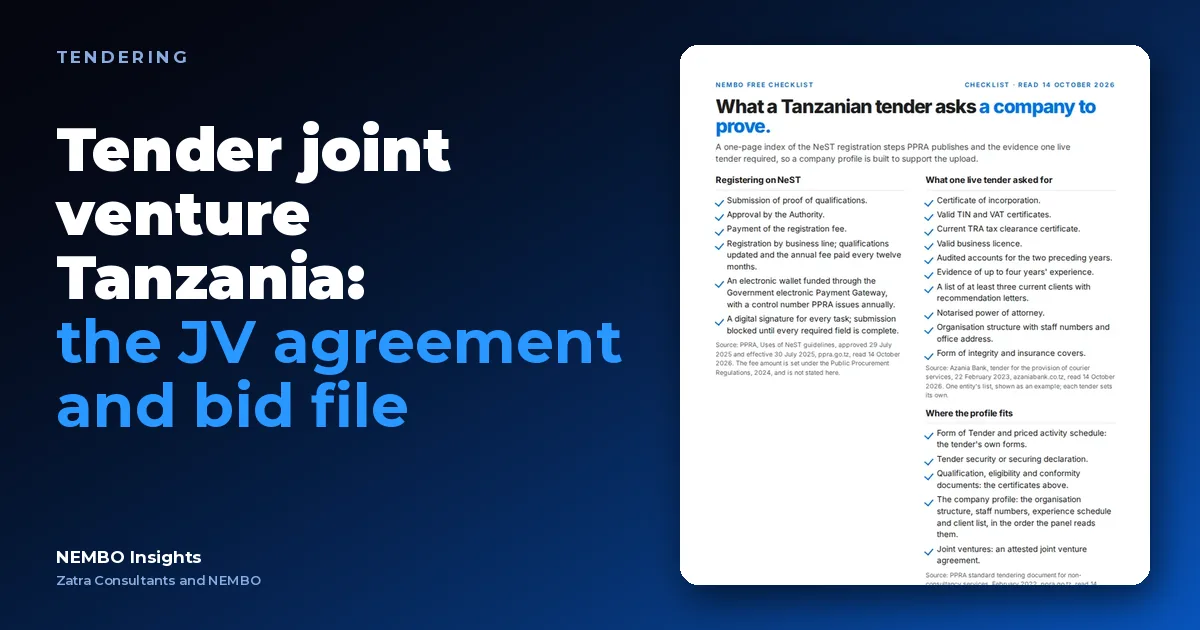
A tender joint venture Tanzania panel can accept has three papers behind it: the JV agreement, the power of attorney that names who signs, and a bid file that proves each partner on its own. Public Procurement Regulations 2024 (GN 518) set the conditions a tender document must state when it allows a joint venture, and the Public Procurement Act 2023 sets the rules for local firms and for foreign tenderers who must team up. This note sets out what each paper must contain, who signs it, how a panel reads it, and where the file usually fails. It builds on the notes on NeST registration, how bids are scored and the margin of preference.
What the law says
The Public Procurement Act, 2023 (Act No. 10 of 2023, assented 29 September 2023) defines a tenderer to include a group of natural or legal persons, so a joint venture can bid. Section 61 lets local individuals or firms form joint ventures to build capacity, and where such a joint venture includes a foreign firm the local firm must lead it. Section 62 requires a procuring entity, for works and non-consultancy services above a limit set in regulations, to make foreign tenderers enter a joint venture with or subcontract to local firms. Section 62(4) requires the foreign tenderer to attach the joint venture agreement or subcontract to its tender, with the key operating procedures that govern it. Section 63 requires the local firms referred to in sections 58 and 61 to have share capital wholly owned by citizens.
The Public Procurement Regulations, 2024 (GN 518 of 2024, in force 1 July 2024) carry the mechanics. Regulation 7(1)(c) lists a partnership, joint venture or association of companies as a permitted form of tenderer. Regulation 7(11) says a Tanzanian may bid alone or with a foreign company, and that a joint venture between local and foreign firms may not be compelled by the procuring entity. Regulation 7(12) lists what the tender document states when it allows a joint venture bid. Regulation 7(13) lists what the bid must contain. The desk read the Kiswahili text; the English words below are a translation, not the official text.
Two readings matter. Section 62(4) of the Act says the foreign tenderer attaches the agreement to the tender. Regulation 7(12)(c) lets the tender document require a copy of the agreement, or the proposed agreement, either as part of the tender or as a condition for the contract to start. Where the two differ, the tender document tells the bidder which it wants. Read it before drafting. Treat the question of which instrument governs as one for an advocate.
Who should read this
Local contractors and suppliers teaming up to reach a turnover or experience threshold. Foreign firms bidding for works or non-consultancy services who must joint venture with a Tanzanian firm. Bid managers who assemble the file on NeST. Company secretaries who draft the board resolutions and the power of attorney. Finance managers who must produce audited accounts for each partner. Zanzibar firms bidding on Union or Mainland tenders, because the Mainland Act and Regulations govern those files.
What must the tender document state about a joint venture?
Regulation 7(12) says that where a tender document allows a joint venture, association or combination of companies, it states, where required, six things. The table turns each into the paper the bid file needs.
| Regulation 7(12) | What the tender document states | Paper in the bid file |
|---|---|---|
| (a) | Whether the members are liable jointly or severally for performance | Liability clause in the JV agreement matching the tender document |
| (b) | Each member must be qualified; one unqualified member disqualifies the whole venture | Registration, tax and licence evidence for every member |
| (c) | Whether a copy of the agreement, or proposed agreement, is submitted with the tender or before the contract starts | Signed JV agreement, or a signed letter of intent with the draft agreement |
| (d) | The venture appoints a lead member with authority to bind it; at award the lead member confirms this with a representation document | Power of attorney naming the lead member and the signatory |
| (e) | The part of the contract each member performs; each member is assessed on its own contribution | Division of work schedule, with percentages |
| (f) | Roles cannot change without the procuring entity's prior written consent | Change control clause in the JV agreement |
The word in the regulation for the document at (d) is a representation document. Tanzanian practice uses a power of attorney for it. The regulation does not prescribe its form or who must sign it, so the tender document and the procuring entity's own forms settle that.
What must the joint venture bid itself contain?
Regulation 7(13) lists the contents of a joint venture bid. The desk reads them as a checklist for every partner, not only the lead.
| Regulation 7(13) | Requirement | Who provides it |
|---|---|---|
| (a) | Original constitutional or legal-status documents, place of registration or seal, and administrative location | Each member |
| (b) | Experience and past performance on similar contracts, including participation details | Each member, and the venture as a whole where it has history |
| (c) | Key equipment, qualifications and experience of key staff, places of performance, where applicable | The member performing that part |
| (d) | Subcontracting proposals where any element above 10 percent of the tender price is to be subcontracted | The lead member |
| (e) | Financial standing: profit and loss statements, audited accounts and auditor reports, two-year projections, authority to obtain bank information | Each member; the authority may come from the venture's authorised representative |
| (f) | Information on legal proceedings or disputes directly relevant to award or performance | Each member |
Item (e) is where most joint ventures lose time. Start the audited accounts, projections and bank authorities on the day the notice appears on NeST published tenders.
What goes into the joint venture agreement?
No regulation prescribes the clauses. The desk builds the agreement so a panel can tick each item of regulation 7(12) against a clause. The standard set:
- Parties, with the registration number, TIN and registered office of each member.
- Purpose, naming the tender number, the procuring entity and the contract.
- Lead member, with authority to bind the venture and receive notices.
- Liability, stated in the words the tender document uses: joint and several, or several.
- Division of work, by scope and by percentage of contract value.
- Participation shares and how profit, loss, retention and advance payment are shared.
- Bank account for receipts, signatories and the mandate rule.
- Securities: who procures the tender security or signs the securing declaration, and the performance security.
- Change control: no change of role or membership without the procuring entity's prior written consent.
- Default, exit and replacement of a member, subject to the same consent.
- Duration: until final completion and the end of the defects liability period.
- Governing law, dispute resolution and execution.
Zatra's note on joint ventures and shareholders agreements explains where a bid joint venture differs from an incorporated one. A bid joint venture is a contract, not a company. Nothing is registered at BRELA unless the parties choose to incorporate. The Act's section 56(4)(b) describes a local joint venture for preference purposes. Its members are incorporated in Tanzania and majority owned by Tanzanians, the venture is registered in Tanzania, and no arrangement sends a major part of net profits to non-citizens. Read that against the agreement before claiming a preference.
Who signs the bid and the power of attorney?
The lead member's authorised signatory signs the bid. The authority chain has three links. First, a board resolution of each member approving the joint venture and the tender, following the pattern in the note on board resolutions. Second, the joint venture agreement appointing the lead member. Third, a power of attorney from the venture to the named signatory. Regulation 7(12)(d) places the representation document at award, but most tender documents ask for the power of attorney with the bid. Supply it with the bid in every case.
A power of attorney and an agreement attract stamp duty under the Stamp Duty Act, Cap. 189. The Zatra fee register records the duty on an agreement and on a power of attorney at TZS 2,000 each (register line F0267, Schedule items 5 and 46, stated at 26 September 2026). Stamping is a tax matter and is also an evidence matter: an unstamped instrument is a problem when a dispute reaches a tribunal. Have the documents stamped before submission. Where a member is a foreign company, its board resolution and power of attorney are usually notarised in its home country and, where the tender document asks, legalised. An advocate confirms the execution formalities for the receiving entity.
On NeST, regulation 11(5) says system users sign with a digital signature under the Authority's procedure, under the Electronic Transactions Act. The person holding the NeST credentials for the lead member must be the person the power of attorney names, or a person the power of attorney lets them delegate to.
How does a panel evaluate a joint venture?
Regulation 7(12)(e) says each member is assessed on its own contribution. A panel therefore reads the division of work first, then checks that the member assigned to each part holds the registration, experience and equipment for that part. Combined figures are read only where the tender document says they may be combined. Many tender documents let partners add turnover and experience for aggregate criteria, but require the lead member alone to meet a minimum share, often stated as a percentage. Read the qualification table in the tender document line by line and map each line to a member.
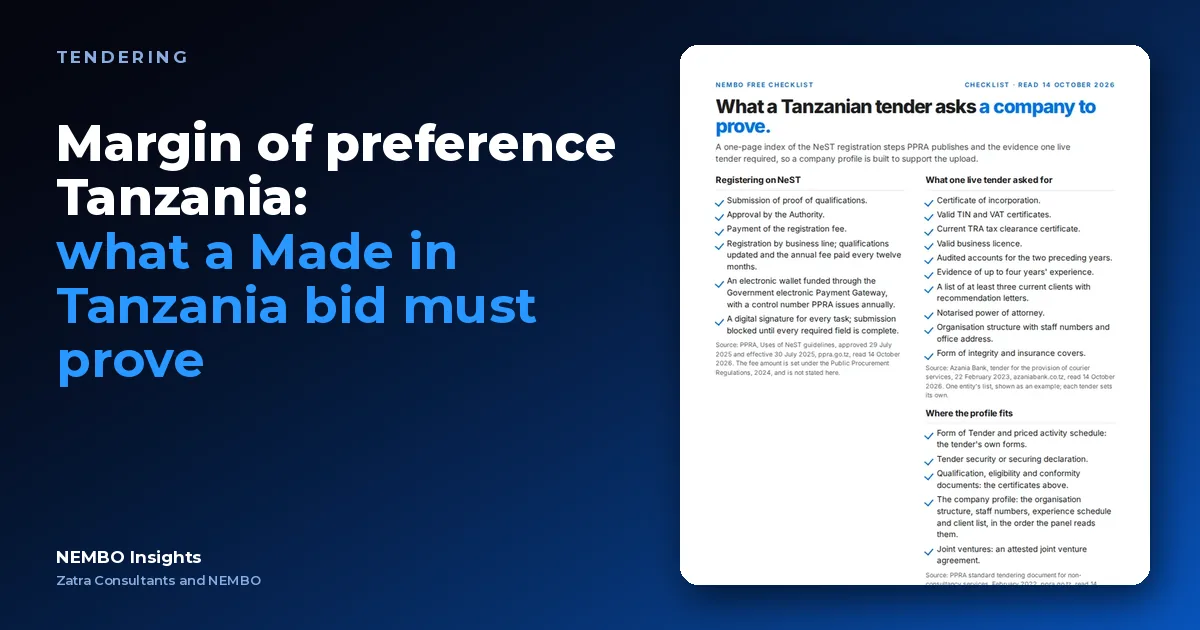
The disqualification rule in regulation 7(12)(b) is absolute. One partner with a lapsed business licence, an unfiled annual return at BRELA or a missing TRA tax clearance disqualifies the venture. The note on NeST registration and the tender file lists the evidence a panel checks. Run that list for every member. The desk has seen a strong bid fail because the minority partner's business licence had expired three weeks before the deadline.
What about the tender security or securing declaration?
Section 67(1) of the Act says that where a tender security or a tender securing declaration is required, the requirement applies equally to all tenderers. Regulation 27(3) says the securing declaration follows Form No. 1 in the Third Schedule and is signed by the relevant tenderers. It does not say which member of a joint venture signs. The safe reading is that the declaration is in the name of the venture and is signed by the lead member under the power of attorney, with each member named. A bank tender security should name all members as the tenderer, in the form the tender document provides, under regulation 23(4). Regulation 24 requires the validity to run at least 28 days beyond the tender validity period. The note on tender security or securing declaration explains the choice. Regulation 27(4) warns that a tenderer who breaks the declaration is debarred under section 72 of the Act. In a joint venture that debarment can reach every member, so the agreement should allocate that risk.
Local firm, foreign firm and the preference rules
Section 61(3) says that where a capacity-building joint venture includes a foreign firm, the local firm leads. Section 62(1) and (2) require foreign tenderers above a prescribed limit to joint venture or subcontract for a prescribed percentage of contract value. The limit and the percentage sit in regulations the desk did not reach in the text read, so take both from the tender document or from the PPRA. Section 63 requires the local firms referred to in sections 58 and 61 to be wholly citizen owned, while section 3 defines a local firm by majority citizen ownership. The two provisions sit side by side in the text and the desk does not reconcile them. State the actual shareholding of each member in the bid and let the procuring entity apply the rule.
Regulation 8 adds three rules. A local tenderer must meet all registration requirements of the statutory bodies. A foreign tenderer is exempt at bid stage. A foreign tenderer selected as lowest evaluated bidder must register, or show that it qualifies for registration, before the contract is signed. Section 53(3) of the Act says the same. A foreign partner should therefore budget for Contractors Registration Board, Engineers Registration Board or other professional registration between notice of award and signing, with the fees taken from the authority's own schedule.
Worked example: a TZS 3.2 billion water works tender
Worked example, illustrative figures. A procuring entity tenders a rural water supply works contract estimated at TZS 3,200,000,000. The tender document asks for average annual turnover of TZS 2,400,000,000 over three years, one similar contract of at least TZS 1,500,000,000 in five years, and liquid assets or a credit line of TZS 500,000,000. It allows joint ventures, requires the lead member to meet 40 percent of the turnover criterion, and asks for the joint venture agreement and the power of attorney with the bid.
Mwanza Civil Works Limited has average turnover of TZS 1,100,000,000 and one similar contract of TZS 900,000,000. Pwani Pipelines Limited has average turnover of TZS 1,500,000,000 and a similar contract of TZS 1,700,000,000. Alone, neither qualifies. Together, combined turnover is TZS 2,600,000,000, above the TZS 2,400,000,000 threshold. Pwani holds the qualifying similar contract. Pwani must lead, because 40 percent of TZS 2,400,000,000 is TZS 960,000,000 and Mwanza's TZS 1,100,000,000 would also pass that test, but only Pwani carries the similar-contract criterion in its own name. The division of work gives Pwani the pipeline and treatment works at 60 percent of value, TZS 1,920,000,000, and Mwanza the civil works and tanks at 40 percent, TZS 1,280,000,000.
The bid file carries two sets of audited accounts, two bank authorities, one joint venture agreement signed by both boards, one power of attorney to Pwani's managing director, two board resolutions, and a tender securing declaration in the venture's name. Government charges are small: stamp duty of TZS 2,000 on the agreement and TZS 2,000 on the power of attorney (register line F0267). The NeST fee and any tender document fee are taken from the notice. NEMBO's design fee and Zatra's checking fee are quoted separately on the pricing page and in writing. Every figure here is illustrative and must be replaced by the tender document's own criteria.
Mainland and Zanzibar
The Public Procurement Act 2023 and GN 518 of 2024 govern Mainland procuring entities and Union institutions. Zanzibar runs its own procurement law through the Zanzibar Public Procurement and Disposal of Public Assets Authority. A joint venture bidding on a Zanzibar Government tender follows the Zanzibar tender document and Zanzibar registration rules, which this note does not cover. A Zanzibar company bidding on a Mainland tender is a Tanzanian company for the Act, but it must still hold the Mainland registrations the tender document names, for example a Contractors Registration Board class. Have an advocate confirm the position for a cross-Union venture before the agreement is signed.
Where joint venture bids fail
| Failure | Why the panel rejects it | Fix |
|---|---|---|
| Letter of intent only, where the tender document asked for a signed agreement | Regulation 7(12)(c) as applied by the tender document | Sign the agreement before submission |
| Power of attorney signed by the lead member alone | It does not bind the other member | All members sign, after board resolutions |
| Division of work missing or without percentages | Regulation 7(12)(e) cannot be applied | Schedule by scope and value |
| One member's licence or tax clearance expired | Regulation 7(12)(b) disqualifies the venture | Run the NeST evidence list for every member |
| Combined turnover claimed where the document bars aggregation | Criterion not met by any member | Read the qualification table before pairing |
| Securing declaration in one member's name | Does not cover the tenderer named in the bid | Issue it in the venture's name, signed under the power of attorney |
| Unstamped agreement or power of attorney | Evidence problem in a dispute; tax exposure | Stamp before submission |
What to do now
- Read the tender document for the joint venture clause, the aggregation rule, the lead member share and whether the agreement is due with the bid or before contract start.
- Choose the lead as the member who carries the criteria the document does not allow to be combined, usually the similar contract.
- Run the eligibility list for every member: BRELA extract, business licence, tax clearance, registration board certificate, NeST registration, annual returns.
- Pass board resolutions in each member approving the venture, the tender and the signatory.
- Sign the joint venture agreement with liability, division of work, change control and securities clauses matching the tender document.
- Execute the power of attorney from all members to the named signatory, then stamp both instruments.
- Assemble financial standing for each member: audited accounts, projections and bank authorities under regulation 7(13)(e).
- Issue the tender security or securing declaration in the venture's name with validity at least 28 days beyond the tender validity.
- Upload on NeST through the lead member's account, using the credentials of the person the power of attorney names.
- Diarise the post-award steps: representation document under regulation 7(12)(d), foreign partner registration under regulation 8(4), performance security.
Key dates and timings
| Date or period | What it governs | Source |
|---|---|---|
| 29 September 2023 | Presidential assent to the Public Procurement Act, 2023 | Act No. 10 of 2023 |
| 1 July 2024 | Public Procurement Regulations, 2024 come into force | GN 518 of 2024, regulation 1 |
| Tender validity plus 28 days | Minimum validity of the tender security or securing declaration | GN 518, regulation 24 |
| At award | Lead member confirms its appointment with the representation document | GN 518, regulation 7(12)(d) |
| Before contract signing | Foreign tenderer registers or proves it qualifies for registration | GN 518, regulation 8(4); Act s.53(3) |
| 26 September 2026 | Date of the Zatra fee register figures used here | Zatra Handbook 06 |
What the NEMBO desk prepares
NEMBO designs and delivers the joint venture bid file: the agreement laid out so each regulation 7(12) item has its clause, the power of attorney, the board resolutions, the division of work schedule, the joint capability statement and the tender evidence index, all in the venture's brand. Zatra Consultants prepares and checks the content: the eligibility list for each member, the mapping of qualification criteria to members, the stamping, and the legal positions, with an advocate for execution formalities and any dispute. Fees sit in two buckets. Government charges, such as stamp duty, NeST fees and registration board fees, are paid to the authority at the official rate and shown separately. NEMBO's and Zatra's fees are quoted in writing from the packages and pricing pages. NEMBO does not decide or guarantee any authority's outcome, and no tender panel's or bank's decision either. See the tender and investor documents desk and the process page, or share the tender details.
How Zatra helps
Zatra's tender and procurement advisory desk runs the readiness diagnostic for each member, builds the evidence pack and checks the bid against the tender document's compliance list. Its note on registering as a government supplier covers the NeST and registration steps a foreign partner must complete before signing. Where a joint venture is to be incorporated rather than contractual, Zatra's company changes desk handles the BRELA filings. Zatra prepares, structures and coordinates; it does not practise law, and execution and disputes go to an advocate.
Investor documents and tender files
Zatra Consultants prepares and checks the content on the details the Client shares. NEMBO designs and delivers it. Fees are published on the packages page and quoted in writing.
Open the desk pageSources and status
Accurate as at 14 November 2026. The Regulations were read in Kiswahili and the English wording in this note is the desk's translation. The text reached the desk only to regulation 29(3), so the schedules, the section 62 limit and percentage, and regulation 231 were not read. The PPRA standard tendering documents could not be opened, so clause numbers in those documents are not cited.
- 1The Public Procurement Act, 2023 (Act No. 10 of 2023), English translationPublic Procurement Regulatory Authority, assented 29 September 2023, translation published as GN 813 of 20 September 2024, read 14 November 2026. Accessed 14 November 2026.
- 2Kanuni za Ununuzi wa Umma za Mwaka 2024 (Public Procurement Regulations, 2024), GN 518Public Procurement Regulatory Authority, Government Notice No. 518 dated 28 June 2024, in force 1 July 2024, read to regulation 29(3) on 14 November 2026. Accessed 14 November 2026.
- 3Public Procurement Regulatory AuthorityPublic Procurement Regulatory Authority, home page listing the Act and Regulations, read 14 November 2026. Accessed 14 November 2026.
- 4NeST published tendersPublic Procurement Regulatory Authority, National e-Procurement System, live list read 14 November 2026. Accessed 14 November 2026.
- 5The Stamp Duty Act, Cap. 189, Revised Edition 2019Tax Revenue Appeals Board copy, Revised Edition 2019, Schedule items 5 and 46, figures as in the Zatra fee register of 26 September 2026. Accessed 14 November 2026.
- 6Contractors Registration BoardContractors Registration Board, registration authority for contractors, read 14 November 2026. Accessed 14 November 2026.
- 7Business Registrations and Licensing AgencyBusiness Registrations and Licensing Agency, company register and annual returns, read 14 November 2026. Accessed 14 November 2026.
- 8Tanzania Revenue AuthorityTanzania Revenue Authority, tax clearance certificates through the Taxpayer Portal, read 14 November 2026. Accessed 14 November 2026.
- 9Zanzibar Public Procurement and Disposal of Public Assets AuthorityZanzibar Public Procurement and Disposal of Public Assets Authority, Zanzibar procurement regulator, read 14 November 2026. Accessed 14 November 2026.
- 10Joint venture and shareholders agreement in TanzaniaZatra Consultants Limited, published 14 September 2026, last reviewed 26 October 2026, independent of the PPRA. Accessed 14 November 2026.
- 11Registering as a government supplier with PPRAZatra Consultants Limited, note read 14 November 2026. Accessed 14 November 2026.
- 12Tender and procurement advisory in TanzaniaZatra Consultants Limited, service page published 13 August 2026. Accessed 14 November 2026.
- 13Company changes in TanzaniaZatra Consultants Limited, service page published 13 August 2026. Accessed 14 November 2026.
Figures to confirm before you act
- Whether the tender document wants the signed joint venture agreement with the bid or before contract start, since the Act's section 62(4) and regulation 7(12)(c) read differently.
- The section 62 limit and percentage for foreign tenderers, which sit in regulations the desk did not read.
- The aggregation rule and lead member share in the specific tender document, which govern over any general reading here.
- The stamp duty on the agreement and power of attorney on the day of stamping, against the Stamp Duty Act Schedule and the TRA control number.
- Which member signs the tender securing declaration under the procuring entity's own form.
- Registration board fees for a foreign partner, from the board's own schedule.
- Every figure in the worked example, which is illustrative.
- That the Zanzibar procurement authority's site and the Engineers Registration Board's site are live on the day you need them; both were unreadable by the desk on 14 November 2026.
This article is general information based on official sources available at the date of publication. It is not legal, tax or financial advice. Laws and notices change. Verify with the issuing authority or consult Zatra before acting.
Frequently asked questions
Does a joint venture have to be registered at BRELA to bid?
No. A bid joint venture is a contract between the members, not a company, and regulation 7(1)(c) lets a joint venture or association of companies tender as it is. Registration arises only if the members choose to incorporate, or where section 56(4)(b) treatment as a local joint venture for preference depends on it. Ask an advocate before incorporating for one tender.
Can two Tanzanian companies add their turnover together to qualify?
Only where the tender document says the criterion may be met jointly. Many documents allow aggregation of turnover and experience but require the lead member to meet a stated share alone. Regulation 7(12)(e) says each member is assessed on its own contribution, so map every criterion to a member before pairing.
Is a letter of intent enough instead of a signed agreement?
Sometimes. Regulation 7(12)(c) lets the tender document require the agreement with the bid or as a condition for the contract to start. Section 62(4) of the Act requires a foreign tenderer to attach the agreement to the tender. Where the document is silent, sign before submission. A letter of intent is never enough once the document asks for the agreement.
Who signs the power of attorney for a joint venture?
Every member, through a person authorised by its own board resolution. A power of attorney signed by the lead member alone binds nobody else. The instrument names the signatory who will sign the bid and the contract and attracts stamp duty under the Stamp Duty Act, recorded at TZS 2,000 in the Zatra fee register.
What happens if one partner's licence expires during evaluation?
Regulation 7(12)(b) makes the whole venture unqualified when one member is found unqualified. Panels check validity at the deadline and sometimes again at award. Diarise every member's business licence, tax clearance, registration board certificate and annual return dates against the tender validity period, and renew early.
Must a foreign partner register with a Tanzanian board before bidding?
No. Regulation 8(2) exempts a foreign tenderer at bid stage. Regulation 8(4) and section 53(3) of the Act require the foreign tenderer that is selected to register, or show it qualifies for registration, before the contract is signed. Budget time and the board's fees for that step between award and signing.
Can the partners change their roles after award?
Not without the procuring entity's prior written consent, under regulation 7(12)(f). The joint venture agreement should carry the same rule, with a procedure for replacing a member who defaults, so the venture is not left in breach of both the agreement and the contract.
Does this apply to a Zanzibar Government tender?
No. The Public Procurement Act 2023 and GN 518 of 2024 apply to Mainland and Union procuring entities. Zanzibar tenders run under Zanzibar law and the Zanzibar Public Procurement and Disposal of Public Assets Authority. Read the Zanzibar tender document and have an advocate confirm the registration rules for each member.