On this page
- What the law says
- Who should read this
- What goes on each page of a capability statement?
- Which registration does each trade have to evidence?
- What does an engineering consultancy's registration cost and require?
- How does a panel or a bank judge the statement?
- Worked example: a Class Four civil contractor's statement
- How does a foreign or joint venture firm present capability?
- Does the same statement work in Mainland Tanzania and Zanzibar?
- What to do now
- Key dates
- What the NEMBO desk prepares
- How Zatra helps
- Sources and status
- Frequently asked questions
What must a capability statement in Tanzania prove before a client or a tender panel reads the rest of the bid?
Four things, each with a document behind it: that the firm exists and is registered where its trade requires, that named people hold the licences the work needs, that it has done comparable work with evidence, and that it has the equipment, premises and finance to deliver. Two to four pages, every claim indexed.
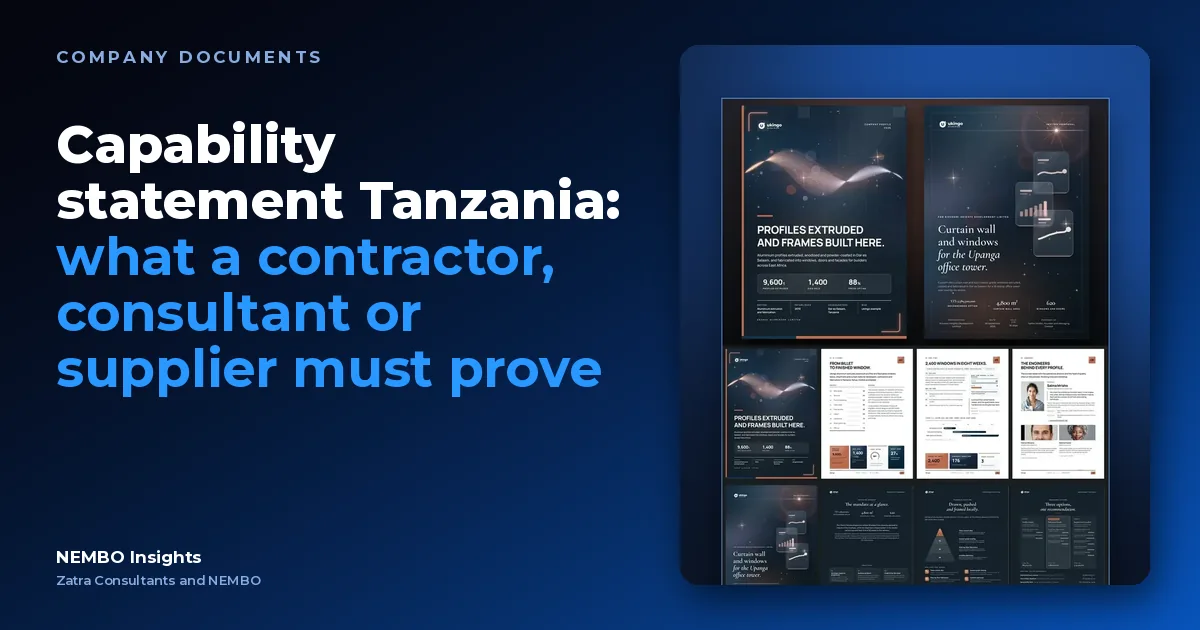
A capability statement Tanzania clients ask for is not a company profile. The profile tells the story; the statement proves capacity for one kind of work, in two to four pages, with a document behind every line. Panels, procurement officers and bank relationship managers read it first and keep it on file. This note sets out what it must contain for a contractor, an engineering consultant, an architecture or quantity surveying practice and a goods supplier, which registrations it must evidence, and how a reader judges it. The company profile note covers the longer document the statement sits beside.
What the law says
No Tanzanian law prescribes a capability statement. What the law prescribes is the registration behind each claim in it. A building, civil, electrical or mechanical contractor must be registered with the Contractors Registration Board under the Contractors Registration Act of 1997, as amended by Act No. 15 of 2008, and its bylaws, listed on the CRB legislation page. An engineering consulting firm must be registered with the Engineers Registration Board under the Engineers Registration Act, Cap. 63, which the ERB registration overview describes as the only legal authorisation to practise engineering. An architecture or quantity surveying practice must be registered under section 18(2) of the Architects and Quantity Surveyors Registration Board's Act, as the AQRB firm registration page states. In public tenders, regulation 7(5) of the Public Procurement Regulations, 2024 asks for evidence of professional and technical eligibility, and regulation 7(6)(h) for proof of tax and social security compliance, in the desk's reading of the Regulations.
A capability statement that claims a class, a discipline or a licence the firm does not hold is a false statement to a public body or a bank. That is why the document is short, dated and signed by a director.
Who should read this
Directors of contractors, consultancies and supply firms who bid for public and private work. Tender desks that prepare pre-qualification files. Foreign firms deciding whether to register in Tanzania or to form a joint venture. Bank officers who want a one-page view of a borrower's trade. Firms in Zanzibar should read the Mainland and Zanzibar section, because the registration boards named here are Mainland bodies.
What goes on each page of a capability statement?
| Page | Content | Evidence indexed |
|---|---|---|
| 1. Identity and registration | Legal name, registration number, date of incorporation, registered office, directors, shareholding by citizenship, the trade registrations held with class and expiry, TIN and VAT status | Certificate of incorporation, BRELA extract, CRB, ERB or AQRB certificate, business licence, tax clearance, NSSF compliance |
| 2. People | Named key staff with the registration number of each professional, years of experience and current role; organisation chart | Professional registration certificates, CVs of one page, contracts of employment |
| 3. Track record | Five to ten comparable contracts: client, scope, value in TZS or USD, dates, role (lead, joint venture partner, subcontractor), completion status | Completion certificates, contract first pages, client reference letters, photographs |
| 4. Capacity | Equipment owned or leased with serial numbers, premises, quality system, insurance, bank facility and turnover for three years | Asset register, lease, ISO certificate if held, insurance schedule, bank letter, audited statements |
The statement closes with a signature block: the director's name, position, date and the firm's stamp. A document without a date goes stale the day it is printed. The letterhead note sets out the identifiers that must appear on page one, and the signature standard note keeps the people page consistent with what the panel sees in email.
Which registration does each trade have to evidence?
| Trade | Board | What the statement shows | Source |
|---|---|---|---|
| Building, civil, mechanical, electrical or specialist contractor | Contractors Registration Board | Contractor type, class (one to seven for general contractors, one to three for specialist), category (local or foreign), registration type (permanent, temporary foreign, temporary joint venture), expiry | CRB registration of contractors |
| Engineering consulting firm | Engineers Registration Board | Firm registration, the disciplines declared from the eleven prescribed, the principal engineer's ERB number, the practising certificate | ERB entity registration |
| Architecture or quantity surveying practice | Architects and Quantity Surveyors Registration Board | Firm registration and the registered partners, at least two living partners registered with the Board | AQRB firm registration page |
| Goods supplier or general services | No professional board; BRELA, TRA, council and PPRA | Business licence class, VAT registration, NeST registration, manufacturer or distributor authorisation, TBS marks where the goods are regulated | Zatra supplier registration note |
CRB's page sets three basic requirements for a contractor. The first is registration with BRELA as a limited company, partnership or sole proprietor. The second is a technical director, meaning at least one shareholder or partner with the minimum technical qualification for the field. The third is office and service facilities, with proof of ownership or lease of offices, workshops and yards for permanent registration. A firm is local if a majority of its authorised shares are owned by Tanzanian citizens; otherwise it is foreign, and foreign contractors register in Class One only. The class limit is the maximum value of a single contract the class may take, including materials, labour and taxes, and CRB revises the limits from time to time. The current values are published on CRB's page as an image; read them there before stating a class limit in the statement. The Zatra note on CRB classes covers the registration route.
What does an engineering consultancy's registration cost and require?
ERB's entity page lists the requirements for a local engineering consulting firm.
- A registered business entity in Tanzania.
- At least one partner or director who is a registered consulting engineer or independent consulting engineer.
- The principal engineer's ERB number.
- Proof of office space by tenancy agreement or title deed.
- A list of professional staff with ERB numbers, and evidence of equipment and resources.
- A declaration of disciplines from the eleven prescribed, and form AECF-10.
A foreign firm needs an active consultancy contract with a Tanzanian client, proof of registration at home, professional indemnity insurance, the list of staff assigned and the project details. Applications run through the ERB registration portal in English, and the overview page gives processing times of 14 to 120 days for local applicants and 2 to 14 days for foreign applicants.
| Fee line (ERB schedule, GN 746 of 2018; fee register F0540) | Local consulting firm | Foreign consulting firm |
|---|---|---|
| Application | TZS 225,000 | USD 2,000 |
| Registration | TZS 450,000 | USD 12,000 |
| Practising certificate | TZS 150,000 | USD 75 |
| Rubber stamp | TZS 200,000 | USD 150 |
| Engineers Development Fund (50 percent of annual) | TZS 350,000 | Not listed |
| Annual subscription | TZS 700,000 | USD 7,000 |
| First-time total stated by ERB, excluding application | TZS 1,850,000 | Not totalled on the page |
These are the figures ERB's registration pages print on 7 November 2026, under the fee schedule made under section 34 of Cap. 63, and the application, registration and annual lines match fee register line F0540 at 26 September 2026. They are paid to the Board against its control number, in the currency the schedule states, and are separate from any professional fee. A foreign firm registering for a project under one year pays USD 2,000, 7,500 and 6,000 on the same line. Read the ERB page on the day of payment.
The other two boards publish their fees in by-laws rather than on the pages the desk read. The Zatra fee register carries them at 26 September 2026, confirmed on the source of record.
| Board and line | Local | Foreign | Basis |
|---|---|---|---|
| CRB application form: first registration; upgrading; temporary (F0528) | TZS 20,000; 30,000; 40,000 | Same | CRB Registration Criteria Book, Table 11; By-laws GN 340 of 1999 as amended by GN 477 of 2017 |
| CRB processing fee, non-refundable (F0529) | TZS 50,000 | Same | Same |
| CRB registration, building, Class I to VII (F0530) | TZS 250,000; 200,000; 150,000; 90,000; 60,000; 50,000; 40,000 | Class I only, USD 20,000 | Criteria Book, Tables 12 and 14 |
| CRB registration, civil works, Class I to VII (F0531) | TZS 300,000; 250,000; 200,000; 150,000; 90,000; 60,000; 50,000 | Class I only, USD 20,000 | Same |
| CRB annual subscription, civil works, Class I to VII (F0534) | TZS 2,500,000; 1,500,000; 1,200,000; 750,000; 400,000; 150,000; 100,000 | Class I, USD 10,000 | Criteria Book, Tables 13 and 14 |
| CRB annual subscription, building, Class I to VII (F0535) | TZS 2,000,000; 1,200,000; 1,000,000; 500,000; 300,000; 150,000; 100,000 | USD 10,000 | Same |
| AQRB firm: application; registration; annual; certificate; practising licence; stamp (F0542) | TZS 30,000; 600,000; 500,000 a year; 50,000; 50,000; 100,000 | TZS 500,000; 25,000,000; 12,500,000 a year; 150,000; 150,000; 150,000 | Architects and Quantity Surveyors By-laws 2024, GN 879 of 2024, para 35 and Third Schedule |
Electrical, mechanical and specialist contractor scales sit on register lines F0532, F0533 and F0536 to F0538. A Class Four civil contractor therefore budgets TZS 150,000 to register and TZS 750,000 a year to stay registered, before the professional fee. A dispensation to work above class carries its own fee under the 2017 amendment by-laws, which the register records as not seen (F0539).
How does a panel or a bank judge the statement?
A reader spends two minutes on the statement and decides whether to open the rest of the file. The judgement runs in a fixed order.
- Does the registration match the work? A Class Five building contractor bidding for a contract above its class limit fails at line one, unless CRB has granted a dispensation, which the page says is limited to one class above the current class and granted on a client's application.
- Are the named people real and registered? Panels check ERB and CRB numbers online. A borrowed engineer on a CV is the commonest failure.
- Is the track record comparable and evidenced? Three completed contracts of similar size and type with completion certificates beat ten unsupported names.
- Can the firm carry the cash? Turnover for three years, a bank facility letter and the equipment list answer the question before it is asked. The evaluation criteria note shows how these lines are scored in a public tender.
- Is it current? The date, the expiry dates of the certificates and the tax clearance must all fall on the right side of the submission date.
Worked example: a Class Four civil contractor's statement
Ruvuma Roads and Drainage Limited is a fictional civil contractor in Songea. The figures are illustrative; the class limit is deliberately not stated because CRB publishes the current limits as an image and revises them.
| Statement line | Entry | Evidence indexed |
|---|---|---|
| Registration | CRB civil works contractor, Class Four, local category, permanent, expiry 30 June 2027; annual subscription TZS 750,000 (F0534) | Certificate and receipt, annex A |
| Ownership | Three shareholders, all Tanzanian citizens, 100 percent | BRELA extract, annex B |
| Technical director | Registered professional engineer, ERB number quoted, 14 years | ERB certificate, annex C |
| Track record | Four completed contracts, TZS 1,100,000,000 to TZS 2,800,000,000, culverts and gravel roads, 2022 to 2026 | Completion certificates, annex D |
| Equipment | Two graders, one excavator, three tippers, one water bowser, owned; one roller leased | Asset register and lease, annex E |
| Turnover | TZS 2,400,000,000; TZS 3,100,000,000; TZS 3,900,000,000 for 2023 to 2025 | Audited statements, annex F |
| Bank facility | Overdraft of TZS 400,000,000 and bid bond line | Bank letter, annex G |
| Compliance | Tax clearance to 31 December 2026; NSSF compliance; business licence | Annex H |
| Length | Three pages plus eight annexes |
The reader can test every line in the time it takes to open the annexes. The turnover trend supports a bid of about one year's turnover, and the bank letter answers the working capital question. Where the firm wants to bid above its class, the statement says so and names the dispensation application, rather than leaving the panel to find the gap. The NeST registration note covers how the same documents are uploaded once for public tenders.
How does a foreign or joint venture firm present capability?
A foreign contractor registers with CRB in Class One only, and for a specific awarded project under temporary foreign registration, or jointly with a registered local partner under temporary joint venture registration, where each partner is first registered individually. The statement for a joint venture therefore carries two identity pages, one for each partner, and a third page for the venture: the agreement, the share of work and resources, and the lead partner. The local preference note explains why the local partner's share of paid-up capital matters in a public tender. A foreign engineering consultancy registers with ERB against an active Tanzanian contract and shows its home registration and indemnity insurance on page one.
Does the same statement work in Mainland Tanzania and Zanzibar?
| Point | Mainland | Zanzibar |
|---|---|---|
| Contractor registration | CRB, Dodoma | Zanzibar has its own contractors' registration regime; confirm with the Zanzibar board before claiming a class there |
| Engineers and architects | ERB and AQRB | Confirm whether Mainland registration is recognised for a given project |
| Company registration | BRELA | Zanzibar Business and Property Registration Agency |
| Tax clearance | TRA | Zanzibar Revenue Authority for Zanzibar taxes; TRA for Union taxes |
| Public tenders | Public Procurement Act, 2023 | Zanzibar procurement law and authority |
The desk has not verified the Zanzibar registration rules for contractors and consultants this week. A firm bidding in Zanzibar should ask the Zanzibar board in writing and keep the answer in the file.
What to do now
- List the claims. Write every statement of capacity the firm wants to make, then strike any without a document.
- Check the registrations. Confirm class, discipline, category and expiry on the board's own certificate, and read the current class limits on CRB's page.
- Name the people. Put registration numbers beside each professional and hold a signed CV for each.
- Evidence the track record. Obtain completion certificates or client letters for every contract listed.
- Prove capacity. Asset register, lease, insurance schedule, bank letter and three years of audited statements.
- Index and sign. Number the annexes, date the statement, sign it as a director and stamp it.
- Refresh before every submission. Tax clearance, social security compliance and certificates must be current on the day.
- Route disputes and legal opinions to an advocate. A contested registration, a debarment or a joint venture agreement belongs with an advocate; audited statements and tax clearance belong with an accountant.
Key dates
| Date | Event | Source |
|---|---|---|
| 1997 | Contractors Registration Act and Engineers Registration Act enacted | CRB legislation page; ERB overview |
| 2008 | Contractors Registration (Amendment) Act No. 15 of 2008 | CRB legislation page |
| 7 December 2018 | ERB fee schedule, GN 746 of 2018 | ERB registration overview |
| 2022 | Contractors Registration (Amendments) Bylaws, GN 744 of 2022 | CRB legislation page |
| 22 September 2023 | PPRA guide for registration of bidders of common use items and services on NeST | PPRA publication page |
| 1 July 2024 | Public Procurement Regulations, 2024 in effect | Regulations, reg. 1 |
| Annual | CRB review against annual return forms; CRB, ERB and AQRB annual subscriptions | CRB and ERB pages |
What the NEMBO desk prepares
The client shares the facts: the certificates, the staff list, the contract records, the asset register and the financial statements. Zatra Consultants prepares and checks the content, including the registration claims and the evidence index. NEMBO designs and delivers the document. The desk prepares the capability statement and tender file, the letterhead it is printed on and the one-page signature standard for the people named in it. The free tender evidence index is the annex list to start from.
Two cost buckets apply. Government and board fees at the official rate are paid to the authority against its control number and are separate from NEMBO's and Zatra's fees. NEMBO and Zatra fees are published on /packages/ and /pricing/ and quoted in writing. See how a job runs, or share the details.
How Zatra helps
Zatra checks the facts, filings and figures in the statement: the class and category, the registration numbers, the contract values and the turnover figures against the audited statements. The tender and procurement advisory service covers readiness and the bid structure, and the corporate secretarial service keeps the registers the identity page relies on. The desk does not decide or guarantee any authority's outcome, whether that authority is a registration board, a tender panel or a bank. Disputes and legal opinions go to an advocate. Financial statements go to an accountant.
Investor documents and tender files
Zatra Consultants prepares and checks the content on the details the Client shares. NEMBO designs and delivers it. Fees are published on the packages page and quoted in writing.
Open the desk pageSources and status
Accurate as at 7 November 2026. The CRB, ERB, AQRB and PPRA pages were read on that date. CRB's class limits are published as images and were not read. ERB fees are as printed on its pages on that date.
- 1Registration of contractorsContractors Registration Board, page read 7 November 2026. Accessed 7 November 2026.
- 2LegislationContractors Registration Board, page read 7 November 2026. Accessed 7 November 2026.
- 3Registration overviewEngineers Registration Board, fee schedule GN 746 of 7 December 2018. Accessed 7 November 2026.
- 4Registration of entitiesEngineers Registration Board, page read 7 November 2026. Accessed 7 November 2026.
- 5Usajili wa kampuni (firm registration)Architects and Quantity Surveyors Registration Board, page read 7 November 2026. Accessed 7 November 2026.
- 6The Public Procurement Regulations, 2024, English version, GN 261 of 2025Ministry of Finance, published 25 April 2025. Accessed 7 November 2026.
- 7Guide for registration of bidders of common use items and services on NeSTPublic Procurement Regulatory Authority, 22 September 2023. Accessed 7 November 2026.
- 8Registering as a government supplier: PPRA, NeST and the tender routeZatra Consultants Limited, 2026. Accessed 7 November 2026.
- 9CRB contractor classes in Tanzania: not a building permitZatra Consultants Limited, 2026. Accessed 7 November 2026.
Figures to confirm before you act
- CRB class limits by class and contractor type, published as an image on CRB's page and revised from time to time.
- The CRB dispensation fee (register F0539), which the by-laws prescribe and the register records as not seen.
- Board fees move by Government Notice; the register lines quoted are at 26 September 2026, and the board's control number governs on the day of payment.
- The Cap number of the Contractors Registration Act, which CRB's page does not print.
- NeST supplier registration documents and any fee, which the NeST site did not display when read.
- Zanzibar registration rules for contractors, engineers and architects.
This article is general information based on official sources available at the date of publication. It is not legal, tax or financial advice. Laws and notices change. Verify with the issuing authority or consult Zatra before acting.
Frequently asked questions
How is a capability statement different from a company profile?
A profile tells the firm's story across many pages for many readers. A capability statement proves capacity for one kind of work in two to four pages, with an annex behind every claim. Panels keep the statement; they skim the profile.
How long should it be?
Two to four pages plus indexed annexes. A reader decides in two minutes whether to open the rest of a file, so the statement must show registration, people, track record and capacity on its first spread and point to the proof.
Can a contractor bid above its CRB class?
Only with a dispensation, which CRB's page says is granted in exceptional cases on a client's application and is limited to one class above the contractor's current class. The statement should say so and name the application rather than hide the gap.
What makes a contractor local or foreign at CRB?
CRB's page classes a firm as local if a majority of its authorised shares are owned by Tanzanian citizens, and foreign otherwise. Foreign contractors are registered in Class One only, on a permanent, temporary foreign or temporary joint venture basis.
Do suppliers of goods need a board registration?
No professional board covers general supply. The statement shows BRELA registration, the business licence, VAT and NeST registration, manufacturer or distributor authorisations and, for regulated goods, TBS marks. Public tenders also require tax and social security compliance.
Should the statement show turnover and bank facilities?
Yes. Three years of turnover from audited statements and a bank facility letter answer the working capital question before a panel or lender asks it. Leave them out and the reader assumes the worst.
How often should it be updated?
Before every submission. Certificates expire, tax clearance is dated, staff move and contracts complete. A statement dated and signed within the month, with current annexes, is what a panel expects.
Who signs it?
A director, with name, position, date and the company stamp. For a joint venture, a director of each partner signs the venture page, and the joint venture agreement is annexed.