On this page
- What the law says
- Who should read this
- What does the issuing bank ask for in the LC application file?
- Which documents must the exporter present under UCP 600?
- How does the bank examine the documents, and what happens on a discrepancy?
- What does the LC cost at a Tanzanian bank?
- What does TRA need before the goods clear?
- Worked example: Ukerewe Agro Processors Limited imports a USD 120,000 line
- Why do LC documents get rejected, and how is a Tanzanian file protected?
- What does the Bank of Tanzania expect after the documents are paid?
- Mainland and Zanzibar: which rules differ?
- What to do now
- Key dates
- What the NEMBO desk prepares
- How Zatra helps
- Sources and status
- Frequently asked questions
What goes into a letter of credit application file in Tanzania?
A letter of credit Tanzania file holds the bank's signed application, the pro-forma invoice or supply contract, any import permit, a board resolution, the KYC pack, the accounts and the cash margin or facility. Regulation 13 of the Foreign Exchange Regulations 2022 sets the bank's file. The LC then names every document the exporter must present under UCP 600.
What the law says
A letter of credit is the issuing bank's own undertaking to pay the exporter when a set of documents is presented in order. In Tanzania the instrument sits under two bodies of rules. The first is the Foreign Exchange Regulations 2022, published as GN No. 294 of 13 May 2022 under the Foreign Exchange Act, Cap. 271. The second is UCP 600, the International Chamber of Commerce's Uniform Customs and Practice for Documentary Credits, 2007 revision, which every Tanzanian bank incorporates into the credit by reference.
- Payment route. Regulation 13(1) reads: "An importer shall make payments for imports of goods and services through a bank or a financial institution." Regulation 13(2) allows other means only where the consignment does not exceed the equivalent of USD 10,000.
- Bank's file. Regulation 13(3) tells the bank what to collect. For direct payments, an invoice and supporting documents. For advance payments, a pro-forma invoice, the supply contract and an account relationship. For goods that need a permit, a copy of the permit. For deferred payment or credit of up to 365 days, proof that the borrowing matches the repayment currency. Regulation 13(4) requires the bank to report those credit arrangements to the Bank of Tanzania.
- Follow-up on the goods. Regulation 14, as amended by the Foreign Exchange (Amendment) Regulations 2026, GN No. 206 of 17 July 2026, keeps the 90-day rule: goods paid for must be consigned to Tanzania within 90 days of payment. Where they are not, the importer files Form C with reasons and the expected arrival date within five days of the period expiring, and the bank decides on an extension within five working days. A shortfall or excess against the documents goes on Form D, again within five days.
- Documents, not goods. UCP 600 article 5 states that "Banks deal with documents and not with goods, services or performance". Article 14 sets the examination standard, article 16 the refusal procedure and article 28 the insurance document.
Two points stay open. GN No. 294 contains no cap on advance payments and no rule written for letters of credit as such. The Bank of Tanzania public notice of 2 May 2025 on GN No. 198 of 28 March 2025 says pricing and payment within the country must be in shillings and that the regulations list the transactions still permitted in foreign currency. Whether an import LC is named in that list is unconfirmed; check with the issuing bank.
Who should read this
This guide is for the finance manager, owner or procurement lead of a Tanzanian company that buys machinery, inputs or stock from abroad and has been told that payment must be by letter of credit. It is also for the accountant who must forecast the cash the LC ties up and the levies due at the port. Export credits and standby credits are outside its scope; the bank guarantee guide treats the second. The pro-forma invoice guide explains the document the file starts from.
What does the issuing bank ask for in the LC application file?
No Tanzanian bank publishes a document checklist for an import LC; CRDB, NMB, NBC and Exim describe the product and direct the reader to a branch. The list below is the file a trade desk works from in practice, built from regulation 13(3) and the application form. Confirm it with the bank.
| Document | Why the bank needs it | Who prepares it |
|---|---|---|
| LC application form, signed by the mandate holders | Sets amount, currency, tenor, expiry, documents and incoterm | Importer |
| Pro-forma invoice or signed supply contract | Regulation 13(3); fixes the goods and terms the LC must mirror | Exporter |
| Import permit where the goods need one | Regulation 13(3)(c): a copy of the permit | Importer, from TMDA, TBS, TASAC or the sector regulator |
| Board resolution or facility acceptance | Authorises the credit and any security | Directors |
| Cash margin or approved trade facility | Covers the bank until documents are paid; the percentage is the bank's decision | Importer and bank |
| KYC: incorporation, licence, TIN, VRN, beneficial owners, signatory IDs | Banking and AML rules; matches the declarant on TANCIS | Importer |
| Insurance arrangement | Seller insures under CIF or CIP; importer under FOB or CFR | Per incoterm |
The margin is the figure most owners underestimate. A bank may hold 100 percent cash cover on a new relationship and less where a facility exists. No bank page read for this guide states a margin, so budget for full cover until the bank confirms otherwise.
Which documents must the exporter present under UCP 600?
The LC lists the documents the beneficiary must present. The bank examines them against the credit, against each other and against UCP 600 as read with ISBP 821. The ICC Academy notes that ISBP 821 was published in July 2023 and does not amend UCP 600. A typical Tanzanian import credit calls for:
- Commercial invoice in the applicant's name, showing the goods, the incoterm and the price in the LC currency.
- Packing list with weights, measurements and marks that match the transport document.
- Transport document: a full set of clean on-board bills of lading, or an air waybill, consigned as the LC states.
- Insurance document where the seller insures. Article 28(f)(ii) provides that, when the credit is silent, "the amount of insurance coverage must be at least 110% of the CIF or CIP value of the goods".
- Certificate of origin where a preferential rate is claimed or the LC calls for one. TRA's TANCIS list does not name it as a universal requirement.
- Certificate of conformity from a PVoC contractor for goods under the TBS scheme. The TBS Guideline for the PVoC Programme 2025 says it is "valid for a period of three months from the date of issuance".
Every document must be named in the LC with the data it has to show; a requirement that lives only in the contract does not bind the bank.
How does the bank examine the documents, and what happens on a discrepancy?
Article 14(a) requires the bank to examine a presentation "on the basis of the documents alone". Article 14(b) gives each bank "a maximum of five banking days following the day of presentation". Article 14(c) requires a presentation with an original transport document to be made "not later than 21 calendar days after the date of shipment" and within the expiry. Article 14(d) sets the data standard: information "need not be identical to, but must not conflict with" the other documents and the credit.
Where the documents do not comply, article 16 governs. The issuing bank may refuse, and it may approach the applicant for a waiver without extending the five days. If it refuses, it must give a single notice listing every discrepancy and stating what it will do with the documents, by the close of the fifth banking day. A bank that misses that notice is precluded from claiming the documents do not comply. For the importer, a discrepancy notice is a decision point: waive and pay, negotiate a price concession, or reject and leave the goods with the exporter.
| Step | Rule | Clock |
|---|---|---|
| Presentation by the beneficiary | UCP 600 art. 14(c) | Within 21 calendar days of shipment and before expiry |
| Examination by each bank | UCP 600 art. 14(b) | Up to five banking days after presentation |
| Refusal notice | UCP 600 art. 16(d) | By close of the fifth banking day |
| Usance maturity | The credit's own tenor | For example 90 days from the bill of lading date |
What does the LC cost at a Tanzanian bank?
Three banks publish their trade tariffs. The Stanbic Bank Tanzania tariff guide of September 2026, the Tanzania Commercial Bank tariff effective 1 May 2026 and the Standard Chartered Tanzania tariff effective 1 March 2025 give the lines below. CRDB and NMB fees were not found in print, so ask for the written tariff before signing.
| Charge | Stanbic, Sept 2026 | TCB, May 2026 | Standard Chartered, Mar 2025 |
|---|---|---|---|
| Issuance or establishment | 1% per quarter, min USD 300 | 1% per quarter or part, min USD 250 | 1% per quarter or part, min USD 350 |
| Usance or acceptance | 1% per quarter, min USD 300 | Acceptance commission USD 50 | Within the issuance line |
| Amendment | USD 165 | USD 250 | USD 150 |
| Discrepancy | USD 100 | USD 60 per pack | USD 130 per set |
| SWIFT | USD 30 on extensions | USD 60 | USD 50 |
Add VAT where the tariff is tax exclusive, as TCB states, the correspondent bank's fee abroad, and the cost of the margin, which earns nothing until the documents are paid.
What does TRA need before the goods clear?
TRA's import procedures page says the importer appoints a licensed clearing and forwarding agent. The agent lodges the declaration in TANCIS at least seven days before arrival with the final invoice, the agent's authorisation letter, any import permits, exemption documents, the packing list and the transport document. The page warns that "The clearance system automatically rejects incomplete declaration."
The port charges come from the fee register. Import duty follows the EAC common external tariff: 0 percent on raw materials, pharmaceuticals and capital goods (F0304), 10 percent on semi-finished goods (F0305), 25 percent on finished consumer goods (F0306) and 35 percent on the sensitive band (F0307). VAT on imports is 18 percent on the Mainland (F0312). The Railway Development Levy is 2 percent of the CIF value (F0309), which TRA's Taxes and Duties at a Glance 2025/26 confirms. The Customs Processing Fee is where the register and the law have moved apart. The register, stated at 26 September 2026, carries 0.6 percent of FOB (F0311). The Tanzania Revenue Authority (Customs Processing Fee) Regulations 2026, GN No. 158D, operative from 1 July 2026, set dry cargo at 1 percent of FOB and wet cargo at TZS 20 million per vessel for goods from outside the EAC. Pay the control number TRA issues; it governs on the day. The PVoC certificate under Route A costs 0.5 percent of FOB, minimum USD 250 and maximum USD 5,000 (F0355), paid to the contractor before shipment.
Worked example: Ukerewe Agro Processors Limited imports a USD 120,000 line
Ukerewe Agro Processors Limited of Mwanza buys a rice milling line from a manufacturer in Pune on CIF Dar es Salaam terms for USD 120,000: FOB USD 110,000, freight USD 7,000 and insurance USD 3,000. The supplier insists on a 90-day usance letter of credit. The bank has approved a trade facility with a 30 percent cash margin. All figures are illustrative; the rate of TZS 2,600 per USD is stated only to show the shilling effect.
| Item | Basis | USD | TZS at 2,600 (illustrative) |
|---|---|---|---|
| Cash margin held from day one | 30% of USD 120,000 | 36,000 | 93,600,000 |
| LC issuance | 1% per quarter, one quarter | 1,200 | 3,120,000 |
| Usance commission | 1% per quarter, Stanbic tariff | 1,200 | 3,120,000 |
| SWIFT and discrepancy fee | USD 60 plus USD 100 if discrepant | 160 | 416,000 |
| PVoC certificate, Route A | 0.5% of FOB, min USD 250 (F0355) | 550 | 1,430,000 |
| Import duty | 0%, capital goods (F0304) | 0 | 0 |
| VAT on import | 18% of CIF plus duty (F0312) | 21,600 | 56,160,000 |
| Railway Development Levy | 2% of CIF (F0309) | 2,400 | 6,240,000 |
| Customs Processing Fee | 1% of FOB, GN 158D (register 0.6% to confirm) | 1,100 | 2,860,000 |
The insurance certificate must show cover of USD 132,000, which is 110 percent of CIF, at the seller's cost. The arithmetic: bank charges USD 2,560 (1,200 plus 1,200 plus 160); port charges USD 25,100 (21,600 plus 2,400 plus 1,100); PVoC USD 550. Landed cost before the clearing agent and transport to Mwanza is USD 120,000 plus 25,100 plus 550 plus 2,560, which is USD 148,210, or TZS 385,346,000 at the illustrative rate. If Ukerewe is VAT registered, the USD 21,600 of import VAT is input tax to recover in the return. The economic cost then falls to USD 126,610, while the cash outlay stays at the higher figure until the offset lands. The VAT Act, Cap. 148, also allows deferment of VAT on capital goods under section 11, subject to TRA's conditions, so ask the accountant before the declaration is lodged. At the register's 0.6 percent the CPF would be USD 660, a difference of USD 440 that the "Figures to confirm" list flags.
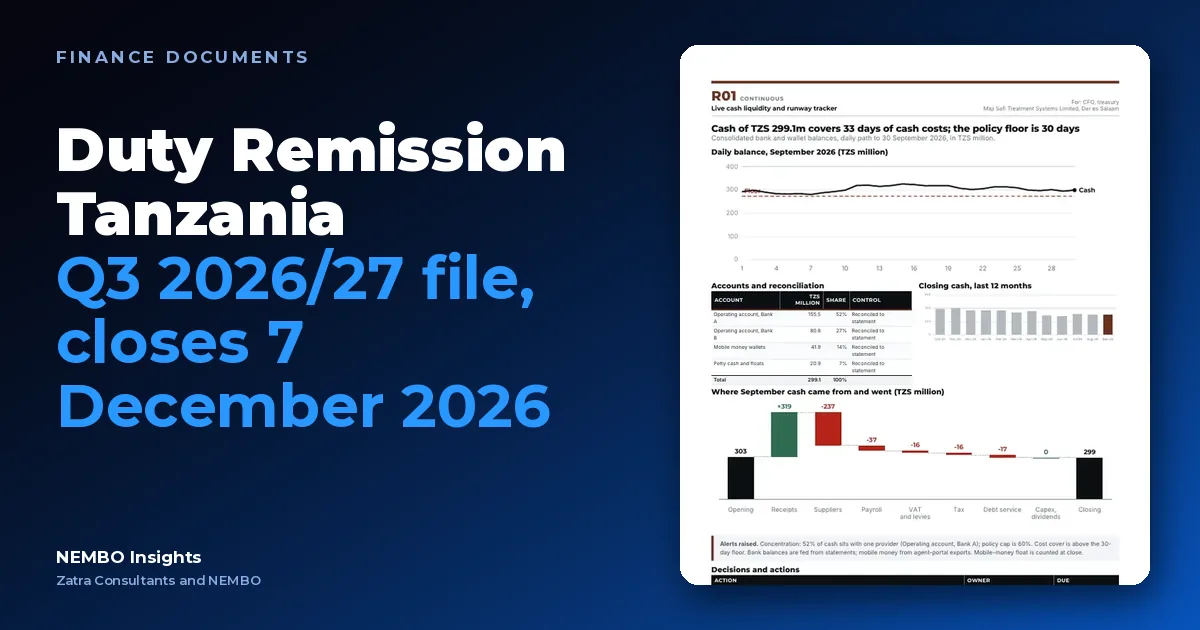
Cash timing matters more than the fee total. The margin leaves the account at application, the port charges fall due on assessment, and the principal is paid at maturity, 90 days after the bill of lading date. A thirteen-week cash forecast that shows those three dates is the page the credit committee reads beside the application.
Why do LC documents get rejected, and how is a Tanzanian file protected?
The common discrepancies are late presentation, an expired credit, a bill of lading not marked on board or consigned to the wrong party, and an invoice that describes the goods differently from the credit. Insurance below 110 percent or dated after shipment, and amounts above the credit, are the others. Each gives the bank the right to refuse under article 16, and each starts as a drafting error.
- Copy the pro-forma into the application, and set the dates with a margin. The goods description, quantity, unit price, incoterm and port must match word for word, and latest shipment, presentation period and expiry should leave room for one correction.
- Name the documents and their issuers. "Certificate of conformity issued by a TBS-appointed PVoC contractor" is a term the bank can check. "Quality certificate" is not.
- Diary the 90 days. Regulation 14 runs from the date of payment. If the vessel is late, prepare Form C before the period expires.
What does the Bank of Tanzania expect after the documents are paid?
The bank reports the credit under regulation 13(4) and tracks the consignment under regulation 14. Clyde & Co, writing on 17 August 2026, summarises the 2026 amendments: Forms C and D require the Unique Consignment Reference number, the paying bank, the transaction number and supporting documents. A bank whose importer fails to report may stop providing foreign currency to that importer until the matter is resolved. FB Attorneys, in a legal update of 31 May 2022, reported that contravention of the Act carries a fine of up to TZS 4 million or imprisonment of up to 14 years or both. That figure is a law firm summary, not the Act text; confirm it with an advocate.
Mainland and Zanzibar: which rules differ?
The Foreign Exchange Act and the 2022 Regulations are Union law, so the payment route, the bank's file and the 90-day rule apply in Zanzibar as on the Mainland. Customs is also a Union function: TRA clears goods through TANCIS at Zanzibar ports and collects duty, RDL and CPF on the same basis. The difference is VAT. VAT on imports into Zanzibar is charged at 15 percent by the Zanzibar Revenue Authority (register pointer F0246), not 18 percent, and a ZRA-registered company recovers it through the ZRA return. Its fiscal receipts carry the ZTN location number described in the Zanzibar VFMS guide.
| Point | Mainland | Zanzibar |
|---|---|---|
| Payment route and bank file | GN 294 of 2022, reg. 13 | Same, Union law |
| 90-day rule, Forms C and D | Reg. 14 as amended by GN 206 of 2026 | Same |
| Customs declaration | TANCIS, TRA | TANCIS, TRA |
| VAT on imports | 18% (F0312) | 15%, ZRA (F0246) |
| Input VAT recovery | TRA VAT return | ZRA VAT return |
What to do now
- Fix the terms. Agree the incoterm, the LC type, the tenor and the currency with the supplier, and get a pro-forma that states them. The USD contract guide explains which contracts may still be priced in foreign currency.
- Check the permits and the PVoC route. Confirm with TBS, TMDA or the sector regulator which permit the goods need. The PVoC guide sets out the routes.
- Ask the bank for its form, tariff and margin in writing. Budget for full cash cover until the bank confirms a lower margin.
- Assemble the file. Signed application, pro-forma or contract, permit copies, board resolution, KYC pack, accounts and the insurance arrangement. The foreign supplier payment guide lists what the bank asks for under regulation 13.
- Draft the LC document list with the exporter. Name each document, its issuer and the data it must show, and share the draft with the supplier's bank before issuance.
- Prepare the customs file in parallel. Appoint the clearing agent and compute duty, VAT, RDL and CPF from the register. The import documents guide and the TANCIS guide cover the sequence.
- Diary the clocks and the cash. Latest shipment, 21-day presentation, expiry, the 90-day period from payment, the usance maturity and the VAT return, with the three outflow dates in the cash forecast.
Key dates
| Date or period | What it governs | Source |
|---|---|---|
| 13 May 2022 | Foreign Exchange Regulations 2022 published | GN No. 294 |
| 1 July 2026 | Customs Processing Fee at 1% of FOB for dry cargo | GN No. 158D |
| 17 July 2026 | Forms C and D and the five-day windows | GN No. 206 of 2026 |
| 21 calendar days after shipment | Latest presentation of documents | UCP 600 art. 14(c) |
| 5 banking days after presentation | Examination and any refusal notice | UCP 600 art. 14(b), 16(d) |
| 90 days after payment | Goods consigned to Tanzania, or Form C within 5 days of expiry | Reg. 14, GN 294 as amended |
| 3 months from issue | Validity of the PVoC certificate | TBS PVoC Guideline 2025 |
What the NEMBO desk prepares
NEMBO designs and delivers the import letter of credit application file as one controlled document set: the application cover note, the document schedule that mirrors the pro-forma, the permit and KYC index, the landed-cost schedule with the register lines, the clock diary and the cash forecast page for the bank. The set sits inside the financial reports and CFO value packs desk, beside the invoices desk that produces the pro-forma. Zatra Consultants prepares and checks the content: the regulation 13 documents, the UCP 600 clauses, the duty band, the VAT and levy arithmetic and the dates. Every page of the finished work reads free online first, with a Customise for your brand option on the library page.
There are two cost buckets on every quotation. Government charges are paid at the official rate to the authority against its control number: import duty, VAT on imports (F0312), the Railway Development Levy (F0309), the Customs Processing Fee (F0311, now set by GN 158D) and the PVoC fee (F0355) go to TRA or the PVoC contractor, never to NEMBO. Bank charges are paid to the bank on its tariff. NEMBO's and Zatra's fees are published on the pricing page and quoted in writing before work starts. NEMBO does not decide or guarantee any authority's outcome, and the same holds for any bank or tender panel. The process page sets out how a brief becomes a delivered file.
How Zatra helps
Zatra's import and export compliance service maps the permits, the PVoC route and the customs file, and its outsourced CFO service builds the landed-cost schedule and the cash forecast the bank reads. Tax and reporting questions, including the import VAT claim and any capital goods deferment, go to CPA Altho Mwangoa. Disputes with a bank over a refusal notice, claims under the Foreign Exchange Act and legal opinions go to Advocate Yona Habiye. The Bank of Tanzania foreign exchange rules guide covers the Act in depth. To begin, use the start page or the answers page, and read the related guides on the pro-forma invoice for imports and the overdraft facility file.
Import letter of credit application file
Zatra Consultants prepares and checks the content on the details the Client shares. NEMBO designs and delivers it. Fees are published on the packages page and quoted in writing.
Open the desk pageSources and status
Accurate as at 23 November 2026. The Foreign Exchange Regulations 2022 (GN No. 294) were read in the Bank of Tanzania copy for regulations 2, 13 and 14, and the 2026 amendments (GN No. 206) with the Clyde and Co summary of 17 August 2026. UCP 600 articles 5, 14, 16 and 28 were read on the ICC Digital Library. TRA's import procedures page, its 2025/26 summary and GN No. 158D were read in full, and the TBS PVoC Guideline 2025 for routes and validity. The Regulations on the Use of Foreign Currency 2025 were not read, so the treatment of import letters of credit under them is unconfirmed. No Tanzanian bank publishes an LC checklist or margin; the file list is practice to confirm. All example figures are illustrative.
- 1Foreign Exchange Regulations 2022, GN No. 294Bank of Tanzania, published 13 May 2022. Accessed 23 November 2026.
- 2Foreign Exchange (Amendment) Regulations 2026, GN No. 206Bank of Tanzania, published 17 July 2026. Accessed 23 November 2026.
- 3Public notice: prohibition on the use of foreign currency for local transactionsBank of Tanzania, 2 May 2025. Accessed 23 November 2026.
- 4UCP 600, Uniform Customs and Practice for Documentary CreditsInternational Chamber of Commerce, 2007 revision, read 23 November 2026. Accessed 23 November 2026.
- 5Documentary credits: rules, guidelines and terminologyICC Academy, 21 October 2024. Accessed 23 November 2026.
- 6Import proceduresTanzania Revenue Authority, undated page read 23 November 2026. Accessed 23 November 2026.
- 7Taxes and Duties at a Glance 2025/2026Tanzania Revenue Authority, July 2025. Accessed 23 November 2026.
- 8Tanzania Revenue Authority (Customs Processing Fee) Regulations 2026, GN No. 158DTanzania Revenue Authority, published 30 June 2026, operative 1 July 2026. Accessed 23 November 2026.
- 9Guideline for the PVoC Programme 2025Tanzania Bureau of Standards, 2025. Accessed 23 November 2026.
- 10Key amendments to the Foreign Exchange RegulationsClyde and Co, 17 August 2026. Accessed 23 November 2026.
Figures to confirm before you act
- Customs Processing Fee: the fee register (26 September 2026) carries 0.6 percent of FOB at F0311, while GN No. 158D of 2026 sets 1 percent of FOB for dry cargo from 1 July 2026; pay the amount on TRA's control number and have the register line reissued.
- Whether an import letter of credit is a transaction expressly permitted in foreign currency under the Regulations on the Use of Foreign Currency 2025 (GN No. 198): check the regulations text with the issuing bank or an advocate.
- Cash margin percentage and the full LC tariff at your own bank: no CRDB or NMB tariff was found in print; obtain the written tariff before signing the application.
- Penalty for contravening the Foreign Exchange Act: the TZS 4 million fine and 14-year term come from an FB Attorneys update of 31 May 2022, not from the Act text.
- VAT deferment on capital goods under section 11 of the VAT Act, Cap. 148: confirm eligibility and the current conditions with TRA before lodging the declaration.
This article is general information based on official sources available at the date of publication. It is not legal, tax or financial advice. Laws and notices change. Verify with the issuing authority or consult Zatra before acting.
Frequently asked questions
Can a Tanzanian company pay an overseas supplier without a letter of credit?
Yes, provided the payment goes through a bank or financial institution as regulation 13(1) of the Foreign Exchange Regulations 2022 requires. A transfer against an invoice, or an advance against a pro-forma and contract, are both allowed. Other means apply only where the consignment is worth no more than USD 10,000. The LC is chosen when the supplier wants a bank's undertaking rather than the buyer's promise.
How much cash does the bank hold when it opens an import LC?
The bank decides. No Tanzanian bank publishes its margin; practice runs from full cash cover on a new relationship to a lower percentage where a trade facility has been approved. Ask for the margin in writing with the tariff, and model the outflow from the application date, not the shipment date.
What is the difference between a sight and a usance letter of credit?
A sight credit pays the exporter when complying documents are presented and examined. A usance credit pays at a fixed later date, for example 90 days from the bill of lading date, so the importer can clear and sell the goods before paying. Banks charge a usance or acceptance commission for the extra period, shown on the Stanbic tariff as 1 percent per quarter.
Does the 90-day consignment rule apply to goods bought on a usance LC?
Regulation 14 counts 90 days from the date of payment. Under a usance credit the bank pays at maturity, so the period should run from that date. Confirm the bank's reading, because it files the reports. If the goods have not reached Tanzania within the period, file Form C within five days of expiry.
Who pays the PVoC certificate of conformity?
The fee is assessed on the FOB value at 0.5 percent under Route A, minimum USD 250 and maximum USD 5,000, and is paid to the PVoC contractor before shipment. The contract decides who bears it; many importers pay it through the exporter and add it to the landed cost. Without the certificate, TBS says the consignment will be rejected or fined.
Can the importer recover the 18 percent VAT paid at the port?
A VAT-registered importer claims the import VAT as input tax in the return, holding the single administrative document that shows its name, TIN and VRN, within six months of the document date. An unregistered importer bears the VAT as a cost. Capital goods may qualify for deferment under section 11 of the VAT Act, subject to TRA's conditions.
What happens if the exporter's documents are rejected?
The issuing bank sends a single refusal notice within five banking days listing every discrepancy. The importer may waive and pay, negotiate a reduction with the supplier before waiving, or refuse, in which case the documents and the goods stay with the exporter. A discrepancy fee of USD 60 to USD 130 is charged on the published tariffs whatever the outcome.
Is the position different for an importer in Zanzibar?
The Foreign Exchange Regulations and customs are Union matters, so the bank file, the 90-day rule and the TANCIS declaration are the same. VAT on imports into Zanzibar is 15 percent, collected by the Zanzibar Revenue Authority, and the input tax is recovered through the ZRA return rather than the TRA return.