On this page
- What the law says
- Who should read this
- What does the bank ask for before it issues a guarantee?
- Who writes the wording, the bank or the beneficiary?
- How do demand and expiry work?
- What does a guarantee cost, and what does it tie up?
- How does a credit committee read the guarantee file?
- What is a counter-guarantee, and when does a foreign contractor need one?
- Worked example: a TZS 2.4 billion construction contract
- Where guarantee files fail
- Mainland and Zanzibar
- What to do now
- Key dates and deadlines
- What the NEMBO desk prepares
- How Zatra helps
- Sources and status
- Frequently asked questions
What does a Tanzanian bank need before it issues a bid, performance or advance payment guarantee?
A guarantee is a credit facility. The bank wants the tender document or contract with its security clause and annexed form of guarantee, audited and management accounts, a contract cash flow, a board resolution, current KYC, and a signed counter-indemnity with cash cover or other security. The procuring entity fixes the wording; GN 518 of 2024 fixes tender security validity at least 28 days beyond the tender validity.
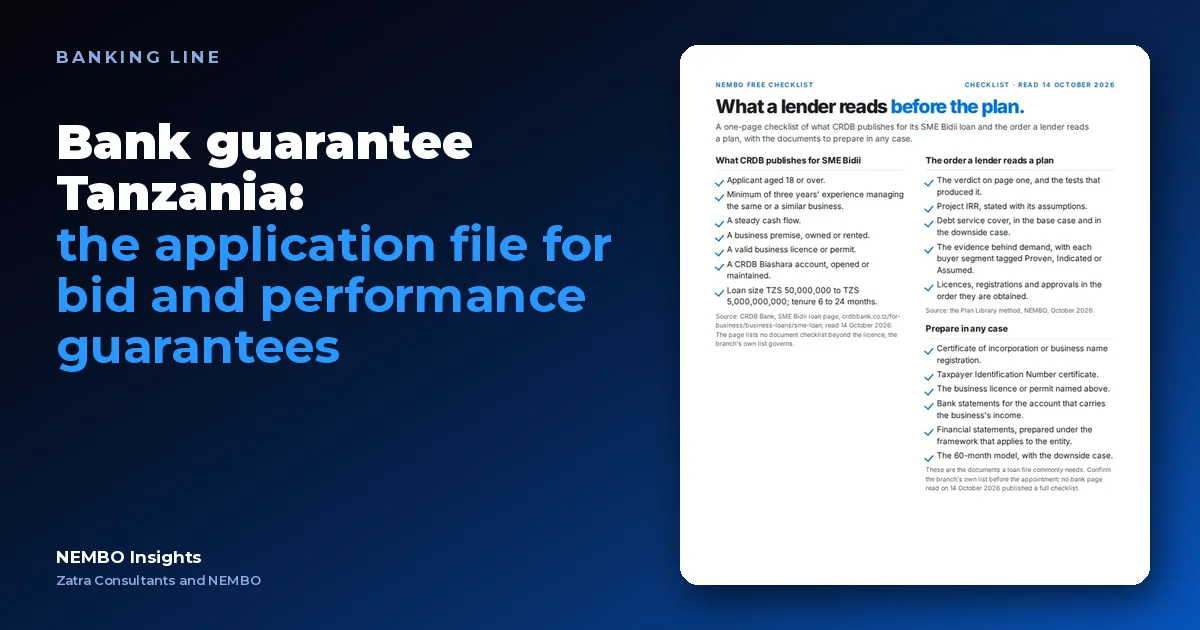
A bank guarantee Tanzania tender panels and employers ask for is the bank's own promise to pay the beneficiary a stated sum on demand if the contractor fails. The bank issues it for a customer, against a facility, a counter-indemnity and often cash cover, and it charges a commission for the period the promise stands. Most contractors meet it three times on one job: a bid security, a performance security at signing and an advance payment guarantee. This note sets out what the bank asks for before it issues, who fixes the wording, what the guarantee costs, and how a demand, an expiry and a credit committee work. It builds on the notes on the securing declaration or bid security, the performance security at contract signing and the overdraft file.
What the law says
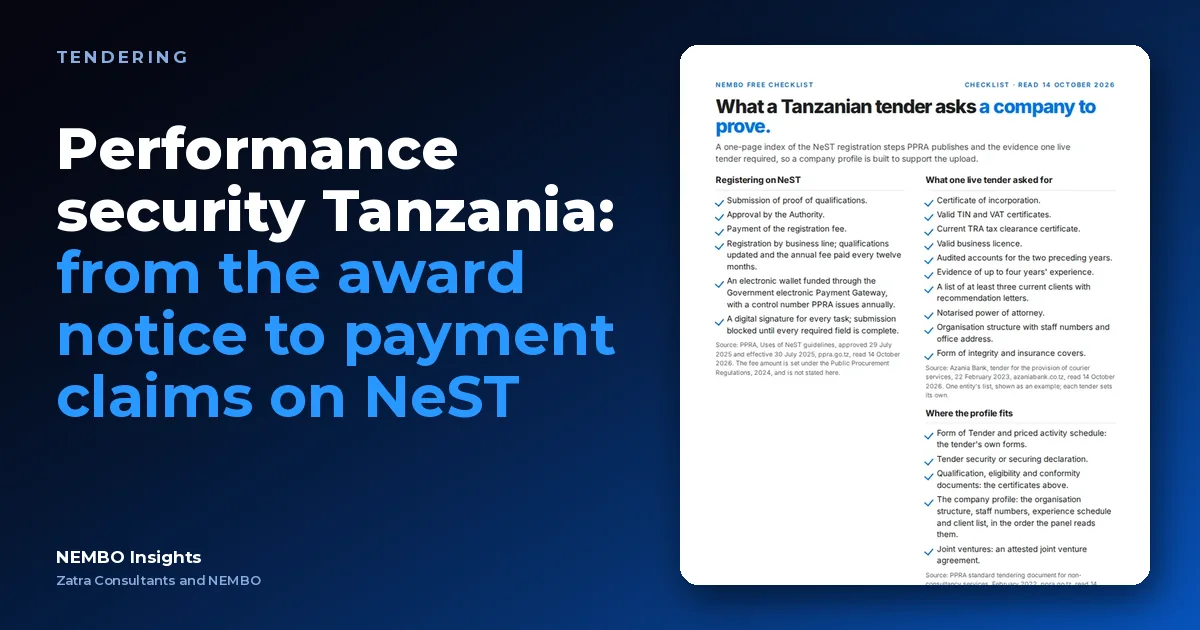
Three instruments govern a bank guarantee on a Tanzanian public contract. The Public Procurement Act, 2023 applies a tender security requirement equally to all tenderers in section 67(1). Section 67(2) requires the successful tenderer to submit performance guarantees, and section 67(4) lets PPRA issue guidelines on minimum values and modalities. The Public Procurement Regulations, 2024, GN 518 of 2024, carry the mechanics. Regulation 23(4) fixes the form of a tender security and regulation 24 its validity, at least 28 days beyond the tender validity period. Regulation 25 covers release, regulation 29 the performance security and its forms, and regulation 30 the securing declaration. The desk read these provisions for the tender notes of 11 and 14 November 2026.
The bank's side rests on two Acts. The Banking and Financial Institutions Act, 2006 is published by the Bank of Tanzania; Clyde and Co's note of 23 February 2022, reproduced by Afriwise, cites section 24(1)(f) as the power under which banks issue guarantees. The Law of Contract Act, Cap. 345, governs the guarantee as a contract. The same note cites sections 85 to 87 on discharge where the underlying contract is varied without consent, section 91 on acts of the creditor that impair the guarantor's remedy, and section 97 on the implied indemnity. The desk did not read the Act's text, so those section numbers are tiered verify.
Internationally, the ICC Uniform Rules for Demand Guarantees, URDG 758, are the standard most banks and the World Bank model forms adopt. The ICC's own note of 2 July 2012 records that the rules then marked two years in force. They run to 35 articles on the parties' liabilities, the presentation of a demand, expiry, amendments and transfers, and the FIDIC construction contracts use them. The full text sits behind the ICC Digital Library's subscription wall and was not read, so no article number is cited.
Who should read this
Contractors, suppliers and consultants bidding on NeST tenders that ask for a bank security rather than a securing declaration. Finance managers pricing the commission and cash cover into a bid. Directors asked to sign a counter-indemnity. Foreign contractors whose home bank will issue a counter-guarantee to a Tanzanian bank. Zanzibar companies, whose procurement law differs but whose bank file does not.
What does the bank ask for before it issues a guarantee?
A guarantee is a credit decision. Diamond Trust Bank's non-fund based credit page states the position plainly: the letter of guarantee is issued after the credit vetting and approval process, as with any other credit facility, and the appraisal assesses the customer's ability to complete the contract for which the guarantee is issued. NBC's trade finance page lists bid bonds, performance, advance payment, shipping, payment and retention guarantees and customs bonds. The file is close to the SME loan file, with the contract added.
| Item | What the bank reads for | Who prepares it |
|---|---|---|
| Application form and facility request | Type, amount, currency, beneficiary, expiry and the tender or contract reference | Finance manager |
| Tender document or signed contract | The security clause: percentage, accepted forms, validity, issuer conditions and the annexed form of guarantee | Bid team |
| Board resolution | Authority to apply for the facility, to sign the counter-indemnity and to pledge cash or assets | Company secretary; see the board resolution note |
| Audited and management accounts | Turnover, margins, working capital, borrowings and contingent liabilities | Accountant |
| Contract cash flow | Month by month: advance, certified work, retention, advance recovered, security released | Finance manager; see the thirteen-week forecast note |
| Track record | Completion certificates, prior guarantees issued and released without a call, references | Bid team |
| Registrations | Incorporation, business licence, TIN and tax clearance, registration board class, NeST registration | Company secretary |
| Counter-indemnity and security | The promise to repay what the bank pays, with cash cover, a lien on deposits or a charge over assets | Directors with an advocate |
| KYC refresh | Beneficial owners, director identities, registered office and mandate current | Company secretary |
Two points decide how fast the bank moves: whether the company holds a guarantee line, a pre-approved limit under which each instrument is issued on a short request, or applies for a one-off facility that goes through full appraisal; and whether the guarantee is cash covered. Diamond Trust Bank's page states that open-ended guarantees are issued only against 100 percent cash cover in the same currency, and that the maximum term is one year, renewable at the bank's discretion. Other banks publish less; take their position from the facility letter.
Who writes the wording, the bank or the beneficiary?
The beneficiary does. On a NeST tender the form of tender security and the form of performance security are annexed to the tender document, and regulation 23(4) requires the tender security to be in the form the document provides. The bank issues on its own letterhead but in that text. The bank will push back on wording it cannot live with: an expiry that depends on an event the bank cannot see, or a governing law clause it does not recognise. The applicant has no power to change either side's standard terms. Send the procuring entity's form to the bank with the application, so objections surface before the deadline.
Regulation 29(4) lists the accepted forms of performance security: cash, a certified cheque, a cashier's or manager's cheque or a bank loan; an irrevocable letter of credit; a bank guarantee; and a surety bond callable on demand from a reputable surety or insurance company. The Clyde and Co note records the same list under the 2013 regulations, adding that a foreign tenderer's bank guarantee must be confirmed by a reputable local bank. Whether the 2024 regulation keeps that wording is tiered verify.
How do demand and expiry work?
A demand guarantee pays on a written demand that complies with its terms. The bank does not ask whether the contractor defaulted. The Clyde and Co note cites Edward Owen Engineering v Barclays Bank International [1978] QB 159 for that rule. It cites Tanchi Brothers Construction Company Limited v Amana Bank Limited, Miscellaneous Commercial Cause No. 28 of 2020, for the Commercial Court's position that payment is restrained only on proof of fraud of which the bank has notice. It cites Akiba Commercial Bank PLC v UAP Insurance Tanzania Limited, Commercial Case No. 24 of 2018, for the rule that a claim must fall within the validity period. The desk did not read the judgments.
For the applicant the consequences are simple. The bank keeps its promise whether or not the contractor agrees with the call, and the contractor's remedy is against the employer under the contract. The guarantee ends on its expiry date, and a demand received after it is out of time. Banks therefore insist on a fixed expiry and a fixed amount; Diamond Trust Bank's page states both as conditions of issue. Where the tender document wants cover until 28 days after a completion certificate, the bank fixes a long-stop date and the applicant diarises it.
| Event | Rule | Source and tier |
|---|---|---|
| Performance security amount | Set by the tender document; neither the Act nor regulation 29 states a percentage | PPA 2023 s.67(2), GN 518 reg. 29; settled |
| Advance payment | Only after the contract is signed, in the amount the regulations or guidelines set | PPA 2023 s.96(2); percentage not read, verify |
| Demand after expiry | Out of time; the claim must fall within the validity period | Akiba Commercial Bank v UAP, per Clyde and Co; verify |
| Bank's maximum term | One year, renewable at the bank's discretion; perpetual guarantees only against 100 percent cash cover | Diamond Trust Bank published terms; other banks verify |
What does a guarantee cost, and what does it tie up?
The price has four parts. A commission on the face value for the period the guarantee runs; Diamond Trust Bank's page states that commission is charged periodically, quarterly, semi-annually or annually on renewal. A flat issuance or amendment fee. Cash cover, a share of the face value blocked in a margin account for the life of the instrument. And the credit line itself, which reduces what the bank will lend for anything else while the guarantee stands. CRDB's rates and charges page lists its Minimum Disclosure of Bank Fees and Charges dated 17 September 2026; the PDF would not render for the desk, so no CRDB rate is quoted here. No commission figure in this note comes from a published tariff. Take the rate from the facility letter.
Stamp duty is a separate, small, government charge. The Zatra fee register records TZS 2,000 on an agreement and TZS 2,000 on a power of attorney under the Stamp Duty Act Schedule items 5 and 46 (F0267). The counter-indemnity and the facility letter are agreements. Whether the guarantee instrument itself attracts a separate Schedule item is not a line in the register, so the desk does not state a figure and the accountant confirms it with TRA before stamping. Stamp duty is paid to TRA against a control number and is never part of a bank's or an adviser's fee.
How does a credit committee read the guarantee file?
The committee asks one question in four forms: if the beneficiary calls, will the customer repay us? The first form is capacity. A contractor with TZS 900 million turnover asking for a TZS 240 million performance guarantee on a TZS 2.4 billion contract is taking on work at almost three times its scale, and the file must show how. The second form is cash: the advance in, the certified work and retention, the advance recovered, and the months in which the company funds the gap. The asset finance note describes the same reading for an equipment loan.
The third form is exposure: the new guarantee added to every facility and contingent liability on the books, against the limit the bank will hold for this customer. The fourth form is security: cash cover, a lien on deposits, a debenture, a legal mortgage or a personal guarantee from the directors, in that order of comfort. Where a credit guarantee scheme covers part of the risk the bank's exposure falls, and so can the cash cover. The Respondent reported on 26 October 2026 that NMB offers mining businesses bid bonds of up to USD 11 million without asset collateral, and advance payment and performance guarantees of up to TZS 11 billion. A bank can sell a guarantee on the strength of the contract rather than the balance sheet, but only to a customer whose file lets it.
What is a counter-guarantee, and when does a foreign contractor need one?
A Tanzanian procuring entity wants a guarantee it can call on a Tanzanian bank. A foreign contractor's home bank cannot give that directly, so it issues a counter-guarantee to a Tanzanian bank, which then issues the local guarantee to the beneficiary. The local bank's risk is on the foreign bank, so the local file is short: the counter-guarantee text, the foreign bank's standing and the beneficiary's form. The ICC rules cover counter-guarantees expressly, which is one reason banks issue them subject to URDG 758. Diamond Trust Bank's page adds that a guarantee for a beneficiary in another country must follow the foreign exchange regulations; read the foreign exchange note first. The joint venture note covers who procures the security when a foreign firm teams with a local one.
Worked example: a TZS 2.4 billion construction contract
Pwani Builders Limited bids for a TZS 2,400,000,000 road maintenance contract on NeST. The tender document, not the regulations, sets the securities: a tender security of 2 percent, a performance security of 10 percent of the contract price, and an advance payment of 20 percent against an advance payment guarantee of the same amount. The bid validity is 90 days. All percentages below are the tender document's; the commission rate is illustrative and labelled so.
| Instrument | Amount | Period | Commission at 0.5 percent a quarter, illustrative |
|---|---|---|---|
| Tender security, 2 percent | TZS 48,000,000 | 90 days plus 28 days, 118 days, charged as two quarters | TZS 480,000 |
| Performance security, 10 percent | TZS 240,000,000 | 12 months to the completion certificate plus 28 days, four quarters | TZS 4,800,000 |
| Advance payment guarantee, 20 percent | TZS 480,000,000, reducing as the advance is recovered | Six months on average, two quarters | TZS 4,800,000 |
| Stamp duty on the counter-indemnity | Agreement | Once | TZS 2,000 (F0267), to TRA |
| Total commission and duty | TZS 10,082,000 plus the bank's flat fees |
The arithmetic checks: 48,000,000 at 0.5 percent is 240,000 a quarter, two quarters 480,000; 240,000,000 gives 1,200,000 a quarter, four quarters 4,800,000; 480,000,000 gives 2,400,000 a quarter, two quarters 4,800,000. The total is 0.42 percent of the contract price and belongs in the bid as a preliminaries item. The larger cost is cash: 30 percent cover on the performance security blocks TZS 72,000,000 for 13 months. A variation of TZS 300,000,000, a 12.5 percent increase, triggers a top-up of TZS 30,000,000 under regulation 29(6). If the employer calls the performance security after a disputed termination, the bank pays TZS 240,000,000 and debits Pwani the same day. Pwani's argument with the employer continues with an advocate, while the bank's debt is already due.
Where guarantee files fail
| Fault | Consequence | Fix |
|---|---|---|
| Bank's standard wording instead of the tender document's form | Tender non-responsive, or the security refused at signing | Send the beneficiary's form with the application and get the bank's confirmation |
| Validity short of 28 days beyond the tender validity | Non-responsive under regulation 24 | Compute the date from the tender document and add a margin |
| Guarantee applied for after the award letter | Signing delayed; award at risk | Hold a guarantee line before bidding |
| Original not returned on completion | Commission keeps running; the line stays blocked | Ask for release under regulation 29(7) and get the original back |
| Counter-indemnity signed by directors without reading it | Personal liability for the full face value | An advocate reads the counter-indemnity before signing |
Mainland and Zanzibar
The Public Procurement Act, 2023 and GN 518 of 2024 govern Mainland procuring entities and Union institutions, and NeST is their system. Zanzibar runs its own procurement law through the Zanzibar Public Procurement and Disposal of Public Assets Authority. The desk could not read the Zanzibar statute or its security forms, so the rules for a Zanzibar Government tender are unknown here and come from the Zanzibar tender document. The bank file is the same on both sides: banking is a Union matter and a branch in Unguja issues under the same facility letter. Stamp duty on the counter-indemnity on the islands is a Zanzibar Revenue Authority matter and the figure above is Mainland only.
What to do now
- Read the security clauses first, in the tender document and the draft contract: percentage, accepted forms, validity and the annexed forms of guarantee.
- Apply for a guarantee line before bidding, sized to the largest contract the company will bid in the year.
- Build the contract cash flow month by month, showing the advance, certificates, retention, recovery of the advance and the release dates of each security.
- Send the beneficiary's form to the bank with the application and get written confirmation that it will issue in that text.
- Price the commission, flat fees and cash cover into the bid as a preliminaries line, using the facility letter's rate, not an assumed one.
- Have an advocate read the counter-indemnity and the facility letter before the directors sign, and pass a board resolution that matches both.
- Stamp the agreements with TRA against a control number and keep the receipts with the originals.
- Diarise every expiry and release date, and ask for release under regulation 29(7) the day the completion certificate issues.
- Return the original to the bank and get the line and the cash cover released in writing.
Key dates and deadlines
| Date or period | What it governs | Source and tier |
|---|---|---|
| Tender deadline on NeST | The tender security must be issued and uploaded before it | Tender document; settled |
| Tender validity plus 28 days | Minimum validity of the tender security | GN 518 reg. 24; settled |
| 30 days after validity expires, or award | Release of unsuccessful tenderers' securities | GN 518 reg. 25; settled |
| Contract signing | Performance security delivered; advance payment only after signing | PPA 2023 s.67(2), s.96(2); settled |
| Any amendment above 10 percent cumulative | Additional security required | GN 518 reg. 29(6); settled |
| Completion or final acceptance certificate | Release of the performance security if no claim is filed | GN 518 reg. 29(7); settled |
| Guarantee expiry date | Last day a demand can be presented; commission runs to it | The instrument; bank terms; settled |
| One year from issue | Maximum term at Diamond Trust Bank, renewable at its discretion | Bank's published terms; other banks verify |
What the NEMBO desk prepares
NEMBO designs and delivers the documents a trade finance desk reads: the application letter and facility request, the contract cash flow, the capability statement and track record pages, the board resolution in the form banks accept, and the securities register with every expiry and release date. Zatra Consultants prepares and checks the content: the security clauses, the cash flow, the figures against the fee register, the stamping, and the legal positions on the counter-indemnity, with an advocate for execution and any dispute. Bank commissions and cash cover are paid to the bank at its own rate, and stamp duty to TRA at the official rate. Neither is ever part of NEMBO's or Zatra's fees, which are quoted in writing from the packages and pricing pages. NEMBO does not decide or guarantee any authority's outcome, and no bank's credit decision either. See the plans desk, the investor and tender documents desk and the process page, or share the tender document.
How Zatra helps
Zatra's tender and procurement advisory desk reads the security clauses, maps them to the forms the bank will accept and sets the timetable from bid to release. Its corporate bank account and KYC desk keeps the bank file current, so a guarantee line is a short request rather than a new onboarding. The bank account opening page lists what a compliance desk checks before any facility. The NeST registration note covers the tenderer side. Zatra prepares, structures and coordinates; a demand under a guarantee, an injunction against payment or a claim against the employer goes to an advocate, and the tax treatment of commissions and the stamping go to the accountant.
Business plan and feasibility study
Zatra Consultants prepares and checks the content on the details the Client shares. NEMBO designs and delivers it. Fees are published on the packages page and quoted in writing.
Open the desk pageSources and status
Accurate as at 16 November 2026. The URDG 758 text sits behind the ICC Digital Library's subscription wall and was not read, so no article number is cited. The Law of Contract Act and Banking and Financial Institutions Act section numbers come from Clyde and Co's note of 23 February 2022 and are tiered verify. The CRDB fee disclosure PDF would not render, so no bank commission rate is quoted; the worked example's rate is illustrative. The Zanzibar procurement statute was not read.
- 1ICC Demand Guarantee Rules URDG 758 celebrate two years of rising popularityInternational Chamber of Commerce, 2 July 2012, read 16 November 2026. Accessed 16 November 2026.
- 2The Public Procurement Act, 2023, Act No. 10 of 2023, English translationPublic Procurement Regulatory Authority, assented 29 September 2023, read for the desk's tender notes of 11 and 14 November 2026. Accessed 16 November 2026.
- 3Kanuni za Ununuzi wa Umma za Mwaka 2024 (Public Procurement Regulations, 2024), GN 518Public Procurement Regulatory Authority, Government Notice No. 518 dated 28 June 2024, in force 1 July 2024. Accessed 16 November 2026.
- 4Performance Security Bonds in TanzaniaClyde and Co via Afriwise, 23 February 2022, read 16 November 2026. Accessed 16 November 2026.
- 5The Banking and Financial Institutions Act, 2006Bank of Tanzania, Act No. 5 of 2006, document opened 16 November 2026, section 24(1)(f) cited from Clyde and Co. Accessed 16 November 2026.
- 6Non-Fund Based Credit: Bank Guarantees and Letters of CreditDiamond Trust Bank Tanzania, product terms page read 16 November 2026. Accessed 16 November 2026.
- 7Trade Finance: Bonds and GuaranteesNBC Bank, product page read 16 November 2026. Accessed 16 November 2026.
- 8Rates and ChargesCRDB Bank, page listing the Minimum Disclosure of Bank Fees and Charges of 17 September 2026, read 16 November 2026. Accessed 16 November 2026.
- 9NMB opens billions in guarantees to mining businessesThe Respondent, 26 October 2026, read 16 November 2026. Accessed 16 November 2026.
- 10The Stamp Duty Act, Cap. 189, Revised Edition 2019Tax Revenue Appeals Board copy, Revised Edition 2019, Schedule items 5 and 46 as recorded in the Zatra fee register at 26 September 2026. Accessed 16 November 2026.
- 11Zanzibar Public Procurement and Disposal of Public Assets AuthorityZanzibar Public Procurement and Disposal of Public Assets Authority, Zanzibar procurement regulator, home page only, 16 November 2026. Accessed 16 November 2026.
- 12Registering as a government supplier: PPRA, NeST and the tender routeZatra Consultants Limited, note read 16 November 2026. Accessed 16 November 2026.
- 13Tender and procurement advisory in TanzaniaZatra Consultants Limited, service page published 13 August 2026. Accessed 16 November 2026.
Figures to confirm before you act
- The security percentages, accepted forms, validity and release wording in the specific tender document; the regulations set no percentage.
- The bank's commission rate, flat fees, cash cover and maximum term, from the facility letter; no published tariff was read.
- Whether a guarantee instrument attracts its own Stamp Duty Act Schedule item beyond the TZS 2,000 agreement duty (F0267), with TRA.
- The Law of Contract Act and Banking and Financial Institutions Act sections, cited from Clyde and Co's note.
- The Zanzibar procurement law's security rules, from the Zanzibar tender document and ZPPDA.
- Every figure in the worked example, which uses an illustrative commission rate.
This article is general information based on official sources available at the date of publication. It is not legal, tax or financial advice. Laws and notices change. Verify with the issuing authority or consult Zatra before acting.
Frequently asked questions
Can an insurance bond replace a bank guarantee on a NeST tender?
Regulation 29(4) of GN 518 of 2024 lists a surety bond callable on demand from a reputable surety or insurance company among the accepted forms of performance security, and the tender document says which forms it accepts. An insurance bond usually ties up less cash. Check the issuer conditions in the tender document before relying on one.
Does the bank check whether I defaulted before paying a demand?
No. A demand guarantee pays on a complying written demand, and the Commercial Court has restrained payment only where the bank had notice of fraud. The bank then debits the company under the counter-indemnity. Any argument that the call was wrongful is against the employer under the contract, with an advocate.
How long does it take a bank to issue a guarantee?
Under an existing guarantee line, a few working days once the beneficiary's form is agreed. A one-off facility goes through full credit appraisal, which can take weeks and will not meet a tender deadline. Apply for the line before the bidding season.
What happens if the guarantee expires before the beneficiary releases it?
A demand after the expiry date is out of time, which is why banks insist on a fixed expiry. The employer may treat a refusal to extend as a default under the contract. Diarise the expiry, ask for release under regulation 29(7) when the completion certificate issues, and extend early if the works run late.
Do I have to pay stamp duty on a bank guarantee?
The Zatra fee register records TZS 2,000 on an agreement (F0267), which covers the counter-indemnity and the facility letter. The register has no line for the guarantee instrument itself, so the desk states no figure for it. Stamp duty is paid to TRA against a control number and is separate from the bank's commission.
Can a foreign contractor give a guarantee from its home bank?
A Mainland procuring entity wants a guarantee on a Tanzanian bank. The home bank issues a counter-guarantee to a local bank, which issues the local instrument in the tender document's form. The local bank's risk is on the foreign bank. Cross-border guarantees must also follow the Bank of Tanzania's foreign exchange rules.
Is the commission a deductible expense, and does it carry VAT?
Commission on a guarantee for a business contract is a cost of earning the contract income. Whether the bank charges VAT on it and how the stamping is treated are questions for the accountant and the bank's invoice. Keep the facility letter and commission advices with the contract file.
Does a Zanzibar tender use the same rules?
No. Zanzibar runs its own procurement law through the Zanzibar Public Procurement and Disposal of Public Assets Authority, and the desk could not read its security rules. Take the percentage, validity and form from the Zanzibar tender document. The bank file is the same, since banking is a Union matter on both sides.