On this page
- What the law says
- Who should read this
- What is a performance security and how is it set?
- When may a bidder give a securing declaration instead of a bank guarantee?
- How does contract signing work on NeST?
- How are payment claims submitted and when is a supplier paid?
- What can change after signing?
- Does the same process apply in Zanzibar?
- Worked example: a TZS 480,000,000 supply contract
- What goes wrong after the award
- What to do now
- Key dates
- What the NEMBO desk prepares
- How Zatra helps
- Sources and status
- Frequently asked questions
What must a winning bidder do after a Tanzanian public tender is awarded?
Wait out the five working days for complaints and receive the notice of acceptance through NeST. Furnish the performance security in the form and amount the tender document set, before signing. Sign the contract in the system with a digital signature, deliver, and submit every payment request or claim through NeST, where the procuring entity also pays.
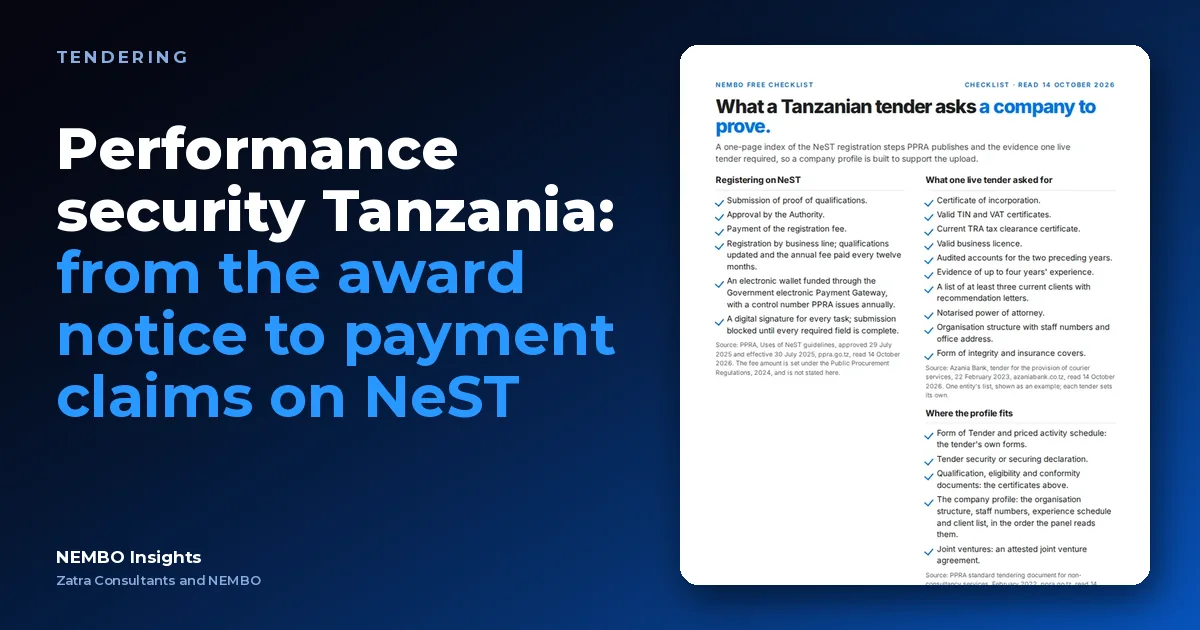
Performance security Tanzania procuring entities ask for is the first document a winning bidder owes after the award, and the one most often late. The Ministry of Finance reported on 30 July 2026 that 181,057 tender awards worth TZS 14.5 trillion went through the National e-Procurement System in the 2025/26 year, and that contract management and payment now run in the system as well. That moves the post-award file online: the notice of intention to award, the notice of acceptance, the contract, the security, the delivery record and the payment claim all pass through NeST. This note sets out what the Public Procurement Act, 2023, the Public Procurement Regulations, 2024 and the 2025 NeST guidelines require at each step, what the bidder prepares, and where the money and the days run. The earlier notes on NeST registration, the securing declaration and evaluation criteria cover the file before the award.
What the law says
The Public Procurement Act, 2023, Act No. 10 of 2023, assented to on 29 September 2023 and published in English translation as GN 813 of 20 September 2024, governs the post-award steps in sections 67, 69, 70, 73 and 93 to 98. The Public Procurement Regulations, 2024, GN 261 published 25 April 2025 and effective 1 July 2024, set the forms of security in regulations 23 to 30 and the payment duty in regulation 50. The Guidelines for Use of the National Electronic Procurement System of Tanzania, 2025, issued by PPRA under section 130 of the Act and effective 30 July 2025, put each step in the system. The desk read the Act sections and regulations 23 to 69 verbatim; regulations 238 onward, including the contract management part, could not be reached in the published PDF and are flagged below.
| Step | Instrument | Rule |
|---|---|---|
| Award decision | Act s.69(2), (3) | Tender board notifies the accounting officer within three working days; otherwise the PMU recommends the award as the regulations prescribe |
| Notice of intention to award | Act s.69(4); Guidelines 34 | Accounting officer issues it to all tenderers who took part, giving five working days to lodge complaints; generated and signed in the system |
| Notice of acceptance | Act s.69(6), (7); Guidelines 35 | Issued to the successful tenderer if no complaint is lodged; sent electronically in the form the tender document prescribes, signed by the accounting officer |
| Performance security | Act s.67(2); Reg. 29(3) | Furnished on receipt of the award letter and before the contract is signed, in the nature, form and amount the tender document specifies |
| Vetting | Act s.69(10), (11) | Attorney General above the regulatory thresholds; the entity's legal officers below |
| Signing | Act s.69(12), (14); s.70; Guidelines 36 | Contract enters into force on signing; hand-written or digital signatures; witnessed under the entity's constituting law or by a commissioner for oaths; signed in the system |
| Notices after award | Act s.69(13), (15) | Authority notified of awardee, value and date within seven days; unsuccessful tenderers told the awardee's name and value within seven days |
| Delivery and acceptance | Act s.94, s.96(1) | User department checks conformity, quantity, quality, cost and time; nothing is paid before it is delivered and accepted, unless the tender document and contract say otherwise |
| Payment claim | Guidelines 37; Reg. 50 | Tenderers submit all payment requests or claims through the system; the entity pays in the system and must pay on time |
| Amendment | Act s.95 | Only if not disadvantageous to the Government and within fifteen percent of the original price, unless the budget approving authority approves; vetted by the Attorney General |
| Closure | Act s.98; Reg. 29(7) | Accounting officer closes the contract; security released after the certificate of acceptance of the final performance report or the completion certificate |
Who should read this
Suppliers, contractors and consultants with a notice of intention to award in their NeST inbox, and the finance manager who has to find the security before signing day. Special groups and local firms under the reserved and preference schemes, because regulation 50(2) requires the entity to confirm funds are set aside before it signs with them. Bankers and insurers asked to issue a performance guarantee or bond in the regulation 29 forms. Company secretaries who must produce the board resolution, the signatory's digital signature and the witnessing arrangement under section 70. The special groups note and the margin of preference note explain the schemes that reach this stage with a securing declaration rather than a bank guarantee.
What is a performance security and how is it set?
Regulation 2 defines a performance security as a security provided by a successful tenderer to the procuring entity to warrant performance of contractual obligations. Section 67(2) of the Act requires the successful tenderer to submit performance guarantees, subject to the regulations, and section 67(4) lets PPRA issue guidelines on minimum values and modalities for tender security and other guarantees or bonds. Regulation 29(2) places the figure in the tender document: the entity specifies the nature, form, amount and other principal terms there. Neither the Act nor regulation 29 states a percentage. The number a bidder plans against is the one in its own tender document, and a bidder that priced without reading that page will be surprised at signing. Regulation 29(4) lists the forms. They are cash, a certified cheque, a cashier's or manager's cheque or a bank loan; an irrevocable letter of credit; a bank guarantee; and a surety bond callable on demand from a reputable surety or insurance company. The list ends with a securing declaration of contract performance under PPRA's guidelines, or another form the Authority permits.
Regulation 29(3) fixes the timing: the security is furnished on receipt of the contract award letter and before the signing of the contract. Regulation 26 discharges the tender security once the performance security is in or the contract is signed, whichever the entity applies. Regulation 29(6) adds a second call on the bank: any cumulative increase of more than ten percent of the contract price after an amendment requires additional security. Regulation 29(7) keeps the security until final completion and releases it after the certificate of acceptance of the final contract performance report, or the completion certificate, provided no claim has been filed. A guarantee drafted to expire on the original completion date, with no extension clause, is the commonest reason a bidder is asked for a replacement halfway through the contract.
When may a bidder give a securing declaration instead of a bank guarantee?
Regulation 30 applies the performance securing declaration to tenders that fall within the threshold of the regional exclusive preference, using Form No. 2 of the Third Schedule, signed by the tenderer. The declaration costs nothing to issue. Its sanction is debarment under section 72 of the Act if the tenderer fails to perform, which bars the company from every procuring entity for the period set. A bank guarantee costs a commission and ties up a credit line; a declaration costs the company's standing on NeST. The securing declaration note walks through the same choice at tender stage. Outside the preference thresholds the tender document decides, and a bidder that wants to substitute a declaration for a guarantee needs the entity's written agreement before signing, not a note on the contract.
| Form of security | Issuer | Cost to the bidder | When it suits |
|---|---|---|---|
| Bank guarantee | A bank, on the bidder's facility or cash cover | Commission on the bank's tariff plus the collateral or cash margin the bank asks for | Large contracts; entities that will not accept a bond |
| Surety or insurance bond, callable on demand | A reputable surety or insurance company | Premium, usually lower than a bank commission; underwriting on the company's accounts | Contractors and suppliers with sound accounts but thin bank lines |
| Irrevocable letter of credit | A bank | Issuance and confirmation charges | Imported goods where the LC also covers the supplier |
| Cash, certified or manager's cheque | The bidder's own funds | Working capital locked for the contract term | Small contracts where a guarantee fee exceeds the cost of idle cash |
| Securing declaration of contract performance | The bidder, on Form No. 2 | None; debarment risk under s.72 | Tenders within the regional exclusive preference threshold under reg. 30 |
How does contract signing work on NeST?
Guideline 36 provides that the procurement management unit prepares the contract documents and submits them to the entity's legal officer for vetting. The contract is prepared, vetted and signed through the system, and the vetted contract is sent to the tenderer for review and signing. Where section 69(10) applies, the Attorney General vets before signing. Guideline 12.2 requires each user to use a digital signature to sign documents or finalise any task in the system, and section 69(14) accepts digital signatures for the contract. Section 70 adds witnessing: under the law establishing the procuring entity, or where that law is silent, by any person listed under the Notaries Public and Commissioners for Oaths Act, Cap. 12. The bidder's side of this is a board resolution naming the signatory, a digital signature registered to that person on NeST, and the performance security already uploaded. Section 69(12) is the line that matters for cash flow: a procurement contract enters into force upon being signed by the parties, not on the notice of acceptance. Mobilising before signature is at the bidder's own risk.
The contract carries the terms of the tender document under section 69(9). A bidder cannot renegotiate price, delivery or payment terms at signing; the negotiation stage, where the Act allows one, is before the notice of intention. Guideline 31.13 attaches any negotiated minutes to the contract in the system. Hand-written signatures remain lawful under section 69(14), but a scanned paper contract still has to sit in the contract record, which the payment module reads.
How are payment claims submitted and when is a supplier paid?
Guideline 37 contains two sentences that change how a supplier's finance team works. Tenderers shall submit all of their payment requests or claims through the system. The procuring entity shall make all payments to the suppliers, service providers and contractors in the system. An invoice emailed to a procurement officer is not a claim; a claim is a record in the contract module, with the delivery evidence attached. Section 96(1) sets the precondition: works, goods or services are not paid for before they are executed, delivered or rendered and accepted by the accounting officer or an officer authorised in writing, unless the tender document and contract say otherwise. Section 96(2) allows an advance payment only after the contract is signed and only in the amount the regulations or guidelines set; the desk could not read regulation 315 and flags the percentage.
Regulation 50(1) requires the procuring entity to ensure that payments are timely made to tenderers, to support the growth of local firms. It names no number of days and no interest rate; the contract's payment clause does that, and the bidder should read it before pricing. Regulation 50(2) requires the entity, before signing under a preference or reserved scheme, to ensure funds have been set aside and approved. A special group or local firm may ask for that confirmation in writing at signing. Two tax deductions reach the claim before the supplier sees the money. Under the Income Tax Act, Cap. 332, s.107 and the First Schedule, a 2 percent withholding tax applies to goods supplied to Government (register line F0223). Where the entity is an appointed VAT withholding agent under the VAT Act, Cap. 148, s.5(5), it withholds 3 percent of the consideration on goods and 6 percent on services, so the supplier receives 15 or 12 percentage points of the 18 percent VAT (F0233). Both deductions are credits against the supplier's own tax, and the EFD and tax invoice note explains the fiscal invoice the claim attaches.
What can change after signing?
Section 95(1) allows an alteration or amendment only where it is not disadvantageous to the Government and does not exceed fifteen percent of the total price of the original contract sum, unless the budget approving authority approves. Section 95(2) sends every proposed change to the Attorney General for vetting first. Section 95(4) applies liquidated damages to the contractor, supplier or service provider for undelivered goods or delayed services or works, at the rate the regulations and the contract set; regulation 318 could not be read. Section 97(2) bars the entity from terminating any procurement contract before obtaining the Attorney General's opinion, which protects a performing supplier from a sudden stop. Section 98 has the accounting officer close out the contract after implementation is complete, and that closure, with the final performance report or completion certificate, is what releases the security under regulation 29(7). Guideline 39 fixes the clock for every time-bound step: the system uses the data centre server time, and weekends and public holidays are excluded from the computation.
Does the same process apply in Zanzibar?
The Public Procurement Act, 2023 and NeST apply to Mainland procuring entities. Zanzibar runs its own procurement law and authority, and the desk could not read the Zanzibar statute or confirm whether Zanzibar entities use NeST or a separate system for contract management and payment. A bidder awarded a contract by a Zanzibar ministry or agency should take the security form, the signing procedure and the payment route from that entity's tender document and its procurement authority. It should not assume the fifteen percent amendment ceiling or the five working day complaint window apply there. A Union institution procuring in Zanzibar follows the Mainland Act. The desk marks the Zanzibar position as unknown.
Worked example: a TZS 480,000,000 supply contract
Pamoja Supplies Limited wins a tender from a Mainland agency to supply laboratory equipment at a contract price of TZS 480,000,000, VAT inclusive. The tender document sets the performance security at 10 percent of the contract price, in the form of a bank guarantee or a callable insurance bond, valid until 28 days after the final acceptance certificate. The illustrative bank commission and bond premium below are assumptions for the example, not quotations.
| Item | Basis | Amount |
|---|---|---|
| Contract price, VAT inclusive | Tender document | TZS 480,000,000 |
| Net of VAT at 18 percent (F0239) | 480,000,000 x 100 / 118 | TZS 406,779,661 |
| VAT | 480,000,000 less net | TZS 73,220,339 |
| Performance security at 10 percent | Tender document; reg. 29(2) | TZS 48,000,000 |
| Bank guarantee commission, assumed 2 percent a year for 9 months | Assumption, bank tariff | TZS 720,000 |
| Insurance bond premium, assumed 1.2 percent flat | Assumption, insurer's quote | TZS 576,000 |
| Withholding tax on goods supplied to Government, 2 percent (F0223) | Applied to the gross payment | TZS 9,600,000 |
| VAT withheld by an appointed agent, 3 percent of consideration (F0233) | 406,779,661 x 3 percent | TZS 12,203,390 |
| Cash received on the final claim, if the entity is a withholding agent | 480,000,000 less 9,600,000 less 12,203,390 | TZS 458,196,610 |
Pamoja's timetable runs on server time. The notice of intention arrives on a Monday; the five working days for complaints end the following Monday. The notice of acceptance follows, and Pamoja has until the signing date in the tender document to upload the guarantee, which its bank takes eight working days to issue against a cash margin of TZS 24,000,000. Signing happens in the system on day 20. Delivery and acceptance take eleven weeks. The claim, with the delivery note, the acceptance record and the fiscal invoice, goes through the contract module, and the entity pays within the period in the contract. If a change order adds TZS 60,000,000 of consumables, the cumulative increase of 12.5 percent passes the fifteen percent test under section 95(1) but exceeds ten percent under regulation 29(6), so Pamoja must top up the security by TZS 6,000,000. The 13-week cash forecast note shows how to carry the security margin and the withheld tax through the forecast.
What goes wrong after the award
The first failure is a guarantee that arrives after the signing date. Regulation 29(3) puts it before signing, and an entity that has waited through the complaint window will not wait for a bank. The second is a guarantee in the wrong form: a letter of comfort, a cheque that is not certified, or a bond from an insurer the tender document excludes. The third is an expiry date tied to the original completion date; the security must live until the final acceptance certificate. The fourth is treating the notice of acceptance as a contract and ordering stock before the entity signs. The fifth is a payment claim sent by email, outside the system, with no delivery or acceptance record attached, which guideline 37 and section 96(1) both reject. The sixth is pricing without the two withholding deductions, so that the cash received is five percent short of the invoice and the margin disappears. The seventh is a change order accepted on site without the Attorney General's vetting under section 95(2), which the entity cannot pay. The Zatra note on registering as a government supplier sets out the registration side of the same file.
What to do now
- Read the security page of the tender document before pricing. Note the percentage, the accepted forms, the validity period and the issuer conditions, and price the commission or premium into the bid.
- Pre-arrange the issuer. Give the bank or insurer the tender document, the company's accounts and the board resolution before the award, so the guarantee can issue within the signing window.
- Diarise the complaint window. Count five working days from the notice of intention on server time, excluding weekends and public holidays.
- Prepare the signing pack. Board resolution naming the signatory, the signatory's digital signature on NeST, the witnessing arrangement under section 70, and the uploaded performance security.
- Build the claim pack as a template. Delivery note, acceptance record, fiscal invoice, the contract reference and the bank details that match the NeST registration, so every claim goes through the system complete.
- Model the deductions. Deduct 2 percent withholding tax and, where the entity is an agent, 3 or 6 percent VAT withholding, and reconcile both to the withholding certificates for the tax return.
- Control changes in writing. No variation without the entity's written instruction, the Attorney General's vetting and, above ten percent, the extra security.
- Close the contract formally. Ask for the final performance report or completion certificate and the release of the security in writing, and cancel the guarantee with the bank.
Key dates
| Trigger | Period | Instrument |
|---|---|---|
| Tender board award decision to the accounting officer | Within three working days | Act s.69(2) |
| Notice of intention to award | Five working days for complaints | Act s.69(4) |
| Performance security | On receipt of the award letter and before signing | Reg. 29(3) |
| Tender security of unsuccessful bidders released | Within thirty days after expiry of validity, or on award, whichever first | Reg. 25 |
| Tender security validity | At least twenty-eight days beyond the tender validity period | Reg. 24 |
| Notice to PPRA of the award | Within seven days of the award date | Act s.69(13) |
| Notice to unsuccessful tenderers | Within seven days of communicating the award | Act s.69(15) |
| Extra security after amendments | Cumulative increase above ten percent of the contract price | Reg. 29(6) |
| Amendment ceiling | Fifteen percent of the original contract sum without budget approving authority approval | Act s.95(1) |
| Security release | After the certificate of acceptance of the final performance report or completion certificate | Reg. 29(7) |
| Time computation | Server time; weekends and public holidays excluded | Guidelines 39 |
What the NEMBO desk prepares
The client shares the facts: the tender document, the notice of intention, the accounts and the bank or insurer's requirements. Zatra Consultants prepares and checks the content: the security request letter to the issuer, the board resolution, the signing pack, the claim pack and the deduction schedule, against the Act, the regulations and the tender document. NEMBO designs and delivers the documents. The desk prepares the post-award set inside the investor and tender documents service, the claim and delivery templates in the invoice set, the contract register as a controlled document, and the letterhead the resolution and letters go out on. The free tender evidence index lists the proofs a panel checks. Fees are published on /packages/ and /pricing/ and quoted in writing. Bank commissions, bond premiums and any stamp duty on the security are paid to the issuer or the authority at its own rate and are separate from NEMBO's and Zatra's fees. See how a job runs, or share the details.
How Zatra helps
Zatra checks the facts, filings and figures: the security percentage and form against the tender document, the signing authority against the articles, the deductions against the withholding rules, and the claim against section 96. The tender and procurement advisory service reviews the contract before signing, and the payroll and tax compliance desks reconcile the withholding certificates. The desk does not decide or guarantee any authority's outcome, whether that authority is PPRA, the procuring entity, the Attorney General or a bank. A complaint, an appeal to PPRA, a termination dispute or a claim on a guarantee goes to an advocate. The withholding reconciliation and the VAT return go to an accountant.
Investor documents and tender files
Zatra Consultants prepares and checks the content on the details the Client shares. NEMBO designs and delivers it. Fees are published on the packages page and quoted in writing.
Open the desk pageSources and status
Accurate as at 11 November 2026. The Act sections and regulations 23 to 69 were read verbatim in the official PDFs. Regulations 238 onward could not be reached and are flagged. The NeST guidelines were read in the PPRA PDF with clause numbers inferred from its layout.
- 1The Public Procurement Act, 2023, Act No. 10 of 2023, English translation, GN 813Public Procurement Regulatory Authority, 20 September 2024. Accessed 11 November 2026.
- 2The Public Procurement Regulations, 2024, GN 261 of 2025, English versionMinistry of Finance, 25 April 2025. Accessed 11 November 2026.
- 3Guidelines for Use of National Electronic Procurement System of Tanzania in Public Procurement and Supply Management, 2025Public Procurement Regulatory Authority, effective 30 July 2025. Accessed 11 November 2026.
- 4Matumizi ya mfumo wa NeST yaongezekaMinistry of Finance, 30 July 2026. Accessed 11 November 2026.
- 5AnnouncementsPublic Procurement Regulatory Authority, latest items 4 November 2026. Accessed 11 November 2026.
- 6NeST issues 40.4tri/- tendersDaily News, 21 August 2026. Accessed 11 November 2026.
- 7Follow NeST contracts from award to delivery and paymentTanzania Digest, The Civil Ledger, 9 November 2026. Accessed 11 November 2026.
- 8Value Added Tax (VAT)Tanzania Revenue Authority, page read 7 November 2026. Accessed 11 November 2026.
- 9Registering as a government supplier: PPRA, NeST and the tender routeZatra Consultants Limited, 2026. Accessed 11 November 2026.
Figures to confirm before you act
- The performance security percentage, form and validity in the tender document for the specific tender; the regulations set none.
- The advance payment percentage under regulation 315, the liquidated damages rate under regulation 318 and the payment period under regulation 314, which the desk could not read.
- The NeST guideline clause numbers 34 to 37 and 39, inferred from the PDF layout.
- The regional exclusive preference threshold that triggers regulation 30, set in the Schedules the desk did not read.
- Withholding tax at 2 percent (F0223) and VAT withholding at 3 and 6 percent (F0233), from the fee register at 26 September 2026; confirm whether the entity is an appointed agent.
- Bank commission and bond premium figures in the example, which are assumptions.
- The Zanzibar procurement law and payment system, which the desk could not read.
This article is general information based on official sources available at the date of publication. It is not legal, tax or financial advice. Laws and notices change. Verify with the issuing authority or consult Zatra before acting.
Frequently asked questions
Is the notice of acceptance a binding contract?
No. Section 69(12) says a procurement contract enters into force when the parties sign it. The notice of acceptance tells the bidder it has won and starts the signing steps. Costs incurred between the notice and the signature are at the bidder's risk unless the contract later provides for them.
How much is the performance security in Tanzania?
The amount the tender document states. Regulation 29(2) requires the procuring entity to specify the nature, form, amount and terms in the tender document, and neither the Act nor the regulation fixes a percentage. Ten percent is common in practice, but the only figure that binds is the one in the document the bidder signed up to.
Can an insurance bond replace a bank guarantee?
Regulation 29(4)(d) lists a surety bond callable upon demand issued by a reputable surety or insurance company as an accepted form. The tender document may narrow the list or set conditions on the issuer. Check the document, and get the entity's written confirmation if it is silent on bonds.
When is the performance security released?
After the certificate of acceptance of the final contract performance report or the completion certificate, provided no claim has been filed, under regulation 29(7). Ask for the release in writing at closure and instruct the bank to cancel the guarantee, or the commission keeps running.
Can I send my invoice by email to the procurement officer?
Send it through NeST. Guideline 37 requires tenderers to submit all payment requests or claims through the system, and the entity pays in the system. Attach the delivery note, the acceptance record and the fiscal invoice; section 96(1) bars payment before delivery and acceptance.
Why is the payment less than my invoice?
Two deductions apply. Goods supplied to Government carry a 2 percent income tax withholding under s.107 of the Income Tax Act. If the entity is an appointed VAT withholding agent, it also withholds 3 percent of the consideration on goods or 6 percent on services. Both are credits against your own tax; keep the certificates.
Can the contract value be increased after signing?
Only under section 95: the change must not disadvantage the Government, must stay within fifteen percent of the original sum unless the budget approving authority approves, and must be vetted by the Attorney General first. A cumulative increase above ten percent also triggers additional security under regulation 29(6).
Does a securing declaration carry a real penalty?
Yes. Regulation 30 ties it to debarment under section 72 of the Act. A company that signs the declaration and then fails to perform can be barred from public procurement for the period set, and the system blocks debarred tenderers from every proceeding during that time.