On this page
- What the law says
- Who should read this
- What is a bank reconciliation statement?
- How do you prepare a bank reconciliation statement, step by step?
- Which reconciling items appear most often in Tanzania?
- How often must a company reconcile?
- Who prepares, reviews and signs the reconciliation?
- Worked example: Mwanga Hardware Limited at 31 October 2026
- What does an auditor accept as evidence under ISA and IFRS?
- How long must the reconciliation and bank statements be kept?
- Mainland and Zanzibar: which rules differ?
- What a bank, an auditor and TRA read in the reconciliation
- What to do now
- Key dates
- What the NEMBO desk prepares
- How Zatra helps
- Sources and status
- Frequently asked questions
What is a bank reconciliation statement and how is it prepared?
A bank reconciliation statement explains the difference between a company's cash book balance and its bank statement balance on one date. Take the bank's closing balance, add deposits in transit, deduct unpresented cheques, then correct the cash book for unrecorded charges, receipts and errors. Both adjusted balances must agree, with no balancing figure, and a reviewer should sign and date the statement.
What the law says
A bank reconciliation statement is the schedule that explains why the cash book balance and the bank statement balance differ on one date. No Tanzanian provision read for this guide orders a company to prepare one by name. Three sets of rules make it necessary in practice.
- Accounting records. The Companies Act Cap. 212, Revised Edition 2023, lists "Keeping of books of accounts" as s.154 in its arrangement of sections. Only that heading was read; the operative text of s.154 could not be read for this guide.
- Tax records. Section 43 of the Tax Administration Act Cap. 438, R.E. 2023, requires a taxable person to keep documents that let tax be determined accurately. Records and accounts must follow generally accepted accounting principles. Bowmans, writing in July 2023, calls the same provision s.35, its number in the earlier edition.
- Reporting standards. The National Board of Accountants and Auditors (NBAA) says Tanzania adopted IFRS and the International Standards on Auditing from 1 July 2004, in Technical Pronouncement No. 1 of 2018. IFAC's profile of the NBAA adds that the ISAs were adopted without modification.
The Chartered Institute of Internal Auditors states that no laws or regulations require a bank reconciliation to be completed. That is a UK body describing UK practice. For a Tanzanian company the point is narrower: the reconciliation is the control that proves the cash records are accurate, and the Companies Act, the Tax Administration Act and the auditor all depend on those records.
Who should read this
This guide is for finance managers, business owners, accountants and consultants who prepare or review a company's month-end and year-end cash work. It is also for credit officers and auditors who need to know what a sound reconciliation looks like.
Read it before an audit, a loan application, an overdraft review or a TRA enquiry. Each of those readers will compare your cash book with a bank record they trust more than yours.
What is a bank reconciliation statement?
The cash book is your record of cash movements. The bank statement is the bank's record of the same account. The two rarely agree on a given date, and the reconciliation statement explains every difference until both sides reach one adjusted balance.
The Chartered Institute of Internal Auditors describes the aim as matching the cash transactions going through the organisation's accounts to those going through its bank accounts. It gives assurance that the records are accurate, complete and up to date.
Differences fall into three groups, and the group decides what you do next.
- Timing differences. The item is right in both records but appears on different dates, such as a cheque written on 30 October that the bank pays on 4 November. No journal is needed.
- Unrecorded items. The bank has an item the cash book lacks, such as a charge or a direct debit. You post a journal.
- Errors. Either you or the bank recorded a wrong amount or the wrong account. You correct your own error and ask the bank in writing to correct its own.
The bank statement is information from a source outside your company. Your cash book is internal. That difference in reliability is why auditors start from the bank side, as the audit evidence section below explains.
How do you prepare a bank reconciliation statement, step by step?
- Fix the date and list every account. Use the last day of the month. Include every current, savings, USD and deposit account; the Chartered Institute of Internal Auditors lists an incomplete account list as a red flag.
- Take the bank balance from the bank's own statement. Use the closing balance printed on the statement or downloaded from the bank portal, never a figure from memory or from a screenshot of a pending balance.
- Take the ledger balance from the accounting system. Reconciling to a side spreadsheet instead of the system's cash account is another red flag the same source names.
- Tick off the items that agree. Match each receipt and payment in the cash book to a line on the statement by date, reference and amount.
- Classify what is left. Label each open item as a timing difference, an unrecorded item or an error, and note the bank reference or cheque number.
- Post journals for unrecorded items and your own errors. Do this before the statement is finalised, so the cash book is corrected and not merely explained.
- Prove both sides to one figure. The adjusted bank balance and the adjusted cash book balance must be identical. A balancing figure means the reconciliation has not been done.
- Review, sign and file. The reviewer signs and dates the statement, and it is filed with the bank statement and the support for each open item.
Which reconciling items appear most often in Tanzania?
The table sets out the usual items, what type each is and what to do. The treatment follows ordinary double-entry logic; the Tanzanian details sit in the notes after it.
| Item | Type | Action |
|---|---|---|
| Deposits in transit (cash or cheques banked late) | Timing | Add to the bank balance; no journal |
| Unpresented cheques | Timing | Deduct from the bank balance; no journal |
| Bank charges and duty on charges | Unrecorded | Journal to bank charges expense |
| Interest credited net of tax withheld | Unrecorded | Journal gross interest and the tax credit |
| Loan instalment by direct debit or standing order | Unrecorded | Journal against the loan account |
| Transfer received with no customer named | Unrecorded | Hold in a suspense line and trace the payer |
| Dishonoured customer cheque | Unrecorded | Reverse the receipt and chase the customer |
| Wrong amount in the cash book | Error | Correct the cash book by journal |
| Wrong amount or account at the bank | Error | Write to the bank; keep on the statement until fixed |
| Cheque too old to be paid | Policy | Reverse or reissue under written policy |
Three notes apply to Tanzania. First, TRA's taxes and duties at a glance for 2025 and 2026 lists a withholding rate of 10 percent on interest, so bank interest reaches the account net of tax. Keep the bank's advice for the tax withheld, and ask your accountant whether it is a credit against your own tax or a final deduction, because that decides the journal.
Second, the same TRA schedule lists banks and financial institutions among the fee payees that attract excise duty. Bank charges therefore often arrive with duty added, and the statement shows one combined debit. Check the rate on the TRA schedule before you split it.
Third, the validity period of a cheque before it goes stale was not confirmed for this guide. Take it from the bank's own terms and write the rule into your reconciliation policy. A USD account is reconciled in USD first and translated afterwards, at the rate your accountant sets in the accounting policy.
How often must a company reconcile?
No Tanzanian provision found for this guide fixes a frequency. The Chartered Institute of Internal Auditors says reconciliation is normally monthly, with some organisations reconciling quarterly as part of wider balance sheet work.
Our advice is monthly for every account, completed within a fixed number of working days after the statement date. Accounts with heavy daily volume, such as a collection account for a shop or a distributor, justify weekly or daily matching. That is a policy judgment and not a legal rule.
Always reconcile every account at the financial year end. The auditor will ask for the year-end reconciliation first, and the monthly management accounts and board pack should carry the cash line only after it has been reconciled.
Who prepares, reviews and signs the reconciliation?
No provision found for this guide names the signatory. The Chartered Institute of Internal Auditors states that it is management's responsibility to perform, supervise and monitor the process. It adds that preparation should be separate from posting accounting transactions, with senior review and sign-off.
In a Tanzanian company that translates into a simple rule set.
- Preparer. An accountant or accounts officer who does not sign cheques, release payments or post to the cash book.
- Reviewer. The finance manager or chief financial officer, who checks the arithmetic, the open items and the support, then signs and dates.
- Owner or board. In a small company the director reviews the bank statement directly, outside the finance team, at least quarterly.
Record the signatories in the delegation of authority matrix. If the sign-off is electronic, the approval workflow should show who signed and when.
Worked example: Mwanga Hardware Limited at 31 October 2026
Mwanga Hardware Limited is an illustrative Dar es Salaam company. Its TZS current account is reconciled at 31 October 2026. The bank statement closes at TZS 52,340,000 and the cash book shows TZS 51,908,500 before adjustment.
Table 1 reconciles from the bank side. It uses only timing differences.
| Line | Treatment | TZS |
|---|---|---|
| Balance per bank statement, 31 October 2026 | Start | 52,340,000 |
| Cash banked on 31 October, credited 2 November | Add | 6,800,000 |
| Customer cheque banked 30 October, cleared 3 November | Add | 4,250,000 |
| Cheque 004711 to supplier, not yet presented | Less | 9,320,000 |
| Cheque 004715 to transporter, not yet presented | Less | 2,150,000 |
| Cheque 004718 for stationery, not yet presented | Less | 380,000 |
| Adjusted bank balance | Result | 51,540,000 |
The arithmetic: 52,340,000 plus 6,800,000 plus 4,250,000 is 63,390,000. Less 9,320,000, 2,150,000 and 380,000, which total 11,850,000, leaves 51,540,000.
Table 2 reconciles from the cash book side. It uses items the bank has recorded and the company has not.
| Line | Treatment | TZS |
|---|---|---|
| Balance per cash book before adjustment | Start | 51,908,500 |
| Interest credited, gross 420,000 less 42,000 tax withheld | Add | 378,000 |
| Customer transfer received, not yet recorded | Add | 3,600,000 |
| Bank charges and duty on charges | Less | 86,500 |
| Loan instalment paid by direct debit | Less | 2,400,000 |
| Customer cheque returned unpaid | Less | 1,500,000 |
| Cheque 004702 recorded as 1,260,000, paid as 1,620,000 | Less | 360,000 |
| Adjusted cash book balance | Result | 51,540,000 |
The arithmetic: 51,908,500 plus 378,000 plus 3,600,000 is 55,886,500. Less 86,500, 2,400,000, 1,500,000 and 360,000, which total 4,346,500, leaves 51,540,000. The interest is 420,000 times 10 percent, which is 42,000, so 420,000 less 42,000 is 378,000. The cheque error is 1,620,000 less 1,260,000, which is 360,000.
Both adjusted balances are TZS 51,540,000, so the difference is nil. The net effect on the cash book is a reduction of 368,500, which is 3,978,000 of additions less 4,346,500 of deductions. Table 3 gives the journals that carry out that change.
| Item | Debit | Credit | TZS |
|---|---|---|---|
| Interest received, net | Bank | Interest income | 378,000 |
| Tax withheld on interest | Withholding tax recoverable | Interest income | 42,000 |
| Customer transfer | Bank | Trade receivables | 3,600,000 |
| Bank charges and duty | Bank charges expense | Bank | 86,500 |
| Loan instalment | Loan payable and interest expense | Bank | 2,400,000 |
| Dishonoured cheque | Trade receivables | Bank | 1,500,000 |
| Cheque 004702 error | Supplier or expense account | Bank | 360,000 |
The deposits in transit and the three unpresented cheques need no journal. They clear in November, and the November statement is the proof. Split the loan instalment between principal and interest using the lender's schedule.
What does an auditor accept as evidence under ISA and IFRS?
An auditor does not accept your reconciliation as proof. The auditor tests it against evidence from the bank.
- Reliability. ISA 500 says audit evidence is more reliable when it comes from independent sources outside the entity, in documentary form, and as original documents. The text was read in the Irish adoption published by IAASA, because the IAASB's own PDF could not be fetched for this guide.
- Confirmation. The IAASB project page for ISA 505 records that ISA 505 (Revised and Redrafted) was approved in September 2008 and applies to periods beginning on or after 15 December 2009. An article by an ACCA examiner, hosted by CPA Ireland, explains that the auditor seeks direct receipt of a confirmation from every bank the client uses. The bank balance is then traced to the reconciliation, and any difference is investigated.
- Cash in the statements. The IFRS Foundation's IAS 7 page says cash comprises cash on hand and demand deposits, and that entities disclose the components of cash and cash equivalents and reconcile them to the statement of financial position. The figure in the statements is the adjusted balance, not the raw bank balance.
The NBAA pronouncement sets three reporting tiers: full IFRS for public interest entities, IFRS for SMEs for larger entities that are not public interest entities, and a micro-entity standard for the smallest. Whichever tier applies, cash is among the first balances an auditor tests. Expect to be asked for the next month's statement, to see that the deposits in transit and unpresented cheques cleared.
The audit file should hold the year-end reconciliation, the bank confirmation reply and the support for every open item. The statutory audit guide explains the wider process.
How long must the reconciliation and bank statements be kept?
Two periods apply, and you work to the longer.
- Tax records. Section 43(3) of the Tax Administration Act, R.E. 2023, as read, requires five years from the "relevant date", or a longer period set by the tax law. For income tax the relevant date is the end of the year of income. For VAT it is the end of the prescribed accounting period.
- Extension. Under s.43(4), as read, documents must be kept longer while an objection, appeal, refund claim, audit or investigation is pending.
- Company books. PwC's overview of the Companies Act 2002 reads s.151 of that text as requiring books of account to be preserved for six years from the date they are made up. The R.E. 2023 number appears to be s.154 by heading, but its operative text was not read, so confirm the period before you rely on it.
Electronic records carry one more rule. Subsections 43(7) to (10), as read, require a person keeping electronic records to maintain a primary data server in the United Republic, accessible to the Commissioner General, from 1 January 2024. Bowmans confirms that the Finance Act 2023 extended this deadline to that date. Read the definition in s.43(9) before you move a ledger to a foreign cloud service. The wider schedule is in the record retention guide.
Mainland and Zanzibar: which rules differ?
The reconciliation method does not change with the jurisdiction. The legal source, the authority and the retention period may. The Zanzibar position on each row below could not be confirmed for this guide.
| Topic | Mainland Tanzania | Zanzibar |
|---|---|---|
| Tax records authority | TRA; Cap. 438 s.43, five years | ZRA; period not confirmed |
| Company records law | Companies Act Cap. 212; BRELA | Companies Act No. 15 of 2013; BPRA; not read |
| Reporting standards | NBAA pronouncement of 2018 | Application not confirmed |
| Reconciliation method | Same two-sided statement | Same two-sided statement |
A company with operations on both sides should check the retention period with ZRA and BPRA and keep to the longer of the two. The Mainland and Zanzibar company guide explains how the two registries differ.
What a bank, an auditor and TRA read in the reconciliation
Each reader has the same document and a different question.
| Reader | What they look for | Source |
|---|---|---|
| Bank or lender | Steady cash flow; a clean tie to its own statement | CRDB page; bank's checklist |
| Auditor | Tie to the bank confirmation; support for open items | ISA 500 and 505; CPA Ireland article |
| TRA | Documents that let tax be determined; reconciled turnover | Cap. 438 s.43; RSM Tanzania |
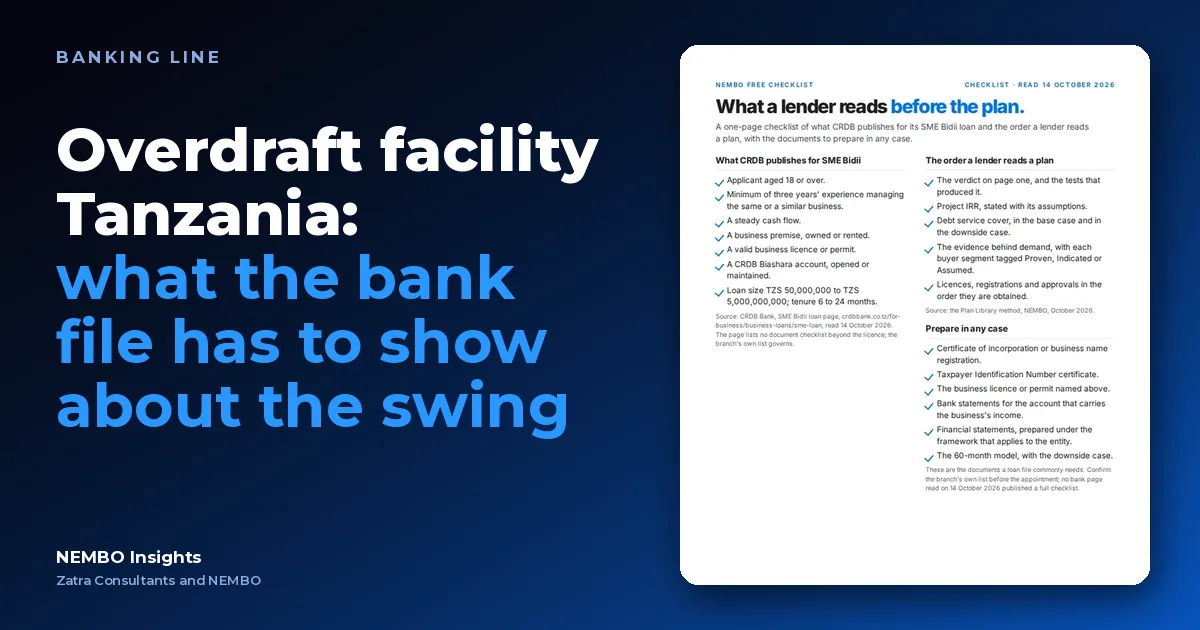
A bank holds its own record of your account, so it can check your reconciliation without help from you. CRDB's page for micro and small enterprise loans lists a steady cash flow and a business account among its eligibility requirements. The page, undated and read on 20 November 2026, does not list documents, so ask the bank for its checklist. The overdraft file guide and the covenant certificate guide show where cash figures enter a lender's file.
For TRA, RSM Tanzania advises that turnover per EFD should be reconciled to VAT returns and financial statements. It also says each reconciliation should be documented with variances explained, and that key reconciliations should be prepared in advance. A bank reconciliation is the first link in that chain, because the receipts that support turnover pass through the bank.
The Chartered Institute of Internal Auditors lists the signs a reviewer treats as warnings.
- Balancing figures. A plug amount means the reconciliation does not reconcile.
- Gaps in the timetable. Missed months suggest the control is not operating.
- Many unexplained adjustments. These can point to misunderstanding or fraud.
- Reliance on the external auditor. The auditor tests the reconciliation; it does not prepare it for you.
What to do now
- List every bank account. Include USD, savings, deposit and project accounts, and record the signatories on each.
- Write a one-page reconciliation policy. State the frequency, the working-day deadline, the preparer, the reviewer and the treatment of stale cheques.
- Reconcile the last month and the last year end. Use the two-table layout from the worked example and clear any balancing figure.
- Post the missing journals. Record charges, interest, direct debits and dishonoured cheques so that the cash book matches the adjusted balance.
- Age the open items. Chase every item older than the next statement and write a reason beside each one that stays open.
- Separate the duties. Make sure the preparer cannot sign cheques or post to the cash book.
- Keep the file together. Store the statement, the reconciliation, the support and the bank confirmation reply in one folder for the retention period.
- Ask your accountant to confirm the periods. Check the tax and company retention periods, and the server rule for electronic records, with CPA Altho Mwangoa before you rely on them.
Key dates
| Date or period | What happens | Source |
|---|---|---|
| Monthly, within your set deadline | Reconcile every bank account | Company policy; no statutory period found |
| Financial year end | Reconcile all accounts; auditor confirms balances with banks | ISA 505; IAS 7 |
| Five years from the relevant date | Minimum retention of tax records | Cap. 438 s.43(3), R.E. 2023 |
| Until the matter is finally determined | Longer retention during objection, appeal or audit | Cap. 438 s.43(4), R.E. 2023 |
| Six years from the date accounts are made up | Company books of account | PwC reading of s.151 of the 2002 text; confirm s.154 |
| 1 January 2024 | Primary data server rule for electronic records | Cap. 438 s.43(7) to (10); Bowmans |
What the NEMBO desk prepares
NEMBO designs and delivers the bank reconciliation statement, the reconciling items schedule, the journal sheet, the monthly sign-off page and the year-end cash pack as one controlled document set. Each page is numbered so that any balance can be traced from the statement to the cash book and to the support. The set sits inside the financial reports and CFO value packs desk. Zatra Consultants prepares and checks the content: the statement layout, the classification of items, the journals, the arithmetic, the tie to the bank confirmation and the retention schedule. Every page of the finished work reads free online first, with a Customise for your brand option on the library page.
There are two cost buckets on every quotation. Government charges are paid at the official rate to the authority concerned. A reconciliation statement attracts no government charge of its own, so the fee register has no line for it, and where it leads to a tax or registry filing the authority assesses the charge on filing. NEMBO's and Zatra's fees are published on the pricing page and quoted in writing before work starts. NEMBO does not decide or guarantee any authority's outcome, and the same holds for any bank or tender panel. The process page sets out how a brief becomes a delivered document.
How Zatra helps
Zatra's accounting and bookkeeping service and its management accounts and financial reporting service prepare and review reconciliations, and tax and reporting questions go to CPA Altho Mwangoa. Disputes, representation and legal opinions go to Advocate Yona Habiye. To begin, use the start page or the answers page, and read the related guides on the chart of accounts and the thirteen-week cash forecast.
Bank reconciliation statement and cash control pack
Zatra Consultants prepares and checks the content on the details the Client shares. NEMBO designs and delivers it. Fees are published on the packages page and quoted in writing.
Open the desk pageSources and status
Accurate as at 20 November 2026. The Tax Administration Act R.E. 2023 was read through s.43 on retention, but only in part, and the operative text of Companies Act R.E. 2023 s.154 was not read, only its heading. The six-year company retention period rests on PwC's reading of s.151 of the 2002 text. ISA 500 was read in the Irish adoption and ISA 505 through the IAASB project page and a CPA Ireland article. Figures are as printed on the sources and in the Zatra fee register on 20 November 2026.
- 1Companies Act Cap. 212, Revised Edition 2023Business Registrations and Licensing Agency, Revised Edition 2023. Accessed 20 November 2026.
- 2Tax Administration Act Cap. 438, R.E. 2023Tax Revenue Appeals Tribunal website, Revised Edition 2023. Accessed 20 November 2026.
- 3Tanzania Finance Act 2023 highlightsBowmans, 6 July 2023. Accessed 20 November 2026.
- 4NBAA Technical Pronouncement No. 1 of 2018National Board of Accountants and Auditors, approved 26 September 2018. Accessed 20 November 2026.
- 5IFAC profile of the NBAAInternational Federation of Accountants, undated page read 20 November 2026. Accessed 20 November 2026.
- 6IAS 7 Statement of Cash FlowsIFRS Foundation, page labelled 2026. Accessed 20 November 2026.
- 7ISA 505 External Confirmations project pageInternational Auditing and Assurance Standards Board, undated page read 20 November 2026. Accessed 20 November 2026.
- 8ISA (Ireland) 500 Audit EvidenceIrish Auditing and Accounting Supervisory Authority, file dated October 2023. Accessed 20 November 2026.
- 9External communications and confirmations articleCPA Ireland, undated page read 20 November 2026. Accessed 20 November 2026.
- 10Companies Act 2002 overviewPwC Tanzania, copyright 2007. Accessed 20 November 2026.
- 11How to audit a bank reconciliationChartered Institute of Internal Auditors, undated page read 20 November 2026. Accessed 20 November 2026.
- 12Navigating tax audits through timely reconciliationsRSM Tanzania, undated page read 20 November 2026. Accessed 20 November 2026.
- 13Taxes and duties at a glance 2025/2026Tanzania Revenue Authority, 2025/2026 edition. Accessed 20 November 2026.
- 14CRDB micro and small enterprise loansCRDB Bank, undated page read 20 November 2026. Accessed 20 November 2026.
Figures to confirm before you act
- Companies Act R.E. 2023 s.154 operative text and the six-year period for books of account: check the printed Revised Edition or BRELA.
- Tax Administration Act s.43 retention period, relevant date and primary data server rule: check the current Cap. 438 on the TRA site.
- Withholding rate on interest and excise duty rate on bank fees: check the current TRA taxes and duties schedule.
- Zanzibar retention periods and reporting rules for bank records: check with ZRA and BPRA before relying on the Mainland position.
- Cheque validity and stale cheque rules: check the terms of your own bank account, because they were not confirmed here.
- Reporting tiers in NBAA Technical Pronouncement No. 1 of 2018: check nbaa.go.tz for any later revision.
This article is general information based on official sources available at the date of publication. It is not legal, tax or financial advice. Laws and notices change. Verify with the issuing authority or consult Zatra before acting.
Frequently asked questions
Is a bank reconciliation statement a legal requirement in Tanzania?
No provision read for this guide names it. The duty sits one level down: the Companies Act requires books of account, and the Tax Administration Act requires records that let tax be determined accurately. A reconciliation is the control that shows those records are right, and auditors and lenders expect to see it.
What is the difference between the bank statement and the reconciliation statement?
The bank statement is the bank's own record of the account. The reconciliation statement is your schedule, prepared and signed internally, that explains each difference between that record and your cash book until the adjusted balances match. The first is outside evidence; the second is management's explanation of the gap.
Do unpresented cheques need a journal entry?
No. An unpresented cheque is already recorded in your cash book and has not yet reached the bank, so it is a timing difference. You deduct it on the bank side of the statement and check that it clears on the next statement. A journal is needed only for items the cash book lacks.
What should I do if the two sides will not agree?
Do not insert a balancing figure. Compare the difference with individual items, and test whether it divides by nine, which often signals two transposed digits, as with 1,260,000 and 1,620,000. Then recheck the opening balance, the prior month's open items and any account you did not list.
Can the external auditor prepare the reconciliation for us?
The auditor tests your reconciliation and confirms the balance with the bank. The Chartered Institute of Internal Auditors lists reliance on the external auditor to perform the reconciliation as a warning sign. An outsourced accountant may prepare it, but a manager should review and sign it.
Does the same method work for a mobile money wallet?
The method is the same: compare the provider's statement with your ledger and explain every difference. Expect settlement timing and commission lines as reconciling items. The provider's own rules and any Bank of Tanzania requirements for wallet accounts were not read for this guide, so confirm them with the provider.
Can I keep bank statements and reconciliations electronically?
Section 43(1) of the Tax Administration Act, as read, allows documents in paper or electronic form. Keep the statement as downloaded from the bank portal, with the reconciliation and support, and check the primary data server rule in s.43 if your ledger runs on a foreign cloud service.
Does a reconciliation help a bank loan or overdraft application?
It helps indirectly. The bank holds its own record of your account and compares your cash figures with it. CRDB's published page for small enterprise loans lists a steady cash flow among its requirements, so a clean, signed reconciliation supports the cash balance in your accounts. Ask the bank for its checklist.