On this page
- What the law says
- Who should read this
- What must a purchase order contain?
- What is the difference between a delivery note and a goods received note?
- How does the three-way match work?
- Which document does TRA want to see?
- Does a public buyer handle receipt and payment differently?
- How does the match run for imports and for Zanzibar?
- Worked example: a hardware order with a short delivery and a price change
- What goes wrong
- What to do now
- Key dates
- What the NEMBO desk prepares
- How Zatra helps
- Sources and status
- Frequently asked questions
What documents should a Tanzanian buyer hold before paying a supplier's invoice?
An approved purchase order, the supplier's delivery note signed on receipt, the buyer's own goods received note recording what was accepted, and the supplier's fiscal tax invoice. The three-way match compares the order, the receipt and the invoice on quantity, price and VAT, and only a matched invoice is approved for payment.
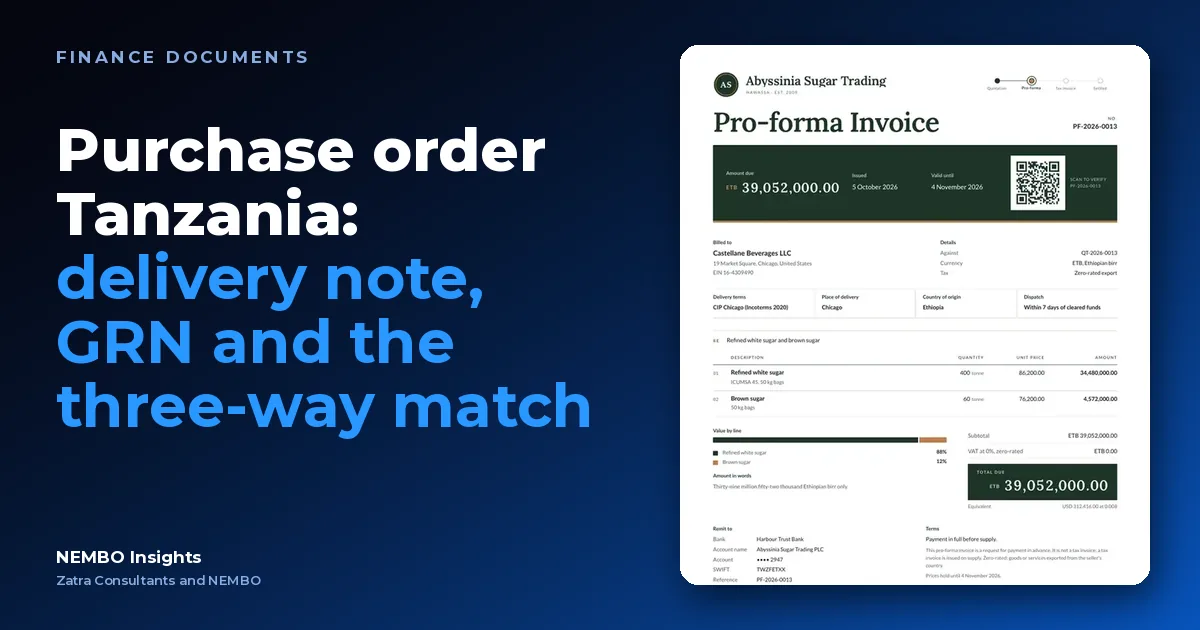
A purchase order Tanzania buyers issue is not a tax document, and that is why it is often skipped. The fiscal receipt is the document TRA asks for, the tax invoice is the one the VAT return needs, and the delivery note is the one the driver wants signed. The purchase order and the goods received note are the buyer's own records, and they are the two that stop a company paying for goods it did not order or did not receive. This note sets out the four documents in a purchase, who issues each, what each proves, and how the three-way match runs before an invoice is approved. It is the buying-side companion to the notes on the three selling documents, the EFD receipt and tax invoice and the credit note.
What the law says
No Tanzanian statute prescribes a purchase order or a goods received note for a private buyer. The documents exist because four duties make them necessary. Section 44(1) of the Tax Administration Act, Cap. 438 requires a person who supplies goods or services, or receives payment for them, to issue a fiscal receipt, and TRA's fiscal devices page makes it an offence for a buyer to fail to demand one. Section 11(4) of the Income Tax Act, Cap. 332, as inserted by the Finance Act 2024, makes expenditure deductible only where it is supported by a fiscal receipt, as the Zatra note on EFD receipts explains. Section 90 of the Value Added Tax Act, Cap. 148 governs the tax invoice, and the TRA VAT page bars an input tax claim later than six months from the invoice or receipt (register line F0245). Section 43 of the Tax Administration Act requires the buyer to keep the documents that enable an accurate determination of its tax for five years from the relevant date. The Sale of Goods Act, Cap. 214 supplies the contract rules on delivery, examination and acceptance that a goods received note records; the desk could not read its text and cites it by name only. For a public buyer, section 96(1) of the Public Procurement Act, 2023 bars payment before goods are delivered and accepted by the accounting officer or an officer authorised in writing.
| Document | Issued by | What it proves | Legal hook |
|---|---|---|---|
| Purchase order | Buyer, signed under the delegation of authority | What was ordered, at what price and terms, by someone with authority to commit the company | Companies Act, Cap. 212, s.40: a contract made by a person with express or implied authority binds the company |
| Delivery note | Supplier, carried with the goods | What the supplier says it delivered, signed by the buyer's receiver with date and time | Sale of Goods Act, Cap. 214: delivery and the buyer's right to examine the goods |
| Goods received note | Buyer, by the stores or receiving officer | What was counted, inspected and accepted, with shortages, damage and rejections | Sale of Goods Act, Cap. 214: acceptance; Public Procurement Act s.96(1) for public buyers |
| Fiscal tax invoice | Supplier, from the fiscal device | The price, the VAT and the supplier's TIN and VRN, for the deduction and the input tax claim | Cap. 438 s.44; Cap. 332 s.11(4); Cap. 148 s.90 |
Who should read this
Finance managers and accounts payable clerks who approve supplier invoices. Stores and site staff who sign delivery notes, because the signature is the company's admission that the goods arrived. Procurement officers who issue orders, and the directors who set the limits they may sign to. Suppliers, because a buyer with a working three-way match pays matched invoices on time and queries unmatched ones for weeks, and the supplier's own paperwork decides which pile an invoice lands on. Public procuring entities, whose receipt and acceptance steps are set by the Act and run through NeST, as the post-award note describes.
What must a purchase order contain?
A purchase order is an offer to buy on stated terms. When the supplier accepts it, by confirmation or by delivering, the contract exists on those terms, so the order has to say everything the buyer wants to hold the supplier to. The Zatra note on execution of documents explains that under section 40 of the Companies Act a contract is made by a person acting under the company's express or implied authority. The delegation of authority note sets the limits each signatory holds. An order signed above the signatory's limit still binds the company to an outsider dealing in good faith; the limit is an internal control, enforced by the matching step, not a defence against the supplier.
| Field | Why it is there |
|---|---|
| Order number, date, buyer's name, address and TIN | The number is the key every later document quotes; the TIN is what the supplier's fiscal invoice must carry for the buyer |
| Supplier's name, address, TIN and VRN | Confirms the supplier is VAT-registered where VAT is charged, so the input tax is claimable |
| Line items: description, specification, quantity, unit, unit price, VAT rate, line total | The three-way match runs line by line; a lump sum cannot be matched |
| Currency and the exchange basis if not TZS | The Bank of Tanzania Act, as amended, requires domestic transactions to be quoted and settled in shillings subject to exemptions |
| Delivery address, date or window, and the person to receive | Fixes where and when the delivery note will be signed |
| Payment terms: days from matched invoice, not from invoice date | Starts the clock from the buyer's acceptance, which section 96(1) of the Public Procurement Act makes mandatory for public buyers |
| Quality, warranty, returns and rejection terms | The basis on which the goods received note may reject a line |
| Signature and title of the approver, within the delegation of authority | Evidence of authority under section 40 and the control that the matching step checks |
What is the difference between a delivery note and a goods received note?
The delivery note is the supplier's document. It travels with the goods and lists what the supplier says is in the consignment. The receiver signs it, and the signed copy returns to the supplier as proof of delivery. A receiver who signs without counting has signed the supplier's version of events. The goods received note is the buyer's document. It records what was counted, inspected and accepted, line by line, against the purchase order, with shortages, damage, rejected items and the time of inspection. It is raised by the stores or receiving officer, not by the person who placed the order, so that the person who committed the money is not the person who confirms the goods arrived. Where the goods need testing, the note records that acceptance is provisional until the test result. The delivery note proves the supplier delivered; the goods received note proves the buyer accepted. The invoice is matched to the second, not the first.
How does the three-way match work?
The match compares three documents on five points before an invoice is approved. The order supplies the authorised quantity and price. The goods received note supplies the accepted quantity. The fiscal invoice supplies the billed quantity, price and VAT. Any difference outside a stated tolerance holds the invoice and sends it back to the person who can resolve it: procurement for a price difference, stores for a quantity difference, the supplier for a VAT or TIN error. A tolerance is set by the board, for example 2 percent of line value for price and nil for quantity. The step is a control under the COSO internal control framework, which the delegation of authority note applies to a Tanzanian company, and the matching procedure is a controlled document under the ISO 9001:2015 approach in the standard.
| Match point | Order | Goods received note | Invoice | If it fails |
|---|---|---|---|---|
| Quantity | Ordered | Accepted | Billed | Pay the accepted quantity; ask for a credit note for the rest |
| Unit price | Agreed | Not stated | Billed | Hold; procurement confirms the agreed price or approves the change |
| VAT | Rate per line | Not stated | Charged, with VRN | Hold; an invoice without a VRN or at the wrong rate cannot support an input claim |
| Supplier identity | Name, TIN | Name on the delivery note | Name, TIN, VRN on the fiscal invoice | Hold; a different name is a different supplier or a mis-issued invoice |
| Dates | Order date before delivery | Receipt date | Invoice date on or after receipt | Query an invoice dated before the goods arrived |
Which document does TRA want to see?
The fiscal receipt or fiscal invoice. Section 44(1) of the Tax Administration Act requires it from the supplier, section 11(4) of the Income Tax Act makes the expense deductible only with it, and the VAT Act's input tax rules run from it. TRA's fiscal devices page sets the offences. A seller who fails to issue a fiscal receipt on receiving payment faces a fine of 200 to 300 currency points, imprisonment of up to three years, or both. A buyer who fails to demand or report a denial faces a fine of up to 100 currency points. A currency point is TZS 20,000 (NEW-02-05). The purchase order and the goods received note are not tax documents, but they are records that enable an accurate determination of tax under section 43(1)(b). In an audit they show that the invoice was for goods the company received for its business. Where a supplier is excluded from fiscal devices under section 44(2), the manual receipt under section 44(4) must carry the date, the seller's and buyer's names and addresses, the description and value, the TIN and any other particulars the Commissioner General specifies. The record retention note gives the five-year clock.
Does a public buyer handle receipt and payment differently?
Yes. Section 96(1) of the Public Procurement Act, 2023 provides that works, goods or services shall not be paid for before they are executed, delivered or rendered and accepted. Acceptance is by the accounting officer or an officer authorised in writing, unless the tender document and contract specify otherwise. The accounting officer appoints an inspection and acceptance committee under section 38(1)(c), as the desk read it in an extract, and section 94 makes the user department responsible for conformity, quantity, quality, cost and time. Section 99 is headed receipt and recording of goods, supplies or assets; the desk could not reach its text. The 2025 NeST guidelines require tenderers to submit payment claims through the system and entities to pay in it. A supplier to a procuring entity therefore attaches its delivery note, the entity's acceptance record and the fiscal invoice to the claim, and the entity's own three-way match runs inside the contract module. The special groups note and the Zatra note on government supplier registration cover the file that precedes the claim.
How does the match run for imports and for Zanzibar?
For an import the purchase order is matched to the pro-forma invoice, the bill of lading or air waybill and the customs entry, and the goods received note is raised on clearance, not on the supplier's dispatch. The pro-forma invoice note and the Zatra note on the import pack set out those documents, and the Railway Development Levy at 2 percent of CIF (F0309), import duty and VAT on the entry join the landed cost. In Zanzibar the fiscal receipt, tax invoice and VAT are administered by the Zanzibar Revenue Authority at a 15 percent standard rate with a TZS 100 million registration threshold (F0246). A Mainland buyer purchasing from a Zanzibar supplier should expect a ZRA fiscal invoice. The three-way match itself is a control, not a tax rule, and runs the same way on both sides; the documents it matches carry the authority that issued them.
Worked example: a hardware order with a short delivery and a price change
Mlima Builders Limited, a Mainland VAT-registered contractor, orders three lines from a Dar es Salaam supplier on purchase order PO-2026-0412, signed by the operations manager within a TZS 30,000,000 limit. The supplier delivers on 18 November 2026 and invoices on 19 November 2026. Prices are VAT exclusive; VAT is 18 percent (F0239).
| Line | Ordered | Accepted on the GRN | Invoiced | Match result |
|---|---|---|---|---|
| Cement, 50 kg bags at TZS 18,500 | 600 bags, TZS 11,100,000 | 580 bags; 20 bags torn and rejected | 600 bags, TZS 11,100,000 | Quantity fail: pay 580 bags, TZS 10,730,000; credit note for TZS 370,000 plus VAT |
| Reinforcement bar, 12 mm, at TZS 1,480,000 a tonne | 8 tonnes, TZS 11,840,000 | 8 tonnes, weighbridge ticket attached | 8 tonnes at TZS 1,520,000, TZS 12,160,000 | Price fail: 2.7 percent above the order, outside the 2 percent tolerance; hold for procurement |
| Binding wire, 25 kg rolls at TZS 62,000 | 40 rolls, TZS 2,480,000 | 40 rolls | 40 rolls, TZS 2,480,000 | Match: approve |
| VAT at 18 percent | TZS 4,575,600 on TZS 25,420,000 | Not stated | TZS 4,633,200 on TZS 25,740,000 | Recomputed on the approved net after the two holds are resolved |
Procurement confirms that the supplier had notified a price rise before the order and the buyer accepted it by email, so the bar price of TZS 1,520,000 is approved and the order is amended to record it. The cement line is paid at 580 bags. The approved net is TZS 10,730,000 plus 12,160,000 plus 2,480,000, which is TZS 25,370,000, with VAT of TZS 4,566,600, a total of TZS 29,936,600. The supplier issues a credit note for the 20 bags, TZS 370,000 plus VAT of TZS 66,600, against the original invoice, and the buyer claims input tax of TZS 4,566,600 in the November return by the 20th of December. Without the goods received note the buyer would have paid TZS 30,373,200 on the invoice as rendered, TZS 436,600 more than it owed.
What goes wrong
The first failure is the order raised after the invoice, to make the file look complete; the dates expose it. The second is the delivery note signed by the gate guard without a count, which makes the supplier's quantity the company's quantity. The third is the invoice matched to the delivery note rather than the goods received note, so that rejected goods are paid. The fourth is the fiscal receipt that names the wrong buyer or carries no VRN, which costs the input tax and the deduction. The fifth is a tolerance nobody set, so that every small difference is either waved through or argued over. The sixth is one person who orders, receives and approves, which no match can control. The seventh is the credit note never requested, so the ledger carries a supplier balance the supplier does not recognise. The invoice terms note shows how the same disputes look from the supplier's side.
What to do now
- Number the orders. One sequence, one register, no order without a number, and the number quoted on every delivery note, goods received note and invoice.
- Set the signing limits. Put the purchase order limits in the delegation of authority matrix and give the matching clerk the list.
- Separate the three roles. One person orders, another receives and raises the goods received note, a third matches and approves.
- Write the receiving procedure. Count, inspect, record shortages and damage on the delivery note before signing, raise the goods received note the same day, and attach weighbridge or test evidence.
- Fix the tolerances. Board-approved tolerances for price and quantity, written in the matching procedure.
- Check the fiscal invoice. Buyer's name and TIN, supplier's TIN and VRN, VAT rate, fiscal signature, invoice date on or after receipt.
- Chase the credit note. Any short delivery or price correction is settled by a credit note within the supplier's seven-day adjustment duty, not by a short payment.
- File the set together. Order, delivery note, goods received note, invoice and credit note in one file per order, kept five years from the relevant date.
Key dates
| Trigger | Period | Source |
|---|---|---|
| Payment received by a supplier | Fiscal receipt issued at the time | Cap. 438 s.44(1) |
| Fiscal device malfunction | Notice to the Commissioner within 24 hours | TRA fiscal devices page |
| Input tax claim | Not later than six months from the invoice or receipt | TRA VAT page; F0245 |
| VAT return and payment | By the 20th of the following month | TRA VAT page; F0245 |
| Adjustment note after a short delivery or price change | Within seven days of the supplier becoming aware, as the credit note note reports | Cap. 148 s.75 |
| Retention of the order file | Five years from the relevant date, extended by any audit or objection | Cap. 438 s.43 |
| Public buyer payment | Not before delivery and acceptance | Public Procurement Act 2023 s.96(1) |
What the NEMBO desk prepares
The client shares the facts: the suppliers, the order limits, the receiving points and the systems in use. Zatra Consultants prepares and checks the content: the order and goods received note formats, the matching procedure, the tolerances and the fiscal invoice checklist, against the Acts as read. NEMBO designs and delivers the documents. The desk prepares the purchase order, delivery note and goods received note set on one numbering scheme with the quotation, pro-forma and tax invoice set. It prepares the receiving and matching procedures as controlled documents, the supplier ledger page in the CFO pack, and the approval workflow in the systems service. The Invoice Library holds the specimen set. Fees are published on /packages/ and /pricing/ and quoted in writing. Government taxes and fees are paid to the authority at the official rate against its control number and are separate from NEMBO's and Zatra's fees. See how a job runs, or share the details.
How Zatra helps
Zatra checks the facts, filings and figures: the fiscal invoice fields, the VAT computation, the input tax timing and the supplier ledger. The accounting and bookkeeping service runs the match inside the monthly close, and the process and SOP service writes the receiving and matching procedures. The desk does not decide or guarantee any authority's outcome, whether that authority is TRA, the Zanzibar Revenue Authority or a procuring entity. A dispute with a supplier over rejected goods or a contested invoice goes to an advocate. The VAT return and the deduction go to an accountant.
Quotation, pro-forma and tax invoice
Zatra Consultants prepares and checks the content on the details the Client shares. NEMBO designs and delivers it. Fees are published on the packages page and quoted in writing.
Open the desk pageSources and status
Accurate as at 11 November 2026. Sections 43 and 44 of the Tax Administration Act and section 96 of the Public Procurement Act were read verbatim. Section 90 of the VAT Act and the Sale of Goods Act could not be read and are cited by name. TRA pages were read on the dates shown.
- 1The Tax Administration Act, Cap. 438, Revised Edition 2023Tax Revenue Appeals Board copy, 2023 edition. Accessed 11 November 2026.
- 2The Value Added Tax Act, Cap. 148, Revised Edition 2023Tax Revenue Appeals Board copy, 2023 edition. Accessed 11 November 2026.
- 3E-Fiscal Devices (EFD)Tanzania Revenue Authority, page read 11 November 2026. Accessed 11 November 2026.
- 4Value Added Tax (VAT)Tanzania Revenue Authority, page read 7 November 2026. Accessed 11 November 2026.
- 5The Public Procurement Act, 2023, Act No. 10 of 2023, English translation, GN 813Public Procurement Regulatory Authority, 20 September 2024. Accessed 11 November 2026.
- 6Guidelines for Use of National Electronic Procurement System of Tanzania, 2025Public Procurement Regulatory Authority, effective 30 July 2025. Accessed 11 November 2026.
- 7Guidance on internal controlCommittee of Sponsoring Organizations of the Treadway Commission, framework 1992, refreshed 2013. Accessed 11 November 2026.
- 8ISO 9001:2015 Quality management systems, RequirementsInternational Organization for Standardization, September 2015. Accessed 11 November 2026.
- 9EFD receipts in Tanzania: what a fiscal receipt must showZatra Consultants Limited, 14 September 2026, reviewed 28 October 2026. Accessed 11 November 2026.
- 10Company seal Tanzania: how a company signs, seals and executes deedsZatra Consultants Limited, 4 November 2026. Accessed 11 November 2026.
- 11Import documentation for Tanzania: the pack before goods arriveZatra Consultants Limited, 14 September 2026. Accessed 11 November 2026.
- 12Registering as a government supplier: PPRA, NeST and the tender routeZatra Consultants Limited, 2026. Accessed 11 November 2026.
Figures to confirm before you act
- Section 90 of the VAT Act on the contents of a tax invoice, cited by heading only.
- The Sale of Goods Act, Cap. 214 provisions on delivery, examination and acceptance, not read.
- Section 38(1)(c) of the Public Procurement Act on the inspection and acceptance committee, read in an extract, and section 99, not reached.
- The fiscal receipt offences and the currency point of TZS 20,000 (NEW-02-05), at 26 September 2026.
- VAT at 18 percent (F0239), the six-month input window and the 20th-of-month return (F0245), and the Zanzibar rate and threshold (F0246), at 26 September 2026.
- The tolerances and prices in the worked example, which are the company's own.
This article is general information based on official sources available at the date of publication. It is not legal, tax or financial advice. Laws and notices change. Verify with the issuing authority or consult Zatra before acting.
Frequently asked questions
Is a purchase order legally binding in Tanzania?
Once the supplier accepts it, by confirmation or by delivering against it, the order's terms form the contract. Under section 40 of the Companies Act a contract made by a person with express or implied authority binds the company, so an order signed above an internal limit still binds the buyer towards a supplier acting in good faith.
Can we pay on the delivery note?
Pay on the goods received note. The delivery note is the supplier's statement of what it sent; the goods received note is the buyer's record of what was counted and accepted. Paying on the first means paying for shortages and rejected goods, which then need a credit note the supplier may resist.
What if the supplier will not give a fiscal receipt?
Report it. TRA's fiscal devices page makes failing to demand or report a denial of a fiscal receipt an offence for the buyer, with a fine of up to 100 currency points. Without the receipt the expense is not deductible under section 11(4) of the Income Tax Act and the input VAT cannot be claimed.
Does a small company need a goods received note?
Yes, if it wants to pay only for what it received. The note can be a stamp and a signature on the buyer's copy of the delivery note, with the counted quantity and any rejection written in. The point is a record made by the receiver, on the day, independent of the person who ordered.
Who should sign the goods received note?
The person who counted and inspected the goods, who should not be the person who raised the order or the person who approves the payment. In a small business the same person may hold two of the three roles; a director should then review the matched file before payment.
How do we handle a price increase after the order?
Amend the order in writing before accepting the goods, or hold the invoice line until procurement confirms the increase was agreed. An invoice price above the order is a match failure; approving it without an amended order breaks the control the order exists to provide.
Does the three-way match apply to services?
Yes, with a service acceptance record in place of the goods received note. The project manager or user department confirms the hours, deliverables or milestones against the order, and the invoice is matched to that record and to the fiscal invoice.
How long must the order file be kept?
Five years from the relevant date under section 43 of the Tax Administration Act, which for income tax is the end of the year of income, and longer while an audit, objection or refund claim is open. Keep the order, delivery note, goods received note, invoice and credit note together.