On this page
- What the law says
- Who should read this
- Who can complain, and when?
- What is the standstill, and what does it protect?
- What must a complaint contain?
- What goes into the PPAA appeal file?
- How does a bidder preserve evidence?
- How should the complaint be written?
- What happens at the PPAA?
- What will the appeal not do?
- What not to do
- Worked example: a dated timeline
- Mainland and Zanzibar
- What to do now
- Key dates and timings
- What the NEMBO desk prepares
- How Zatra helps
- Sources and status
- Frequently asked questions
How does a bidder challenge a tender award in Tanzania?
Complain in writing to the procuring entity's accounting officer within the five working days the notice of intention to award allows. If the reply is late or unsatisfactory, appeal to the PPAA on Form No. 1 with the fee. PPAA pages give five or seven working days for the appeal, so verify and file at the earlier date.
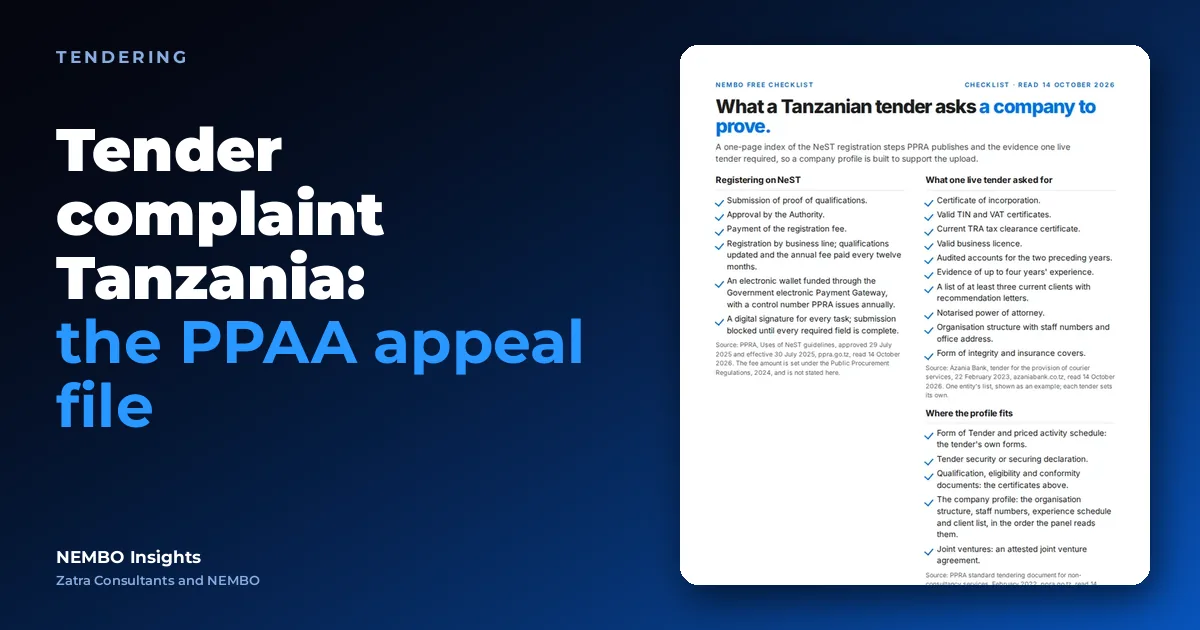
A tender complaint Tanzania bidders lodge is a legal step with short clocks, not a letter of protest. The Public Procurement Act 2023 gives a losing bidder a route: a written complaint to the procuring entity's accounting officer, then an appeal to the Public Procurement Appeals Authority, called the PPAA. The clocks run in working days. The PPAA's own pages disagree on one of them. This note sets out what the desk could read, what it could not, and the appeal file a bidder should build while the clock runs. It is a companion to the notes on NeST registration and the tender file, evaluation criteria and performance security.
What the law says
The desk read the Act, the 2024 Regulations, the PPRA's 2025 NeST guidelines and the PPAA pages on 12 November 2026. We tier each claim. Settled means an official text or page states it. Verify means sources conflict or the text could not be read. Unknown means the desk found nothing. The Act text is published by the regulator, the Public Procurement Regulatory Authority, on its Act PDF. The copy the desk could open stops before Part XI, which holds the complaint and appeal sections. The table therefore rests on section 69, the NeST guidelines and the PPAA pages.
| Rule | What the sources say | Tier |
|---|---|---|
| Notice of intention to award | Accounting officer issues it to all tenderers, with five working days to complain (section 69(4)) | Settled |
| Standstill | The word is not used in the text read; the five working days work as the pause | Verify |
| Complaint first | Complain to the accounting officer, who decides within five working days (PPAA pages) | Verify |
| Appeal to the PPAA | Five working days on two pages, seven on the FAQ page | Verify |
| Contract already in force | Appeal direct, five working days from awareness | Verify |
| PPAA decision time | Forty days from registration; calendar or working days not stated | Verify |
| Filing channel | NeST guidelines say lodge in the system; PPAA pages describe a form, a letter and email | Verify |
| Zanzibar | Own law and authority; not read by the desk | Unknown |
Three points are settled on the texts read. The notice of intention to award is signed by the accounting officer and sent electronically (section 69(7)). The accounting officer handles tenderers' complaints and sends the Authority a copy with the findings (section 38(1)(n)). The PPRA's NeST guidelines of 2025, effective 30 July 2025, say weekends and public holidays do not count when the system computes complaint and appeal time.
Who should read this
Directors and bid managers of Mainland firms that bid through NeST. Finance managers who must explain a lost tender to a board. Company secretaries who keep the authority papers. Advocates who will draft the complaint and any appeal. A Zanzibar bidder should read the Mainland and Zanzibar section first. A bidder that has not yet bid should read the note on bid security as well.
Who can complain, and when?
Any tenderer in the process may complain. The PPAA's how-to page lists the matters it hears: acceptance or rejection of a tender, an award or intention to award, an unacceptable clause in the tender document, a process that broke the rules, and failure to decide in time. It also covers appeals against blacklisting by the regulator, which have their own limit of 21 days.
There are three routes. First, complain to the accounting officer after the notice of intention to award. Second, if the accounting officer is late, go to the PPAA within five working days of the date the decision was due. Third, if the contract is already in force, go direct to the PPAA within five working days of learning of the matter. Each of these day counts comes from PPAA pages and sits at the verify tier.
Complaints about a tender clause belong early. Regulation 12(1) of the 2024 Regulations sets clarification requests at least three days before a competitive deadline. A bidder who saw a defective clause and said nothing weakens a later complaint. That is the desk's reading, not a stated rule.
What is the standstill, and what does it protect?
The standstill is the pause between the notice of intention to award and the next step. Section 69(4) gives tenderers five working days to complain. If none is lodged, the accounting officer issues a notice of acceptance to the successful tenderer (section 69(6)). Section 69(5) lifts the notice for national shopping, common use items and services, single source and minor value procurement. Check which method your tender used.
The NeST guidelines issue the notice through the system and show the reasons for award and for non-responsiveness. Their First Schedule shows one to five working days from notice to letter of acceptance, depending on the method. Do not read that as extra time for you. Two questions remain at the unknown tier: whether a lodged complaint suspends the award, and whether it suspends contract signing. The desk could not read the sections that answer them.
What must a complaint contain?
The desk found no prescribed form for the first complaint. The PPAA lists four items for an appeal, and a sound complaint mirrors them. The PPAA FAQ page says the complaint goes to the Permanent Secretary of the ministry or the chief executive of the institution.
- The entity and tender. Name, address, tender number and title.
- The decision challenged. The notice or award, with the date you received it.
- The grounds. One numbered ground per defect, each tied to a document.
- The remedy sought. State what you ask the accounting officer to do.
- The attachments. An indexed list, signed by your authorised signatory.
The NeST guidelines say tenderers lodge complaints in the system. Keep the lodgement receipt. It proves the date.
What goes into the PPAA appeal file?
The PPAA requires Form No. 1, the Statement of Appeal, and the appeal fee. The Form 1 content is the entity, the tender, the grounds and the remedies. The rest of the table is the desk's practice for a file that an advocate can use at once. It is not a PPAA checklist.
| Item | What it shows | Where it comes from |
|---|---|---|
| Form No. 1, Statement of Appeal | Entity, tender, grounds, remedies | PPAA forms page |
| Your bid and submission receipt | What you filed, and when | NeST |
| Tender document, addenda, clarifications | The rules the panel had to apply | NeST download record |
| Notice of intention to award | Stated reasons and the start of the clock | NeST |
| Evaluation report extract | How each criterion was scored | The entity, on request |
| Your complaint and proof of lodging | You complained first, on time | NeST |
| Accounting officer's reply, or proof of none | The trigger for the appeal | NeST |
| Evidence exhibits, indexed | Support for each ground | Your records |
| Authority to act | Who may sign and instruct counsel | Board resolution, power of attorney |
| Proof of fee | The fee was paid | Payment receipt |
The entity answers on Form No. 2, the Statement of Reply, listed on the PPAA forms page. That page lists the forms with a numbering mismatch, so download the current set from the PPAA site, not from an old link. Some PPAA links point to a demo server.
Evaluation papers are not always handed over. Regulation 14 of the 2024 Regulations lists what a procurement record holds, including a summary of pre-award complaints, and sets a five working day release on request in the cases it names. Some items go only on an order of the Authority, the Appeals Authority or a court. Verify what your entity must release.
How does a bidder preserve evidence?
Start on the day the notice arrives. Evidence that exists only in one person's inbox is weak evidence.
- Freeze the bid record. Export your submission and the timestamped receipt. Do not edit the originals.
- Save the tender pack as issued. Keep the documents, addenda and clarifications in their original format.
- Capture status pages. Screenshot the NeST pages that show dates, with the date visible.
- Log contacts. Note every call and meeting with the entity: who, when, what was said.
- Request records in writing. Ask for the evaluation extract and keep the request and any reply.
- Appoint one custodian. One person holds the index and the copies. See the retention note for how long to keep the set.
Never obtain another bidder's confidential papers by improper means. A file built that way can end the appeal and expose the company.
How should the complaint be written?
Write facts first. A fact points to a document: the tender document gives experience a stated number of marks, and the evaluation extract gives your bid fewer. An allegation points to a motive: the panel favoured a rival. Facts can be proved from the file. Allegations need evidence of their own.
The PPAA hearing page says arguments must rest on the filed papers, so the complaint is also the outline of the appeal. Use plain, measured language. Do not allege corruption, bias or fraud without evidence and an advocate's review. A careless allegation can harm the bidder and may expose it to a claim of its own.
What happens at the PPAA?
The appeal is registered on filing of Form No. 1 and the fee. The PPAA pages say the Authority decides within 40 days of registration. The hearing page adds that it decides within five working days after the hearing ends. How the two periods fit is at the verify tier.
The hearing is described as simple and not bound by technical court rules. A party may bring an expert, and the page says a lawyer is not required. New arguments are not raised at the hearing unless the Authority allows it. Adjournments are described as rare. A tidy, early file suits that approach.
The tenderer who would receive the award may join as a party. The PPAA states five working days from notice of the appeal, Form No. 5, and Regulation 17 of the Appeals Rules. An extension of time is a separate application, within five working days of the original due date, with reasons proved beyond doubt. The application page names Form No. 5 for it while the forms page lists a form numbered 6. Verify the form.
The Daily News reported on 25 May 2026 that the PPAA has a complaints and appeals module in NeST where bidders track appeals. It also reported a planned link to the Judiciary's system for High Court review in 2026/27. The Citizen reported on 13 April 2025 that the Executive Secretary said filings outside NeST would not be recognised once enforced. File through NeST and keep the receipt. Confirm the channel with the PPAA.
What will the appeal not do?
It will not hear disputes about contract implementation. The PPAA says so on its complaint pages. Those follow the contract's own procedure.
It will not guarantee a result. It decides on the grounds you raised and the papers you filed. It will not reopen points you left out. Whether the PPAA can award costs or damages is unknown, because no page the desk read says so. The list of orders it can make is also not stated. The appeal form asks only what remedy you want.
It will not replace an advocate. An appeal is a legal process an advocate should run. Review by the High Court is a further step with its own rules, which the desk did not read.
What not to do
- Do not wait for a debrief. The clock started at the notice or at your awareness.
- Do not skip the complaint. Go to the PPAA first only where the accounting officer is late or the contract is in force.
- Do not rely on one day count. File at the earlier of any two stated limits.
- Do not contact evaluators informally. Write to the accounting officer.
- Do not alter documents. A corrected copy is a new document, marked as such.
- Do not argue in public. Social media posts about the entity or a rival add risk and no weight.
- Do not hold back grounds. New points are rarely allowed at the hearing.
Worked example: a dated timeline
This example is illustrative. It uses the five working day limits read on the Act and PPAA pages, ignores weekends and assumes no public holidays. Whether the notice day counts, and whether the PPAA's 40 days are calendar days, are verify points.
| Date | Event | Basis |
|---|---|---|
| Mon 7 June 2027 | Notice of intention to award issued in NeST | Section 69(4) |
| Fri 11 June 2027 | Complaint lodged, working day 4 | Within five working days |
| Mon 14 June 2027 | Last day to complain | Day after notice counted as day 1 |
| Thu 17 June 2027 | Accounting officer rejects the complaint | Due date was Fri 18 June |
| Thu 24 June 2027 | Last day to appeal, five working days | PPAA how-to page |
| Mon 28 June 2027 | Last day to appeal, seven working days | PPAA FAQ page |
| Tue 3 Aug 2027 | Decision due if registered 24 June, in calendar days | 40 days from registration |
The careful bidder files by Thursday 24 June at the latest and aims for the Monday before. It does not plan on 28 June. If the appeal is filed, the fee is TZS 300,000 as stated by the PPAA fee page, not in the Zatra fee register; confirm with PPAA. The same page sets TZS 1,000,000 to withdraw an appeal, so decide the grounds with counsel before filing.
Mainland and Zanzibar
Everything above concerns the Mainland system: the Public Procurement Act 2023, the PPRA, NeST and the PPAA. The Zatra supplier registration note records that Zanzibar has its own procurement law and authority, so a Mainland registration does not cover Zanzibar tenders. The desk did not read the Zanzibar law, its authority's pages or any Zanzibar complaint route. Time limits, forum and fees for Zanzibar tenders are unknown. Take advice from a Zanzibar advocate before acting.
What to do now
- Diary the dates. Record the notice date and the earliest possible limit. Count working days from the day after.
- Brief an advocate. Send the notice and tender pack on day one. The advocate drafts the complaint and any appeal.
- Freeze the evidence. Export the bid, receipt, addenda and status pages. Name one custodian.
- Request the records. Ask the entity in writing for the evaluation extract.
- Draft facts first. List each defect with its document. Remove any sentence that guesses a motive.
- Lodge the complaint in NeST. Keep the receipt and a copy of every attachment.
- Prepare the appeal shell. Download the current Form No. 1, assemble the table above and confirm the fee and channel with the PPAA.
Key dates and timings
| Step | Limit | Tier |
|---|---|---|
| Complaint after notice of intention to award | Five working days (Act section 69(4)) | Settled |
| Accounting officer decides | Five working days (PPAA pages) | Verify |
| Appeal after decision | Five or seven working days | Verify |
| Appeal when decision late | Five working days from due date | Verify |
| Appeal when contract in force | Five working days from awareness | Verify |
| Join an appeal | Five working days from notice | Verify |
| Extension of time | Five working days from original due date | Verify |
| Blacklisting appeal | 21 days from knowledge | Settled |
| PPAA decision | 40 days from registration | Verify |
What the NEMBO desk prepares
Zatra Consultants prepares the facts and figures, and NEMBO designs and delivers the documents. For a bidder in a dispute, the desk prepares the indexed evidence file, the bid and company papers in the investor and tender documents set, and a timeline of dates for the advocate. The delegation of authority matrix supports the authority-to-act paper. Fees are shown on /pricing/ and /packages/; see /pricing/ for what each costs. The PPAA fee, any court fee and an advocate's fee are paid at the official or agreed rate and are separate from NEMBO's and Zatra's fees. NEMBO does not decide or guarantee any authority's outcome, and that includes a bank's or a tender panel's decision. See how a job runs, or share the details.
How Zatra helps
Zatra checks the facts behind the file: the bid, the register papers and the tax clearance valid on the closing date. The tender and procurement advisory service builds the standing evidence pack and checks a bid against the invitation before submission. The corporate secretarial service keeps the resolutions and signatory papers current. The complaint and the appeal are an advocate's work. Financial claims in a bid are an accountant's work. Zatra does not submit bids in its own name, does not promise an award, and routes each part to the right professional.
Investor documents and tender files
Zatra Consultants prepares and checks the content on the details the Client shares. NEMBO designs and delivers it. Fees are published on the packages page and quoted in writing.
Open the desk pageSources and status
Accurate as at 12 November 2026. The copy of the Public Procurement Act the desk could open stops before Part XI, and the 2024 Regulations stop at Regulation 29, so the complaint and appeal sections of both were not read. Time limits come from PPAA pages, which disagree on one day count. The PPAA fee is as stated by its fee page. Three press reports loaded only in part.
- 1How to file an appeal (Jinsi ya kukata rufaa)Public Procurement Appeals Authority, undated page, read 12 November 2026. Accessed 12 November 2026.
- 2Appeals Authority feesPublic Procurement Appeals Authority, undated page, read 12 November 2026. Accessed 12 November 2026.
- 3How to appeal (FAQ)Public Procurement Appeals Authority, undated page, read 12 November 2026. Accessed 12 November 2026.
- 4How to prepare for a hearingPublic Procurement Appeals Authority, undated page, read 12 November 2026. Accessed 12 November 2026.
- 5How to submit an application to the PPAAPublic Procurement Appeals Authority, undated page, read 12 November 2026. Accessed 12 November 2026.
- 6PPAA formsPublic Procurement Appeals Authority, forms dated 23 July 2024, read 12 November 2026. Accessed 12 November 2026.
- 7The Public Procurement Act, 2023Public Procurement Regulatory Authority, Act dated 6 November 2023 on the PPRA site, read to section 98 only. Accessed 12 November 2026.
- 8Public Procurement Regulations, 2024 (GN No. 518)Public Procurement Regulatory Authority, dated 2 July 2024 on the PPRA site, read to Regulation 29 only. Accessed 12 November 2026.
- 9Guidelines for use of the National Electronic Procurement System of Tanzania, 2025Public Procurement Regulatory Authority, July 2025, effective 30 July 2025. Accessed 12 November 2026.
- 10PPAA pushes digital reforms in public procurementDaily News, 25 May 2026. Accessed 12 November 2026.
- 11Tanzania moves to enforce digital procurement appealsThe Citizen, 13 April 2025, article body loaded in part. Accessed 12 November 2026.
- 12Registering as a government supplier in Tanzania with PPRAZatra Consultants Limited, September 2026. Accessed 12 November 2026.
Figures to confirm before you act
- The complaint and appeal sections of the Public Procurement Act 2023, listed in its table of contents as sections 119 to 122, which the desk could not read. Confirm each time limit and any amendment since 2024.
- Whether the appeal limit is five working days, as two PPAA pages state, or seven working days, as the PPAA FAQ page states.
- The accounting officer's five working days to decide a complaint, taken from a PPAA page, and whether a lodged complaint suspends the award or contract signing.
- Whether the PPAA's 40 days from registration are calendar or working days, and how they fit with the five working days after a hearing.
- The PPAA appeal fee of TZS 300,000, as stated by the PPAA fee page, not in the Zatra fee register; confirm with PPAA how and where it is paid.
- The filing channel: NeST guidelines and press reports point to NeST, while PPAA pages describe a form, a letter and email.
- The current form numbers, since PPAA pages differ on the extension form, and the status of the 2014 and 2017 Appeals Rules and any 2024 appeals regulations.
- Zanzibar law, authority, time limits and fees, which the desk did not read.
This article is general information based on official sources available at the date of publication. It is not legal, tax or financial advice. Laws and notices change. Verify with the issuing authority or consult Zatra before acting.
Frequently asked questions
How long do I have to complain after losing a tender?
The Act gives five working days from the notice of intention to award (section 69(4)). Count from the day after you receive it and keep the NeST receipt. Verify the counting rule with an advocate, because the complaint sections of the Act could not be read.
Do I complain to the PPAA or to the procuring entity first?
To the accounting officer first. The PPAA hears the matter if the accounting officer is late, if you are dissatisfied with the decision, or if the contract is already in force. Check which route fits your date and keep proof of every filing.
Is the PPAA appeal limit five or seven working days?
PPAA pages disagree. Two pages state five working days and the FAQ page states seven. Treat the shorter figure as the limit, file early, and ask the PPAA to confirm the figure in writing before you rely on the longer one.
What does the PPAA appeal cost?
As stated by the PPAA fee page, an appeal costs TZS 300,000 and withdrawing one costs TZS 1,000,000. The figure is not in the Zatra fee register. The page is undated and gives no payment method, so confirm with PPAA. Advocate fees are separate.
What documents go in an appeal file?
PPAA requires Form No. 1 and the fee, naming the entity, tender, grounds and remedies. A usable file adds your bid and receipt, the tender pack, the notice, your complaint, the reply, indexed evidence and authority to act. Those extras are desk practice.
Can I appeal about contract performance after signing?
Not to the PPAA. Its pages state that it does not handle complaints from contract implementation, which follow the contract's own procedure. A bidder who learns of a defect in the award after signing can still go direct to the PPAA within the stated limit.
Do I need an advocate?
The PPAA hearing page says a lawyer is not required. An appeal is still a legal process with strict limits and consequences, so an advocate should run it. Accountants check financial claims. Zatra and NEMBO prepare the evidence file and route each part.
Does this apply to Zanzibar tenders?
Not on what the desk read. Zanzibar has its own procurement law and authority, according to a Zatra note, and the desk did not read that law. Time limits, forum and fees for Zanzibar are unknown here. Take advice from a Zanzibar advocate.