On this page
- What the law says
- Who should read this
- What is the debt service coverage ratio?
- How do you calculate DSCR for a Tanzanian business?
- What does a Tanzanian lender typically want to see?
- What goes into the cash-flow schedule?
- How do tenor, grace and instalment frequency change the ratio?
- How should the plan stress the ratio?
- What are the common mistakes in a DSCR table?
- Worked example: a TZS 600,000,000 milling-plant loan over five years
- Mainland and Zanzibar: which rules differ?
- What a bank credit committee reads in a DSCR table
- What to do now
- Key dates
- What the NEMBO desk prepares
- How Zatra helps
- Sources and status
- Frequently asked questions
What is the debt service coverage ratio in a Tanzanian business plan?
A debt service coverage ratio business plan Tanzania banks read shows, for each year of the loan, cash flow available for debt service divided by scheduled interest plus principal. A result of 1.00 means exact cover. Lenders test each year, not the average, and no Tanzanian bank minimum was found published, so ask the bank.

What the law says
A debt service coverage ratio business plan Tanzania lenders accept rests on one test: does the project earn enough cash, year by year, to pay interest and principal on time? No Act or regulation read for this guide fixes a DSCR formula or a minimum ratio. The rules that bind a bank are about repayment capacity, and the DSCR table is the evidence for it.
Four official texts matter. The Bank of Tanzania Risk Management Guidelines for Banks and Financial Institutions, 2010 say credit "should be entered into primarily on the strength of the borrower's repayment capacity" (para. 2.3.3.1.9). They ask the bank to analyse "the capacity to repay based on various scenarios" (para. 2.3.3.1.2(e)) and to "ensure that projected cash flows on major credits meet debt servicing requirements" (para. 2.4.1.3.6(d)).
The Banking and Financial Institutions (Management of Risk Assets) Regulations, 2014 (GN 287 of 2014) explain why a bank cares. Under reg. 17(3)(d), a term loan to a borrower "whose cash flows are not sufficient to meet currently maturing debts" is classed as substandard. A classified loan is a problem for the bank, so a plan that shows thin cover in any year is a plan the credit committee will test hard.
Law firm Clyde and Co, writing in Mondaq in July 2015, reads the 2014 package as revoking the 2008 regulations and tightening how expired loans may be extended. Reg. 7(4) of GN 287 upgrades a restructured term loan only after four consecutive timely instalments.
The Banking and Financial Institutions Act, 2006, Cap. 342, as printed on TanzLII, applies "to Tanzania Mainland as well as to Tanzania Zanzibar" (s.2(1) of the 2006 text; the revised edition may number it differently).
One caution on status. The Bank of Tanzania regulations page read for this guide still lists GN 287 of 2014 as the current text. A Zatra note on the 2026 draft banking regulations reports a draft replacement in consultation. We could not confirm that draft on the Bank of Tanzania site, so check the register of regulations before you cite a regulation number in a lender pack.
Who should read this
This guide is for owners, finance managers and consultants preparing a business plan, feasibility study or loan application that includes a term loan, and for accountants who reconcile the model to the tax computation. If a bank has asked for cash flow projections or repayment capacity, the DSCR table is its answer.
What is the debt service coverage ratio?
The debt service coverage ratio, or DSCR, measures how many times the cash available in a period covers the debt payments due in that period. The World Bank PPP knowledge pages define it as the cash flow available to meet periodic interest and principal payments on debt, in Key Issues in Developing Project Financed Transactions (undated page read 20 November 2026).
A ratio of 1.00 means the business has exactly enough cash and nothing left for the owners. Below 1.00, the shortfall must come from reserves or the owners. The Corporate Finance Institute treats anything below 1.0 times as a weak result in its debt service coverage ratio note, last modified 28 September 2026.
DSCR is a cash test, not a profit test. A company can report a profit and still fail the ratio, because loan principal is not an expense in the income statement.
How do you calculate DSCR for a Tanzanian business?
Use one formula for every year of the loan: DSCR equals cash flow available for debt service divided by debt service for the same period. Forvis Mazars Financial Modelling gives the same definition in its project finance DSCR guide, last updated 2 November 2026. It treats debt service as scheduled interest plus scheduled principal.
The numerator: cash flow available for debt service
Start from operating earnings before interest, tax, depreciation and amortisation, or EBITDA. Then take out the cash items that stand ahead of the lender in real life.
- Income tax paid in cash, including instalments, not the accounting tax charge.
- The increase in working capital: stock, receivables and prepayments, net of payables.
- Maintenance capital expenditure needed to keep the plant earning. Expansion capex is funded separately and sits in the sources and uses.
The Corporate Finance Institute warns that EBITDA is not cash flow. Dividing raw EBITDA by debt service overstates cover.
The denominator: debt service
Debt service is every scheduled interest and principal payment due in the year, on every facility, including finance leases and instalment credit from suppliers. Overdraft interest belongs in it too. Do not net off interest income.
Build the loan schedule on the reducing balance. Interest on a flat-rate quote is a different number, as the Zatra note on flat rate versus reducing balance shows. Use the rate and payment dates in the bank's offer letter.
Period by period, not one average
The World Bank page says DSCR is measured over a set period, such as annually or semi-annually. A strong average can hide a weak year, and the weak year is the one that breaches a covenant.
What does a Tanzanian lender typically want to see?
Published Tanzanian bank pages describe how the repayment is judged, but none of those read for this guide states a numeric DSCR minimum. We therefore give no Tanzanian bank threshold. Ask the bank for its ratio in writing.
International sources give a typical range. The Corporate Finance Institute calls 1.25 times a typical minimum requirement and says many commercial banks prefer closer to 2 times. Forvis Mazars says lenders commonly target around 1.30 times when sizing debt for contracted infrastructure, with roughly 1.20 to 1.35 times for contracted revenue and a strong counterparty. Treat these as typical practice abroad, not a Tanzanian rule.
| Lender page | What it says about repayment |
|---|---|
| TADB project financing | Term loans of 1 to 15 years; maximum 2 years grace; instalments monthly, quarterly or semi-annually "based on cashflow realization"; up to 75 percent of project costs |
| CRDB investment financing | Grace of up to 1 year depending on business and cash flow; equity of 25 percent to 35 percent on asset loans |
| NMB SME loans | Steady cash flow required; repayment 6 to 60 months depending on credit purpose and expected cash flows |
Each page is undated, read on 20 November 2026, with a 2025 or 2026 copyright notice. Terms change by product and customer, so confirm them with the bank. The pattern holds: the schedule follows the cash flow, and the borrower funds a share.
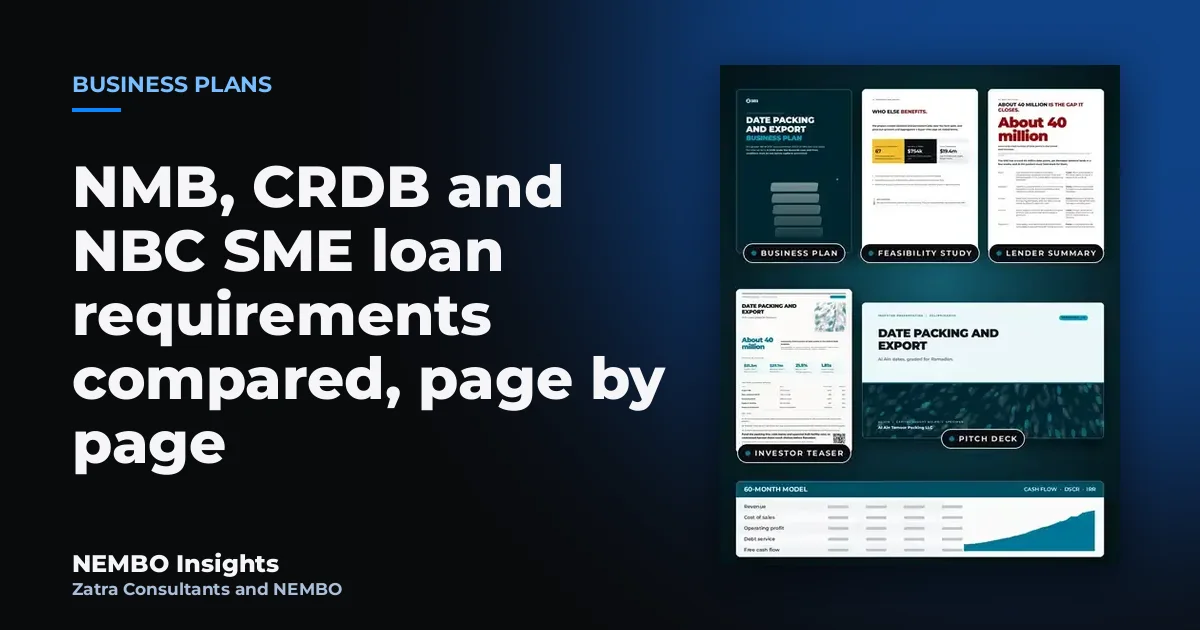
See also the comparison of NMB, CRDB and NBC SME loan requirements and what an asset finance credit committee reads.
What goes into the cash-flow schedule?
The schedule is a table of cash in and cash out for every period of the loan, with the DSCR as the last line. Use monthly columns for the first year and any ramp-up, then annual columns. Every line needs an assumption, as the note on financial model assumptions investors challenge explains.
| Line | What it holds | Where the figure comes from |
|---|---|---|
| Opening cash | Cash and bank at the start of the period | Prior period closing; opening balance sheet |
| Receipts | Cash collected from customers, after credit days | Sales forecast and debtor days |
| Operating payments | Suppliers, wages, rent, utilities, insurance | Cost schedules and creditor days |
| Tax and levies paid | Income tax instalments and VAT cash settled | Tax computation, agreed with the accountant |
| Maintenance capex | Spares, repairs and replacement of worn assets | Asset register and maintenance plan |
| Cash flow available for debt service | The numerator of the ratio | Sum of the lines above |
| Interest and principal | Scheduled payments on every facility | Offer letter and loan schedule |
| Reserve account movement | Cash set aside for the next instalment, if required | Facility terms |
| Equity and distributions | Owner funding in, dividends out | Sources and uses of funds |
| Closing cash | Cash carried to the next period | Total of the schedule |
Keep new borrowing, equity and asset sales out of the numerator. They are funding, not earnings. The BDO guide IFRS in Practice: IAS 7 Statement of Cash Flows lists the drawdown and repayment of borrowings under financing activities. It adds that interest paid may be classified as operating, investing or financing if applied consistently. Whichever way the statement classifies interest, show it in debt service.
The sources and uses of funds and the thirteen-week cash forecast must agree to the first columns.
How do tenor, grace and instalment frequency change the ratio?
The denominator is a contract term, so you can design it. A longer tenor lowers each year's principal. A grace period lowers early debt service, but interest still runs. Quarterly instalments need a quarterly cash-flow view, because a seasonal business can be short in the month an instalment falls due.
Seasonal sectors should match instalments to harvest or sales cycles. The TADB, CRDB and NMB pages all tie repayment to cash flow, so a request for a seasonal profile fits how those banks describe their own products.
Grace has a price: the principal falls due in fewer years, so later ratios tighten. The worked example shows the trade.
How should the plan stress the ratio?
The BoT guidelines ask for a forward-looking analysis based on various scenarios, and the World Bank page says lenders test ratios against sensitivities such as a 20 percent rise in construction costs or a 10 percent drop in revenues. Those are World Bank examples for large projects, not a Tanzanian rule.
For a business plan, run at least three cases and show the DSCR for each year in each case.
- Base case. The most likely sales, prices and costs, with documented assumptions.
- Downside case. Revenue or volume lower by a stated amount, with costs held where they cannot fall.
- Rate and currency case. A higher interest rate, and, if inputs or sales are priced in US dollars, a weaker shilling.
The Bank of Tanzania October 2026 Monetary Policy Report kept the Central Bank Rate at 6.25 percent for the quarter ending December 2026 and puts the average lending rate at about 15 percent, broadly unchanged. Your own rate comes from the offer letter. See the Zatra note on the Q4 2026 central bank rate.
What are the common mistakes in a DSCR table?
- Using EBITDA as the numerator. Tax, stock build-up and repairs are paid in cash before the lender is repaid.
- Averaging the years. The bank tests each period. One weak year is the finding.
- Using flat-rate interest. A flat quote misstates both the cash cost and the ratio. Model the reducing balance.
- Ignoring other debt. Existing loans, overdraft interest, finance leases and shareholder loans repayable on demand all sit in the denominator.
- Taxing the wrong profit. Interest, depreciation allowances and loss relief change the tax paid each year, so link the tax line to a real computation. The note on capital allowances sets out the allowances.
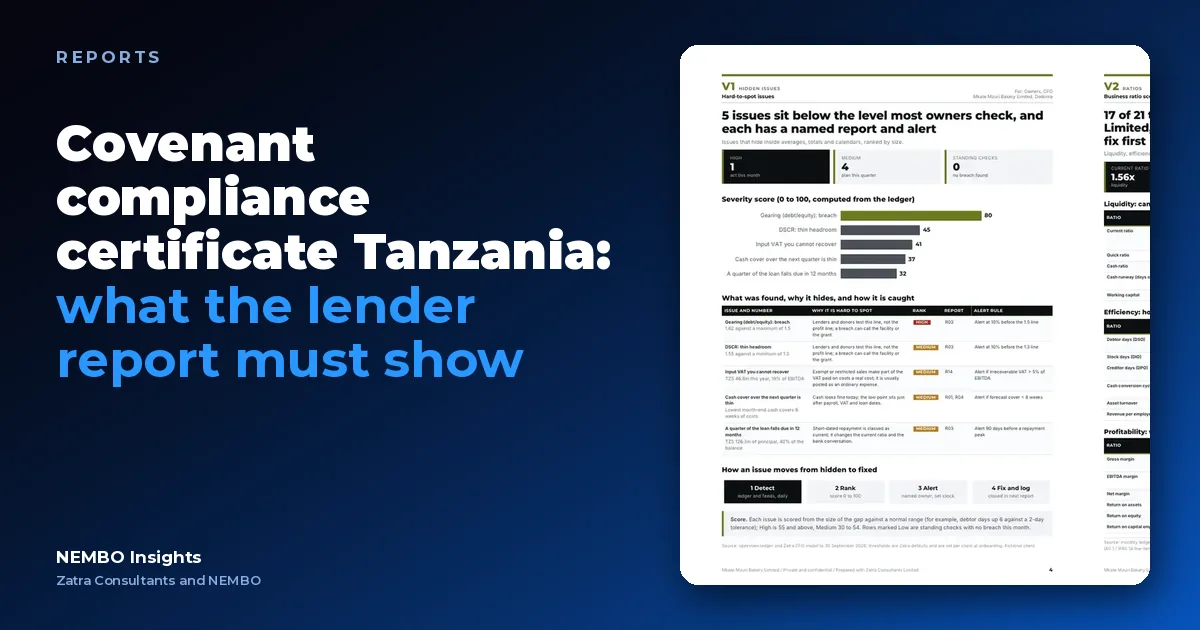
- Treating the forecast as the covenant. The ratio in the plan is a forecast. The covenant is a test on actual results, as the covenant compliance certificate note explains.
Worked example: a TZS 600,000,000 milling-plant loan over five years
The figures below are illustrative, not a forecast for any real company. A Morogoro grain-milling and packing company plans a project costing TZS 800,000,000. It borrows TZS 600,000,000, which is 75 percent of cost, and funds TZS 200,000,000 from owners. Interest is 16 percent a year on the reducing balance, a little above the roughly 15 percent average lending rate in the Bank of Tanzania report. Principal has one year of grace, then four equal annual payments of TZS 150,000,000. A real schedule would follow the offer letter.
Step 1: the debt service schedule
| Year | Opening balance (TZS) | Interest at 16 percent (TZS) | Principal (TZS) | Debt service (TZS) | Closing balance (TZS) |
|---|---|---|---|---|---|
| 1 | 600,000,000 | 96,000,000 | 0 | 96,000,000 | 600,000,000 |
| 2 | 600,000,000 | 96,000,000 | 150,000,000 | 246,000,000 | 450,000,000 |
| 3 | 450,000,000 | 72,000,000 | 150,000,000 | 222,000,000 | 300,000,000 |
| 4 | 300,000,000 | 48,000,000 | 150,000,000 | 198,000,000 | 150,000,000 |
| 5 | 150,000,000 | 24,000,000 | 150,000,000 | 174,000,000 | 0 |
Check: 600,000,000 times 16 percent is 96,000,000, and 450,000,000 times 16 percent is 72,000,000.
Step 2: cash flow available for debt service
The company's EBITDA is forecast by year. Taxable profit is EBITDA less depreciation of TZS 80,000,000 a year and less interest. The depreciation is a simple straight-line figure for the example, not the TRA tax depreciation classes. Income tax is 30 percent of taxable profit, the corporate rate in the TRA Taxes and Duties at a Glance 2025 and in the PwC Tanzania tax summary, last reviewed 9 September 2026 (F0196).
| Year | EBITDA (TZS) | Taxable profit (TZS) | Tax at 30 percent (TZS) | Working capital increase (TZS) | Maintenance capex (TZS) | CFADS (TZS) |
|---|---|---|---|---|---|---|
| 1 | 220,000,000 | 44,000,000 | 13,200,000 | 40,000,000 | 0 | 166,800,000 |
| 2 | 340,000,000 | 164,000,000 | 49,200,000 | 20,000,000 | 10,000,000 | 260,800,000 |
| 3 | 380,000,000 | 228,000,000 | 68,400,000 | 10,000,000 | 10,000,000 | 291,600,000 |
| 4 | 410,000,000 | 282,000,000 | 84,600,000 | 10,000,000 | 15,000,000 | 300,400,000 |
| 5 | 440,000,000 | 336,000,000 | 100,800,000 | 10,000,000 | 15,000,000 | 314,200,000 |
Check, year 2: 340,000,000 less 80,000,000 less 96,000,000 is 164,000,000 of taxable profit; 30 percent of it is 49,200,000. Then 340,000,000 less 49,200,000 less 20,000,000 less 10,000,000 is 260,800,000.
Step 3: the ratio
| Year | CFADS (TZS) | Debt service (TZS) | DSCR | Against 1.25 times |
|---|---|---|---|---|
| 1 | 166,800,000 | 96,000,000 | 1.74 | Above |
| 2 | 260,800,000 | 246,000,000 | 1.06 | Below |
| 3 | 291,600,000 | 222,000,000 | 1.31 | Above |
| 4 | 300,400,000 | 198,000,000 | 1.52 | Above |
| 5 | 314,200,000 | 174,000,000 | 1.81 | Above |
The five-year average is 1.49, which looks comfortable. Year 2 is 1.06, and that is the year the bank will read. To reach 1.25 in year 2, cash flow available for debt service would need to be 246,000,000 times 1.25, or 307,500,000. That is 46,700,000 more than the plan shows. Put the other way, year 2 can carry at most 260,800,000 divided by 1.25, or 208,640,000. The 1.25 benchmark is the Corporate Finance Institute's typical minimum, not a Tanzanian bank figure.
Step 4: three tests of the weak year
| Case for year 2 | Working | DSCR |
|---|---|---|
| Base case | 260,800,000 / 246,000,000 | 1.06 |
| CFADS 10 percent lower | 234,720,000 / 246,000,000 | 0.95 |
| Interest at 18 percent | 260,800,000 / (108,000,000 + 150,000,000) | 1.01 |
| Two years grace on principal | 260,800,000 / 96,000,000 | 2.72 |
Both stress cases hold tax constant, which slightly understates cash flow. The two-year grace case fixes year 2 but moves the pinch: year 3 debt service becomes 96,000,000 plus 150,000,000, or 246,000,000, and the ratio falls to 1.19. Year 4 is 1.35 and year 5 is 1.59. The loan then runs into year 6, so the model must show year 6. TADB lists 2 years as its maximum grace.
The conclusion for this plan is that TZS 600,000,000 on this profile is too much debt for year 2. Options are a smaller loan, a longer tenor, a seasonal profile, more equity or a funded reserve account. Each is a new run of the model.
Mainland and Zanzibar: which rules differ?
Bank credit rules do not split by jurisdiction: the Act applies to both, so a bank lending in Zanzibar reads repayment capacity under the same Bank of Tanzania texts. Tax and registration do differ.
| Item | Mainland | Zanzibar |
|---|---|---|
| Bank credit rules | Bank of Tanzania texts above | Same, under s.2(1) of the 2006 Act |
| Corporate income tax | 30 percent (F0196) | Not confirmed for this guide; ask ZRA or the accountant |
| VAT | 18 percent (F0239) | 15 percent, threshold TZS 100,000,000 (F0246) |
| Company registry | BRELA | BPRA, under Zanzibar Companies Act No. 15 of 2013 |
| Charge registration fee | BRELA, by sum secured (F0011) | Not in the register; the authority assesses it on filing |
The Zanzibar VAT line is as printed in the TRA July 2025 guide. A Zanzibar borrower should model tax on ZRA advice and state the rate used. For Mainland security, see the Zatra note on registration of charges covers for the Mainland.
What a bank credit committee reads in a DSCR table
Given the Bank of Tanzania texts above, a credit analyst has reason to test the points below.
- The weakest year. The lowest DSCR and the year it falls in, compared with the bank's own minimum.
- The source of the numerator. Whether sales, prices and margins rest on contracts, history or market evidence. The note on market sizing data a lender accepts covers this.
- Existing debt. Whether the denominator includes every loan the business and its owners already carry.
- The cushion. What happens to the ratio under the downside and rate cases.
- The exit if cover fails. Reserve account, owner support, security and covenants. The BoT guidelines ask the bank to set covenants "designed to limit changes in the future risk profile of the borrower" (para. 2.3.3.1.2(h)).
The World Bank page adds what happens after signing: a breached ratio can block dividends, sweep cash or draw on a reserve account. If cover later weakens, the loan restructuring request file is the next document, and reg. 7 of GN 287 limits how far a bank may restructure.
What to do now
- Get the facility terms in writing. Ask the bank for the indicative rate, tenor, grace, instalment dates, fees, reserve account and its minimum DSCR before you finalise the model.
- List every debt. Gather schedules for all loans, leases, overdrafts and supplier credit, including those held by the owners for the business.
- Build the loan schedule on the reducing balance. Match the bank's payment dates, and check the first and last payments against the offer letter.
- Build cash flow available for debt service. Use EBITDA less cash tax, working capital and maintenance capex, with each line tied to an assumption.
- Link tax to a real computation. Ask CPA Altho Mwangoa to confirm the tax paid line, depreciation allowances and any loss relief.
- Test every year and three cases. Show base, downside and rate cases, and mark each year below the bank's minimum.
- Redesign the debt, not the numbers. If a year fails, change amount, tenor, grace or profile, and rerun the model.
- Reconcile the pack. Agree the schedule to the sources and uses, the balance sheet and the narrative.
Key dates
| Date or period | What happens | Source |
|---|---|---|
| Each instalment date | DSCR is tested for the period, annually or semi-annually | World Bank PPP page |
| Four consecutive instalments | A restructured term loan may be upgraded if all are paid on time | GN 287 of 2014, reg. 7(4)(b) |
| Two consecutive quarters | A restructured overdraft may be upgraded after satisfactory performance | GN 287 of 2014, reg. 7(4)(a) |
| Up to 2 years | Maximum grace on TADB project financing | TADB project financing page |
| Up to 1 year | Grace on CRDB investment financing, depending on cash flow | CRDB investment financing page |
| Quarter to 31 December 2026 | Central Bank Rate held at 6.25 percent | BoT Monetary Policy Report, October 2026 |
| Before submission | Check the Bank of Tanzania list for a replacement of GN 287 of 2014 | bot.go.tz regulations page |
What the NEMBO desk prepares
NEMBO designs and delivers the bankable business plan or feasibility study as one controlled set: the financial summary, the assumptions sheet, the loan schedule, the cash-flow schedule, the DSCR and sensitivity tables, and the sources and uses statement. Each table is numbered so a credit analyst can trace a ratio back to its assumption. The set sits inside the business plans desk. Zatra Consultants prepares and checks the content: the loan schedule against the offer letter, the tax line, the working-capital days, the downside cases and the reconciliation to the balance sheet. Every page of the finished work reads free online first, with a Customise for your brand option on the library page.
There are two cost buckets on every quotation. Government charges are paid at the official rate to the authority concerned: where a company creates a charge to secure the loan, BRELA registration by sum secured (F0011) and stamp duty on a mortgage deed (F0274), and the corporate income tax rate assumed in the model (F0196). NEMBO's and Zatra's fees are published on the pricing page and quoted in writing before work starts. NEMBO does not decide or guarantee any authority's outcome, and the same holds for any bank or tender panel. The process page sets out how a brief becomes a delivered document.
How Zatra helps
CFE Joseph Marwa leads the plans desk at Zatra, and the team builds the model through business plans and feasibility studies and financial modelling and forecasting. Tax lines and reporting go to CPA Altho Mwangoa, and security, loan agreements and any dispute with a lender go to Advocate Yona Habiye. To begin, use start, read the answers page, and see the related notes on the annual budget a board and a lender expect and the overdraft bank file.
Bankable business plan and feasibility study set
Zatra Consultants prepares and checks the content on the details the Client shares. NEMBO designs and delivers it. Fees are published on the packages page and quoted in writing.
Open the desk pageSources and status
Accurate as at 20 November 2026. The Bank of Tanzania Risk Management Guidelines, the 2014 Risk Assets Regulations (GN 287), the Banking and Financial Institutions Act 2006 as printed on TanzLII and the TADB, CRDB and NMB product pages were read on 20 November 2026. No Tanzanian bank publishes a DSCR minimum on the pages read, so none is quoted. Figures are as printed on the sources and in the Zatra fee register on 20 November 2026; the worked example is illustrative.
- 1Management of Risk Assets Regulations, GN 287 of 2014Bank of Tanzania, GN 287 published 22 August 2014. Accessed 20 November 2026.
- 2Risk Management Guidelines for Banks and Financial InstitutionsBank of Tanzania, August 2010. Accessed 20 November 2026.
- 3Banking and Financial Institutions Act, 2006TanzLII, Act of 2006, 2006 text. Accessed 20 November 2026.
- 4October 2026 Monetary Policy ReportBank of Tanzania, October 2026. Accessed 20 November 2026.
- 5Taxes and Duties at a Glance 2025Tanzania Revenue Authority, July 2025. Accessed 20 November 2026.
- 6Tanzania corporate income tax summaryPwC Tax Summaries, last reviewed 9 September 2026. Accessed 20 November 2026.
- 7Key Issues in Developing Project Financed TransactionsWorld Bank PPP Knowledge Lab, undated page read 20 November 2026. Accessed 20 November 2026.
- 8Debt Service Coverage RatioCorporate Finance Institute, published 29 January 2020, modified 28 September 2026. Accessed 20 November 2026.
- 9DSCR in Project FinanceForvis Mazars Financial Modelling, last updated 2 November 2026. Accessed 20 November 2026.
- 10IFRS in Practice: IAS 7 Statement of Cash FlowsBDO, 2022 to 2023 edition. Accessed 20 November 2026.
- 11New Banking and Finance RegulationsClyde and Co via Mondaq, 7 July 2015. Accessed 20 November 2026.
- 12TADB project financingTanzania Agricultural Development Bank, undated page read 20 November 2026. Accessed 20 November 2026.
- 13CRDB investment financingCRDB Bank, undated page read 20 November 2026. Accessed 20 November 2026.
- 14NMB SME loansNMB Bank, undated page read 20 November 2026. Accessed 20 November 2026.
Figures to confirm before you act
- Status of GN 287 of 2014: a 2026 draft replacement is reported but unconfirmed. Check the bot.go.tz regulations page before citing it.
- The lender's own minimum DSCR, grace, tenor and equity share. None is published on the pages read; get them in the offer letter.
- Corporate income tax rate of 30 percent. Confirm against the current Finance Act and the TRA rates guide.
- Zanzibar income tax rate and BPRA charge registration fee. Not confirmed here; check ZRA and BPRA.
- Average lending rate of about 15 percent. Use the rate in the bank's offer letter, not this figure.
- Section 2(1) of Cap. 342 as printed in the 2006 text. Check the revised edition for the current number.
This article is general information based on official sources available at the date of publication. It is not legal, tax or financial advice. Laws and notices change. Verify with the issuing authority or consult Zatra before acting.
Frequently asked questions
What is a good DSCR for a loan in Tanzania?
No Tanzanian bank minimum was found published on the pages read, so none is quoted. The Corporate Finance Institute calls 1.25 times a typical minimum, and Forvis Mazars cites about 1.30 times for contracted infrastructure. Ask the bank for its credit policy ratio in writing and test the plan against it.
Is DSCR the same as interest cover?
No. Interest cover compares earnings with interest only. DSCR compares cash flow with interest plus scheduled principal, so a business can pass interest cover and still fail DSCR in the years when principal falls due.
Can a profitable company fail the DSCR test?
Yes. Principal repayments are not an expense in the income statement, so profit can look healthy while cash is short. In the worked example, year 2 EBITDA is TZS 340,000,000 and the ratio is still only 1.06.
Should the plan use EBITDA or cash flow in the ratio?
Use cash flow available for debt service: EBITDA less cash tax, working capital build-up and maintenance capex. If the facility agreement defines a covenant ratio differently, model that definition as well and show both.
How many years should the DSCR table cover?
Every year of the tenor, including grace, with monthly or quarterly columns where instalments are not annual. The ratio is a period test, so a table that stops before the last instalment leaves the bank to guess.
Does a grace period improve the ratio?
It improves the early years and weakens the later ones. In the worked example, two years of grace lifts year 2 from 1.06 to 2.72 but cuts year 3 to 1.19, and the loan then runs into year 6.
Does the Bank of Tanzania require a DSCR?
No formula or minimum was found in the texts read. The guidelines require analysis of repayment capacity, and reg. 17(3)(d) of GN 287 classes a term loan as substandard where cash flows cannot meet maturing debts. The DSCR table is the usual evidence.
Who prepares the DSCR schedule?
Zatra Consultants builds and checks the model, and CPA Altho Mwangoa confirms the tax line. NEMBO designs and delivers the finished plan. Neither decides a bank's credit outcome. Fees are on the pricing page.