On this page
- What the law says
- Who should read this
- What do Tanzanian banks offer, and on what terms?
- Why does the bank advance 70 percent and not 100?
- What goes in the receivables finance file?
- How is the invoice assigned, and what does the new Act change?
- Worked example: a TZS 118,000,000 invoice at 60 days
- What are the tax points on a discounting facility?
- Mainland and Zanzibar: what differs?
- What to do now
- Key dates
- What the NEMBO desk prepares
- How Zatra helps
- Sources and status
- Frequently asked questions
What does a Tanzanian bank need to approve invoice discounting?
Invoice discounting Tanzania banks approve against a fiscal tax invoice under 60 days old, a signed delivery note or acceptance, a debtor with a clean payment record, the supplier's accounts and tax clearance, and a payment route into the bank's collection account. CRDB publishes an advance of up to 70 percent of the invoice excluding VAT for 30 to 90 days, shaped by the Bank of Tanzania's risk assets regulations.
What the law says
Invoice discounting Tanzania banks offer is a credit accommodation under the Bank of Tanzania's Banking and Financial Institutions (Management of Risk Assets) Regulations, 2014 (GN 287 of 2014). Regulation 3 defines a credit accommodation to include loans, overdrafts, advances, acceptances and letters of credit, and treats a facility as unsecured where there is no security or the exposure exceeds the market value of the security. Regulation 10(1) places a facility past due in its entirety once any contractual payment is due and unpaid, and regulation 10(2) names a dishonoured bill and a bill unpaid on its due date as past-due events. Regulation 23(1) classifies receivables by age: 31 to 60 days especially mentioned, 61 to 90 substandard, 91 to 180 doubtful, 181 days and more loss. Regulation 27(1) sets the provisions at 1, 3, 20, 50 and 100 percent. Those rules decide why a bank advances only part of an invoice, only for a short tenor, and only against a debtor it trusts.
The law of the assignment is changing. The Secured Transactions (Movable Property) Act, 2026 (Act No. 5 of 2026) passed on 31 August 2026, received assent on 19 September 2026 and was gazetted on 2 October 2026, according to FB Attorneys and the Gazette copy they published. Its section 3 defines receivables as a right to payment of a money debt. Section 4 establishes a Collateral Registry within the Bank of Tanzania. Section 21 ranks security interests by the time of registration, and section 39 directs an account debtor to pay the secured lender once it has proof of the lender's interest. Section 1 commences the Act on a date the Minister notifies, and section 2 confines it to Mainland Tanzania. Until commencement, assignments of book debts run on contract and on the Companies Act register of charges. Zatra's note on the Secured Transactions Act tracks the commencement notice.
Three further rules shape the file. Section 2(1) of the Value Added Tax Act, Cap. 148 defines financial services to include granting, negotiating and dealing with loans and credit, and excludes debt collection and debt factoring from the exempt dealing in debts, so the tax treatment of the bank's charge turns on how the product is structured. The TRA EFD and VFD page requires a supplier with turnover of TZS 11,000,000 or more to issue a fiscal receipt or invoice, and a bank will not discount an invoice that was not fiscalised. And the Stamp Duty Act, Cap. 189 charges TZS 2,000 on the facility agreement (F0267) within 30 days of execution, with the duty on a deed of assignment to be assessed on the Schedule.
Who should read this
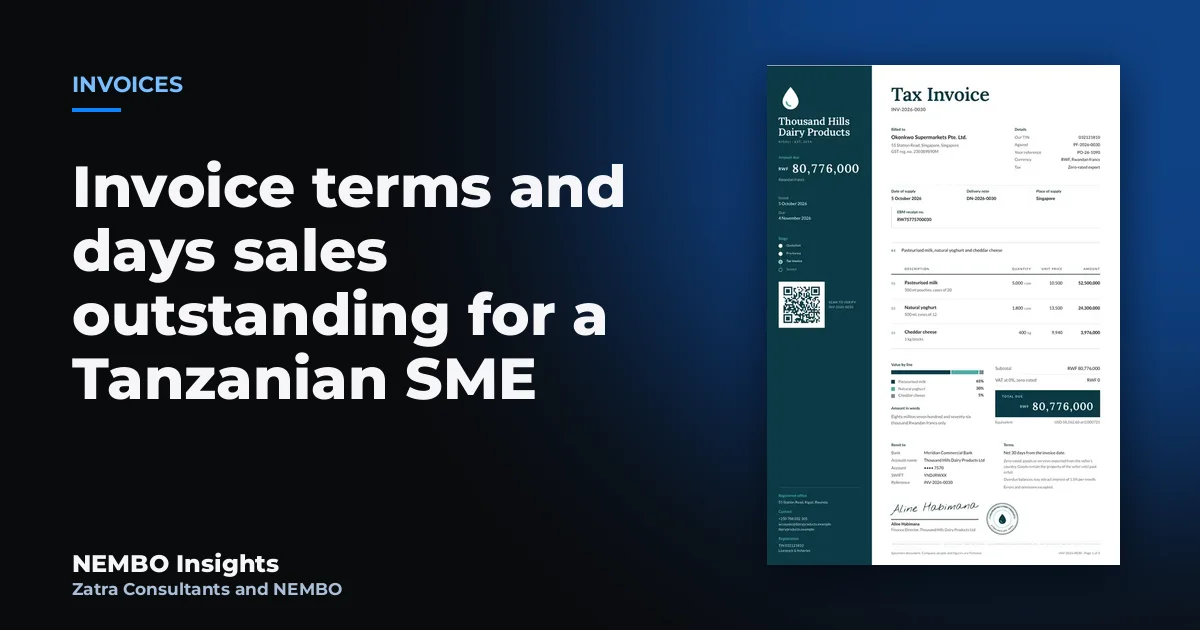
This guide is for the owner or finance manager of a Tanzanian supplier, contractor or service firm that invoices large corporates, telecoms, mining contractors, NGOs or government bodies on 30 to 90 day terms and is waiting for cash it has already earned. It also serves a Fursa365 member that has won a local purchase order it cannot fund from working capital, and the CPA who assembles the bank file. The NEMBO note on invoice terms and days sales outstanding covers the receivables book itself.
What do Tanzanian banks offer, and on what terms?
Product pages read on 18 November 2026 show one bank publishing hard terms and the rest publishing a product name. The table records only what each bank's own page printed.
| Bank | Product | Terms printed on the bank's page | Not printed |
|---|---|---|---|
| CRDB Bank | Invoice Discounting Finance | Up to 70 percent of the tax invoice value excluding tax; 30 to 90 days per LPO or sales contract; maximum TZS 5,000,000,000 or USD equivalent; invoices outstanding under 60 days; from reputable organisations that pay on time; prior executed invoice discount contract; Biashara account | Rate, fees, recourse |
| CRDB Bank | Certificate Discounting Finance | Same tests against certified payment certificates; up to 70 percent; 30 to 90 days; up to TZS 5,000,000,000 | Rate, fees |
| Exim Bank | Invoice Discount Facility, Pepa to Pesa; Exim Supply Chain platform | Unsecured; relies on the buyer's creditworthiness; platform covers supplier, payables, LPO and distributor finance | Advance rate, tenor, fees |
| NBC | Invoice Discounting; Import Invoice Financing; Export Bills Discounting; Pre-Shipment Finance | Open-account sellers, domestic or cross-border; pre-shipment with recourse against sales contract, PO or LC; commercial invoices and transport documents | Advance rate, tenor, fees |
| Diamond Trust Bank | Bills Financing | Tenor up to 180 days | Advance rate, fees |
| Equity Bank Tanzania | Invoice Discounting; LPO Financing | Named products | All terms |
| Tanzania Commercial Bank | Invoice Discounting | Confirmed invoices | All terms |
| NMB Bank | Supply Chain Financing | Listed in the site navigation; page not readable | All terms |
Two conventions sit behind the table. Invoice discounting is normally confidential and with recourse: the debtor is not told, and the supplier repays if the debtor does not. Factoring is disclosed and may be without recourse. The FCI product definitions and the EU Federation glossary set out advance ratio, reserve, dilution and notification in those terms. CRDB's requirement of a prior executed contract and a reputable debtor is a recourse lender's underwriting of the supplier, not only the invoice.
Why does the bank advance 70 percent and not 100?
The gap is the bank's cover for three things that happen to invoices. The first is dilution: credit notes, retentions, set-offs and disputes that reduce what the debtor pays. The NEMBO note on the credit note explains how often a Tanzanian invoice is adjusted after issue. The second is VAT: CRDB advances against the invoice value excluding tax, because the 18 percent output VAT belongs to TRA by the 20th of the following month (F0245), whether or not the debtor has paid. The third is the classification clock. If the debtor pays late, regulation 23(1) moves the receivable from especially mentioned at day 31 to substandard at day 61, and regulation 27 raises the provision from 3 percent to 20 percent. A 70 percent advance on a 60-day invoice leaves the bank whole even where the debtor pays 30 days late and takes a 10 percent deduction.
Pricing follows the same logic. The Bank of Tanzania held the Central Bank Rate at 6.25 percent for the quarter ending December 2026 and reported overall lending rates at around 15 percent in its October 2026 Monetary Policy Report, with negotiated rates for prime borrowers around 12 percent. A discount charge on a 60-day advance is quoted as an annual rate applied for the days outstanding, plus an arrangement fee. No Tanzanian bank page read for this guide printed either figure. Zatra's note on the Central Bank Rate for the fourth quarter of 2026 carries the BoT statement.
What goes in the receivables finance file?
The bank underwrites four things: the supplier, the debtor, the invoice and the route the cash will take. The file is organised in that order.
| Section | Documents | What the credit officer tests |
|---|---|---|
| 1. The supplier | Certificate of incorporation, business licence, TIN and VAT certificates, tax clearance (NEW-02-18), board resolution, KYC on directors, 12 months' bank statements, audited accounts or management accounts | Regulation 7 credit policy tests; account conduct; whether the firm fiscalises every sale |
| 2. The debtor | Contract, LPO or framework agreement; debtor's payment history on past invoices; debtor's consent to assignment where the contract requires it | Is the debtor a reputable organisation that pays on time; days to pay on the last six invoices |
| 3. The invoice | Fiscal tax invoice from the EFD or VFD; delivery note signed by the debtor; goods received note or service acceptance; certificate where the contract pays on certification | Was the supply made and accepted; is the invoice under 60 days old; is the amount net of retention |
| 4. The route | Debtor's payment instruction to the collection account; deed of assignment or notice of assignment; security documents and stamping | Will the cash reach the bank first; regulation 16(a)(ii) treats an improperly executed deed of assignment as a technical defect |
| 5. Credit data | Consent to a credit reference bureau search for the company and directors | Regulation 24(1) of GN 416 of 2012 requires written consent; regulation 6 of GN 417 of 2012 has the bank report the facility monthly by the 10th |
Government debtors need one more document. Clause 23.1 of the PPRA General Conditions of Contract for goods and clause 10.1 of the conditions for small works bar assignment of the contract without the procuring entity's written consent. A supplier who assigns an invoice on a public contract without that consent has breached the contract it is financing. The same conditions set the payment clock the bank will lend against: 28 days from invoice under clause 19.3 for goods, and 28 days to certify plus 28 days to pay under clauses 52.2 and 53.1 for works, with interest from the due date. The NEMBO notes on the purchase order and three-way match and the payment claim after contract signing cover the paper behind sections 2 and 3.
How is the invoice assigned, and what does the new Act change?
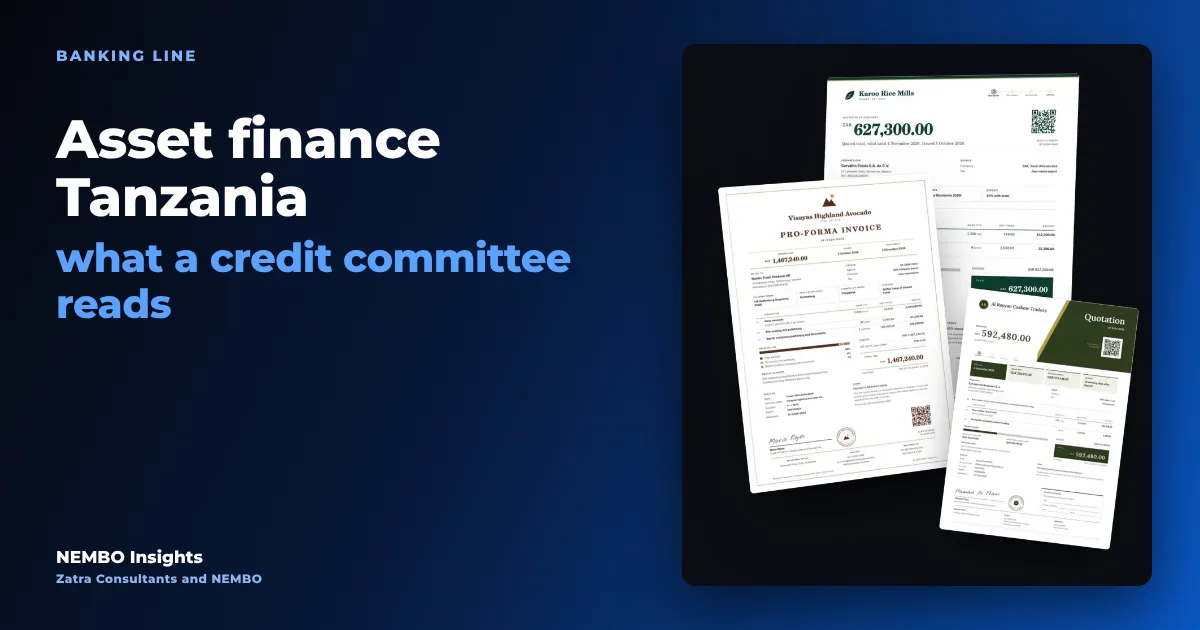
Today the assignment is a contract between supplier and bank, perfected against the debtor by notice. A Commercial Division ruling of 15 October 2021 accepted that a creditor may assign a debt without the debtor's consent, while leaving the notice point open and citing no Tanzanian statute. Where the facility is secured by a floating charge over book debts, section 96 of the Companies Act requires registration at BRELA within 42 days. The fee is TZS 22,000 to 150,000 by the sum secured (F0011). An unregistered charge is void against a liquidator and creditors. The NEMBO note on asset finance and Zatra's note on registration of charges cover that register.
Once Act No. 5 of 2026 commences, a bank will register its interest in receivables at the Collateral Registry inside the Bank of Tanzania. Priority will run from the time of registration under section 21. The debtor will be obliged under section 39 to pay the bank on proof of its interest, keeping its own defences against the supplier under section 39(2). Section 44 keeps outright sales of receivables outside the enforcement part. The practical effect is that a supplier's receivables will be searchable, so a second bank will see the first bank's interest, and a debtor can no longer safely pay the supplier after notice. The commencement date was not published at the date of this guide.
Worked example: a TZS 118,000,000 invoice at 60 days
This worked example follows a Dar es Salaam packaging supplier that has delivered to a beverage bottler against a purchase order and issued a VFD tax invoice of TZS 100,000,000 plus VAT of TZS 18,000,000, payable in 60 days. The bank applies CRDB's published advance rule. The rate and the fee are illustrative, labelled as such, and chosen against the Bank of Tanzania's reported lending rate of around 15 percent.
| Line | Computation | TZS |
|---|---|---|
| Invoice value excluding VAT | Fiscal invoice | 100,000,000 |
| Output VAT due to TRA by the 20th of next month | 18 percent (F0239, F0245) | 18,000,000 |
| Advance, 70 percent of the ex-VAT value | 100,000,000 x 70 percent | 70,000,000 |
| Discount charge, illustrative 16 percent a year for 60 days | 70,000,000 x 16 percent x 60 / 365 | 1,841,096 |
| Arrangement fee, illustrative 1 percent, confirm with the bank | 70,000,000 x 1 percent | 700,000 |
| Stamp duty on the facility agreement | F0267 | 2,000 |
| Debtor pays on day 60 into the collection account | Invoice total | 118,000,000 |
| Bank recovers advance, charge and fee | 70,000,000 plus 1,841,096 plus 700,000 | 72,541,096 |
| Residual released to the supplier | 118,000,000 less 72,541,096 | 45,458,904 |
| Cost of 60 days' liquidity as a share of the ex-VAT invoice | 2,541,096 / 100,000,000 | 2.54 percent |
Three variations matter. If the debtor pays on day 90, the charge rises to TZS 2,761,644 and the receivable has passed through the 61 to 90 day band at the bank, which will ask why. If the debtor takes a TZS 5,000,000 credit for damaged stock, the residual falls to TZS 40,458,904 and the bank's 30 percent margin absorbs the dilution. If the supplier spends the advance and fails to remit the TZS 18,000,000 of VAT by the 20th, TRA charges the higher of 2.5 percent or TZS 300,000 a month (NEW-02-06) plus interest at the statutory rate (NEW-02-08). No bank facility covers that cost.
What are the tax points on a discounting facility?
The VAT Act definition of financial services in section 2(1) covers granting and dealing in credit, which is how a with-recourse discount charge is structured, but carves debt factoring and debt collection out of the dealing-in-debts limb. Whether the bank's charge and fee carry VAT therefore depends on the product's legal form, and the Schedule item exempting financial services could not be read for this guide. The supplier's own output VAT is unaffected: the invoice was taxable when issued, and the discounting does not move the time of supply. Zatra's note on VAT bad debt relief covers the position if the debtor never pays.
Withholding tax on interest is 10 percent for residents (F0208). The Zatra fee register records no exemption line for interest paid to a resident bank, and PwC's September 2026 summary lists the rate without one. The treatment of the discount charge is therefore a point for the supplier's accountant to confirm with the bank. Stamp duty is TZS 2,000 on the agreement (F0267), 1 percent capped at TZS 100,000 on a bill of sale by way of security under the Finance Act 2026 amendment (F0270), and a Schedule assessment on a deed of assignment. The NEMBO note on the withholding tax certificate covers the paper the debtor issues on the invoice itself.
Mainland and Zanzibar: what differs?
The Bank of Tanzania supervises banks across the United Republic, so the risk assets regulations govern a facility booked at a Zanzibar branch in the same way. The Secured Transactions Act, 2026 applies to Mainland Tanzania only under its section 2, so a Zanzibar receivable will continue to run on contract, notice and the Zanzibar registry regime after the Act commences. Stamp duty is administered by the Zanzibar Revenue Authority under the Stamp Duty Act No. 7 of 2017, which charges agreements at 0.5 percent and debentures at 0.5 percent capped at TZS 500,000, within 30 days. A Zanzibar supplier is VAT registered with ZRA at 15 percent on a TZS 100,000,000 threshold (F0246) and fiscalises on the Virtual Fiscal Management System, as the NEMBO note on the Zanzibar VFMS receipt explains. Route a Zanzibar assignment through an advocate admitted there.
What to do now
- Fiscalise and reconcile the book. Every invoice from the EFD or VFD, every delivery note and GRN signed, and an aged debtor list that ties to the ledger.
- Pick the debtors. List the five debtors with the best payment record over the last twelve months, with days to pay on each invoice. Those are the invoices a bank will discount first.
- Check the contracts for assignment clauses. On public contracts obtain the procuring entity's written consent before any assignment; on private contracts read the clause and obtain consent where required.
- Assemble sections 1 to 5 of the file. Supplier KYC and accounts, debtor evidence, fiscal invoices with proof of acceptance, the payment route documents, and credit bureau consents.
- Ask the bank for the four numbers in writing. Advance rate and its base, annual discount rate, arrangement fee, and whether the facility is with recourse.
- Ring-fence the VAT. Transfer the output VAT on each discounted invoice to a separate account on the day of the advance, so the 20th is funded.
- Stamp and register. Agreement within 30 days (F0267), any charge at BRELA within 42 days (F0011), and, once Act No. 5 of 2026 commences, the registration at the Collateral Registry.
Key dates
| Date or period | What happens | Source |
|---|---|---|
| Day 0 | Fiscal invoice issued; VAT time of supply | VAT Act Cap. 148; TRA EFD page |
| 20th of the following month | Output VAT on the invoice due to TRA | F0245 |
| Day 28 | Payment due on a PPRA goods contract from invoice | GCC Goods clause 19.3 |
| Day 31 to 60 | Receivable especially mentioned at the bank | GN 287 reg 23(1) |
| Day 61 to 90 | Substandard; 20 percent provision | GN 287 regs 23(1), 27(1) |
| Within 30 days of execution | Stamp duty on the facility agreement and deed | Cap. 189 s.25; F0267 |
| Within 42 days of creation | Charge over book debts registered at BRELA | Companies Act; F0011 |
| 10th of each month | Bank reports the facility to the Credit Reference Databank | GN 417 of 2012 reg 6 |
| 2 October 2026 | Secured Transactions (Movable Property) Act, 2026 gazetted; commencement by Minister's notice | Act No. 5 of 2026 s.1 |
| Quarter ending December 2026 | Central Bank Rate held at 6.25 percent | BoT MPC, October 2026 |
What the NEMBO desk prepares
NEMBO designs the receivables finance file as one document set: the fiscal invoice and delivery note templates that already carry the fields a bank tests, the aged debtor schedule, the debtor payment history, the file index for sections 1 to 5 and the covering letter to the credit officer. The set sits in the quotation, pro-forma and tax invoice desk and connects to the free SME loan file. Zatra Consultants prepares and checks the content: the fiscalisation audit, the assignment clause review, the VAT ring-fence and the stamping and registration schedule. Every page of the finished work reads free online first, with a Customise for your brand option on the library page.
There are two cost buckets, kept separate on every quotation. Government charges are paid at the official rate to the authority: stamp duty to TRA or ZRA (F0267, F0270), BRELA charge registration (F0011), and the Collateral Registry fee once the Act commences and its fee order is published. Bank charges are the bank's own and are quoted by the bank. NEMBO's and Zatra's fees are published on the pricing page and quoted in writing. NEMBO does not decide or guarantee any authority's outcome, and the same holds for any bank or tender panel. The process page sets out how a brief becomes a delivered file.
How Zatra helps
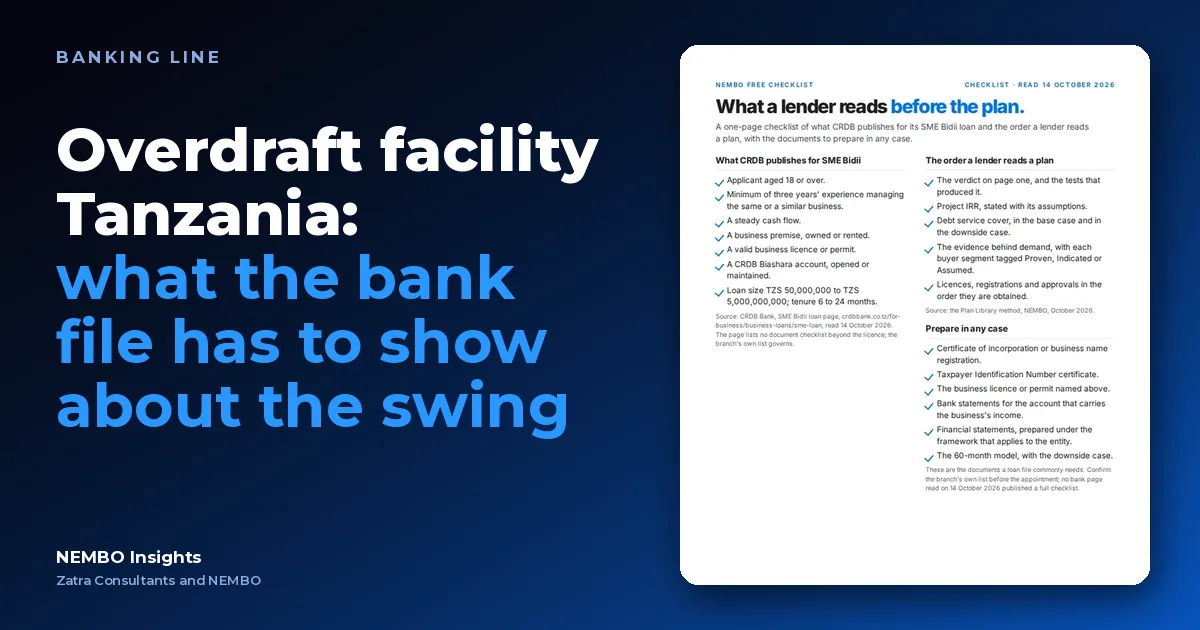
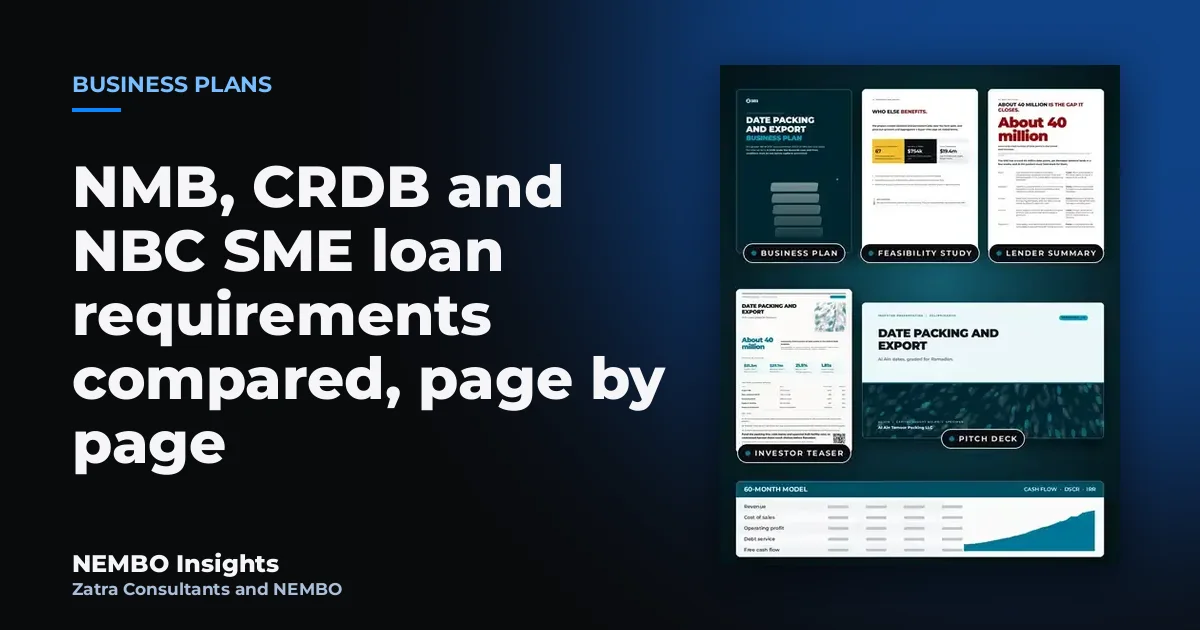
Zatra's outsourced CFO service builds the receivables book, prepares the bank file, attends the credit meeting and runs the collections and VAT calendar after drawdown. Tax and reporting are led by CPA Altho Mwangoa. The deed of assignment, the debtor's consent on a public contract and any recovery action against a debtor who does not pay are drafted and run by an advocate, as Zatra's note on debt recovery before litigation sets out. Brief the desk through the start page, and read the NEMBO notes on the overdraft facility file and the SME loan requirements compared for the alternatives a bank may offer instead.
Invoice set and receivables finance file
Zatra Consultants prepares and checks the content on the details the Client shares. NEMBO designs and delivers it. Fees are published on the packages page and quoted in writing.
Open the desk pageSources and status
Accurate as at 18 November 2026. The regulations, the Act No. 5 of 2026 Gazette text (Swahili), the bank pages and the PPRA conditions were read in full. The VAT Act Schedule exempting financial services could not be opened, so the VAT treatment of the discount charge is stated as a point to confirm. NMB's supply chain finance page was not readable. The commencement date of Act No. 5 of 2026 had not been published at the access date. The worked example's rate and fee are illustrative.
- 1Banking and Financial Institutions (Management of Risk Assets) Regulations, 2014, GN 287 (regulations 3, 7, 10, 13, 16, 23, 27)Bank of Tanzania, 22 August 2014. Accessed 18 November 2026.
- 2Bank of Tanzania (Credit Reference Databank) Regulations, 2012, GN 417, regulation 6Bank of Tanzania, 28 December 2012. Accessed 18 November 2026.
- 3Invoice Discounting FinanceCRDB Bank Plc, product page read 18 November 2026. Accessed 18 November 2026.
- 4Business lending: Invoice Discount FacilityExim Bank Tanzania, product page read 18 November 2026. Accessed 18 November 2026.
- 5Trade finance: invoice discounting and billsNBC Bank, product page read 18 November 2026. Accessed 18 November 2026.
- 6New law on movable assets as security for loans introduced (Act No. 5 of 2026)FB Attorneys, 8 October 2026. Accessed 18 November 2026.
- 7General Conditions of Contract for Supply of General Goods, PPRA/GCC/G/GG/02/2022 (clauses 19.3, 23.1, 27.2)Public Procurement Regulatory Authority, February 2022. Accessed 18 November 2026.
- 8General Conditions of Contract for Small Works, PPR/GCC/W/SW/02/2022 (clauses 10.1, 52.2, 53.1)Public Procurement Regulatory Authority, February 2022. Accessed 18 November 2026.
- 9Value Added Tax Act, Cap. 148 R.E. 2023, section 2(1) financial servicesTax Revenue Appeals Board library, Revised Edition 2023. Accessed 18 November 2026.
- 10EFD and VFD: who must issue fiscal receiptsTanzania Revenue Authority, undated page read 18 November 2026. Accessed 18 November 2026.
- 11Stamp duty ratesTanzania Revenue Authority, undated page read 18 November 2026. Accessed 18 November 2026.
- 12Stamp duty, Zanzibar Stamp Duty Act No. 7 of 2017Zanzibar Revenue Authority, page read 18 November 2026. Accessed 18 November 2026.
- 13Factoring products: invoice discounting, recourse and non-recourse factoringFCI, undated page read 18 November 2026. Accessed 18 November 2026.
- 14EUF glossary of receivables finance termsEU Federation for Factoring and Commercial Finance, January 2017. Accessed 18 November 2026.
Figures to confirm before you act
- Commencement date of the Secured Transactions (Movable Property) Act, 2026 (Act No. 5 of 2026): watch for the Minister's notice in the Gazette.
- Discount rate and arrangement fee: no Tanzanian bank page read prints them; take the bank's written offer. The 16 percent and 1 percent in the worked example are illustrative.
- VAT on the bank's discount charge: the Schedule item exempting financial services was not read; confirm with the bank and TRA.
- Withholding tax on the discount charge at 10 percent (F0208): confirm whether the bank's practice treats it as exempt interest to a resident financial institution.
- Stamp duty on a deed of assignment of book debts: a Schedule assessment; the agreement rate TZS 2,000 (F0267) and the bill of sale cap TZS 100,000 (F0270) are from the register.
- Central Bank Rate 6.25 percent and lending rates around 15 percent: BoT October 2026 report; check the January 2027 MPC statement.
This article is general information based on official sources available at the date of publication. It is not legal, tax or financial advice. Laws and notices change. Verify with the issuing authority or consult Zatra before acting.
Frequently asked questions
What is the difference between invoice discounting and factoring in Tanzania?
Invoice discounting is normally confidential and with recourse: the debtor pays the supplier's collection account as usual and the supplier repays the bank if the debtor does not. Factoring is disclosed, the factor collects from the debtor and may take the credit risk without recourse. The VAT Act carves debt factoring out of the exempt dealing in debts, so the tax treatment can differ.
How much of an invoice will a Tanzanian bank advance?
CRDB publishes up to 70 percent of the tax invoice value excluding VAT, for 30 to 90 days, up to TZS 5,000,000,000. Other banks name the product without printing a rate. The margin covers credit notes, retentions, late payment and the 18 percent VAT that belongs to TRA by the 20th of the following month regardless of when the debtor pays.
Can an invoice on a government contract be discounted?
Only with the procuring entity's written consent. Clause 23.1 of the PPRA goods conditions and clause 10.1 of the small works conditions bar assignment without it. The conditions also set the payment clock a bank lends against: 28 days from invoice for goods, and 28 days to certify plus 28 days to pay for works.
Why does the bank want the invoice to be under 60 days old?
Because of the classification clock. Regulation 23(1) of the risk assets regulations places a receivable 31 to 60 days past due in especially mentioned, 61 to 90 in substandard with a 20 percent provision, and 91 to 180 in doubtful at 50 percent. An invoice already 60 days old leaves no room before the provision bites.
Does the debtor find out that the invoice has been discounted?
Under confidential discounting, no. The debtor pays the supplier's collection account at the bank and the assignment is undisclosed. Once the Secured Transactions Act 2026 commences, a bank that registers its interest may give notice, and section 39 then obliges the debtor to pay the bank on proof of the interest.
What happens if the debtor does not pay?
With recourse, the supplier repays the advance and the charge at the end of the agreed tenor and pursues the debtor itself. The bank reports the facility monthly to the Credit Reference Databank, so arrears appear on the supplier's record. Recovery against the debtor is an advocate's work, starting with a demand letter.
Do I still pay VAT on an invoice the bank has advanced?
Yes. The invoice was taxable when issued and the 18 percent output VAT is due to TRA by the 20th of the following month, whether or not the debtor or the bank has paid. Ring-fence the VAT from the advance. Late payment attracts a penalty of the higher of 2.5 percent or TZS 300,000 a month plus interest.
Is invoice discounting available in Zanzibar?
The same banks lend in Zanzibar under the same Bank of Tanzania regulations. The Secured Transactions Act 2026 applies to the Mainland only, stamp duty is paid to ZRA at 0.5 percent on agreements under the 2017 Act, and a Zanzibar supplier fiscalises through the VFMS at 15 percent VAT. The assignment documents should go through an advocate admitted in Zanzibar.