On this page
- What the law says
- Who should read this
- What must the loan application letter state?
- How does the letter map to the bank's credit memorandum?
- What does a credit committee read first?
- Which attachments must the file index?
- Which three authorisations must sit on top of the file?
- Common faults and how to fix them
- What follow-up letters come after the offer?
- Worked example: Tanga Cold Chain Limited, December 2026
- Mainland and Zanzibar: which rules differ?
- What to do now
- Key dates
- What the NEMBO desk prepares
- How Zatra helps
- Sources and status
- Frequently asked questions
What must a business loan application letter state in Tanzania?
A business loan application letter in Tanzania states the amount and facility type, the purpose tied to quotations, the tenor and repayment profile, the named repayment source with its coverage ratio. It adds the security offered with owner and value, the company's standing, and an index of attachments. Two authorised signatories sign it, with a credit proposal, a board resolution, a beneficial owner declaration and a signed credit reference consent.
What the law says
No Tanzanian statute prescribes the form of a business loan application letter. The letter is a commercial document. What the law prescribes is the bank's side: how it must appraise the request, what it must check before it lends, and what it must hold on file afterwards. A company that understands those duties writes a letter the bank can process at the first sitting.
The Risk Management Guidelines for Banks and Financial Institutions, 2010, issued by the Bank of Tanzania in August 2010, set out what a credit appraisal must cover. Paragraph 2.3.3.1.2 lists the purpose of the credit and the source of repayment, the integrity and reputation of the borrower, and repayment capacity based on financial trends and cash flow projections. It adds a forward-looking analysis under various scenarios and the adequacy and enforceability of collateral. Paragraph 2.3.3.1.4 names a credit reference bureau check as one way the bank confirms repute. Paragraph 2.3.3.2.1 requires an audit trail for every approval, and paragraph 2.4.1.3.4 requires the credit file to show the borrower's current financial condition.
The Banking and Financial Institutions (Management of Risk Assets) Regulations, 2014, Government Notice No. 287 of 22 August 2014, govern classification once the loan is drawn. Regulation 16 lets a bank mark a facility "especially mentioned" where the file lacks up-to-date financial statements, income tax returns or a credit analysis, or where title documents cannot be located. Regulation 27 sets minimum provisions of 1, 3, 20, 50 and 100 per cent across the five classes. A bank reads a weak file as a future provision, which is why it asks for the documents before it lends.
The Bank of Tanzania (Credit Reference Bureau) Regulations, 2012, Government Notice No. 416 of 28 December 2012 (also on TanzLII), govern the credit check. Regulation 24(1) allows a bank to access a bureau database only with the written consent of the borrower, and regulation 24(3) requires a hard copy of that consent to be kept with the credit application. Regulation 29 gives the data subject the right to dispute an entry: the bureau must endorse the report within 2 working days and investigate within 15 working days.
Two further texts bear on the attachments. The Anti-Money Laundering Regulations, 2022, Government Notice No. 397 of 3 June 2022, define the detailed entity information a bank must obtain from a company: the certificate of incorporation, a board resolution authorising the relationship, the ownership structure and, for an unlisted entity, the full name, date of birth and gender of all beneficial owners. The Companies Act, 2002, as consolidated on TanzLII, makes a charge on land, book debts or a floating charge void against a liquidator and creditors unless particulars reach the Registrar within 42 days (section 96 of that consolidation; the R.E. 2023 number may differ). Zatra covers board resolutions and the credit reference bureau.
Who should read this
This guide is for the managing director or finance manager of a Tanzanian company about to ask a bank for a term loan, an overdraft or an asset facility above the micro tier. It is also for the company secretary who minutes the resolution to borrow and signs the beneficial owner declaration. A sole proprietor borrowing under TZS 50,000,000 against a licence and a personal ID can skip the sections on resolutions and beneficial owners.
What must the loan application letter state?
The letter is one to two pages on the company's letterhead, addressed to the branch or relationship manager, dated, signed by two directors or by a director and the company secretary, and referenced to the attached credit proposal. It states seven things, in this order.
- Amount and facility type: "TZS 850,000,000 term loan" or "an overdraft limit of TZS 120,000,000", in one currency.
- Purpose: what the money buys, in nouns the bank can verify against a quotation, a contract or a bill of quantities.
- Tenor and repayment profile: months requested, any moratorium on principal, and whether instalments are equal, seasonal or bullet.
- Repayment source: the cash flow that services the loan, named by product line, contract or tenant, with the projected debt service coverage ratio.
- Security offered: each asset, its owner, its estimated value, the valuer and valuation date, and any existing charge on it.
- The company's standing: incorporation date, years trading, last audited turnover and profit, existing borrowings and their status, and any tax clearance held.
- The ask: a request for the bank's offer letter, a named contact, and the list of attachments indexed in the credit proposal.
The credit proposal behind the letter is 8 to 15 pages: the business and its owners, the project, the market, the sources and uses of funds, three years of historical figures, projections with sensitivity cases, the DSCR schedule and the attachments index. The finance manager prepares it, an external accountant reviews the projections, the company secretary certifies the copies, and every page carries a version number and date.
How does the letter map to the bank's credit memorandum?
A relationship manager does not forward the letter. He rewrites it into the bank's internal credit memorandum under a credit policy that sets approval authority at each level (paragraph 2.3.2.1(c) of the 2010 guidelines), and that memo is what the committee reads.
| Letter section | Credit memorandum section | What the analyst adds |
|---|---|---|
| Amount, type, tenor | Facility summary | Pricing, fees, existing exposure, group limits |
| Purpose | Transaction rationale | Checks the quotation, contract or BOQ against the amount |
| Repayment source | Repayment capacity | Bank statement analysis, DSCR under the bank's own sensitivity |
| Security offered | Collateral and cover | Panel valuation, forced-sale value, cover ratio, charge search |
| Company standing | Borrower profile and character | CRB report, TRA status, BRELA search, directors' records |
| Attachments index | Documentation and conditions precedent | Lists missing items as conditions before drawdown |
A figure the letter does not state is a figure the analyst must estimate, and an estimate is always conservative. Every number in the letter should be tied to an attachment.
What does a credit committee read first?
Committee members read the memo in a fixed order that follows the appraisal duties in the 2010 guidelines.
- Purpose: whether the money is for a productive use the bank may fund, and whether the amount matches the quotation.
- Repayment capacity: the historical cash flow in the bank statements, the projected cash flow, and the coverage ratio under the bank's own stress. The twelve months of statements are read before the projections, because statements cannot be edited.
- Security: forced-sale value against exposure, whether the title is registered and free of a prior charge, and whether the asset's owner is the borrower. The security documents post covers the instruments.
- Character and the CRB record: the credit report on the company and each director, payment history on existing facilities, bounced cheques and court cases. The credit report post explains the entries.
- Conditions and covenants: what must be in place before drawdown and what must be reported after it.
A committee rarely declines on security alone. It declines on repayment capacity and defers on documentation, and a deferral costs a month until the next sitting.
Which attachments must the file index?
Each bank publishes an eligibility page rather than a document list. The table records what each page said when read on 26 November 2026. A requirement not on the page is branch practice; ask the relationship manager for the branch checklist in writing.
| Bank page (read 26 November 2026) | Published amount and tenor | Published eligibility or documents |
|---|---|---|
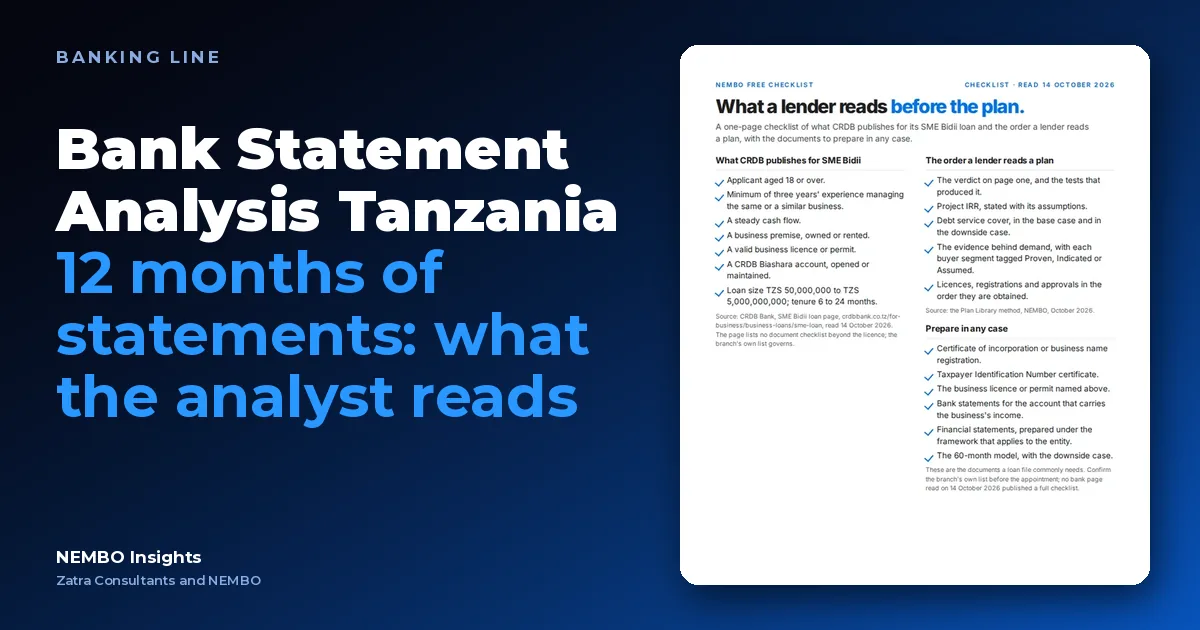
| NMB SME Loans | TZS 50,000,000 to TZS 1,500,000,000; 6 to 60 months | 18 or over; 3 years in the same business; steady cash flow; record keeping; premises; licence in the applicant's name; NMB Business Account |
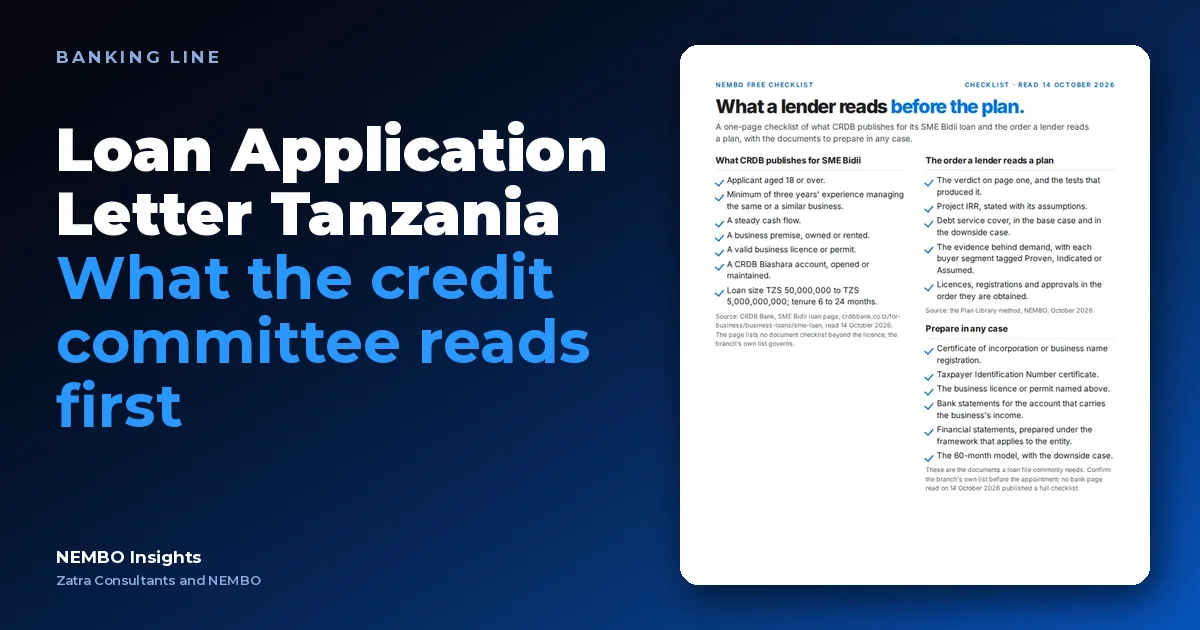
| CRDB SME Loan | TZS 50,000,000 to TZS 5,000,000,000; 6 to 24 months | 18 or over; 3 years' experience; steady cash flow; premises; valid licence or permit; CRDB Biashara Account; no document list |
| NBC SME Banking | Not published | Term loan, overdraft and trade finance named; no eligibility or document list |
| Stanbic Term Loan | 1 to 60 months; amount not published | 12 months or more in business; repayment assessed on past profitability or cash flow projections; first-class tangible collateral |
| Exim Term Loans | Not published | Acceptable security: mortgage or property, cash, government securities, bank guarantee, standby letter of credit |
| Azania SME Loans | From TZS 500,000; up to 2 years; capital invested below TZS 500,000,000 | Formal business; reliable income to service the loan; interest shown as 17 to 19 per cent |
| PBZ Commercial Loan (Zanzibar) | 2 to 5 years; amount not published | 6 months as a PBZ customer; 2 years' audited accounts; cash flow projections; licence, TIN, tax clearance, title deed; for companies: board resolution, MEMARTS, certificate of incorporation, directors' CVs and IDs |
Because the published lists are thin, the file should index the full set an analyst needs under regulation 16 of the 2014 regulations. The free SME loan file checklist numbers it; in summary:
- Certificate of incorporation, MEMARTS, latest annual return receipt, business licence, TIN and VAT certificates, tax clearance.
- 3 years' audited accounts, management accounts to the latest quarter, 12 months' statements from every bank, debtors and creditors lists, fixed asset register.
- Title deeds and valuation reports, the quotations behind the purpose, the projections and amortisation schedule.
- Board resolution, beneficial owner declaration, signed CRB consents, directors' IDs and CVs.
A September 2022 Farm Africa review (Access to Finance for MSMEs) lists the same items for a limited company and adds a local government introduction letter.
Which three authorisations must sit on top of the file?
The board resolution to borrow
The bank asks for a certified extract of a directors' resolution that approves borrowing up to a stated amount from the named bank, approves the security, and authorises named signatories to execute the facility letter, the charge documents and any variation. The bank reads the articles for a borrowing limit and asks for a shareholders' resolution where it is exceeded. The board resolution post gives the wording banks accept.
The declaration of beneficial owners
The bank's form asks for every natural person who ultimately owns or controls the company, at the threshold the form states, with name, date of birth, nationality, address and the nature of the interest. It must match the particulars filed with BRELA; a mismatch triggers the higher-risk factors in regulation 3(3) of the AML Regulations, which name nominee shareholders and undeterminable owners. The beneficial ownership post and Zatra's beneficial ownership compliance page cover the register side.
The consent to a credit reference check
The application form carries a consent clause under regulation 24 of the CRB Regulations 2012, signed by the company through its authorised signatories and separately by each director and guarantor as an individual. Without it the bank may not pull the report; it also covers follow-up enquiries once the facility is granted (regulation 24(2)). A director who expects an adverse entry should pull his own report first and lodge a dispute under regulation 29.
Common faults and how to fix them
| Fault | How the committee reads it | Fix |
|---|---|---|
| Amount stated without a quotation | Purpose unverified; amount likely padded | Attach dated pro forma invoices or a BOQ that sum to the amount |
| Repayment source described as "business income" | No capacity analysis possible | Name the contracts, tenants or product lines and show monthly cash flow |
| Audited accounts older than 18 months | Regulation 16 trigger | Attach management accounts to the latest quarter |
| Board resolution unsigned or without a limit | Authority to borrow unproven | Certified extract with amount, bank, security and signatories |
| Beneficial owners differ from the BRELA filing | Higher-risk CDD; enhanced verification | Reconcile the register first, then declare |
What follow-up letters come after the offer?
The bank's approval arrives as an offer letter, also called a facility or sanction letter, listing the facility, pricing, security, conditions precedent, covenants and a validity period, often 30 days. The company replies with an acceptance letter, signed as the resolution allows, that accepts the offer, lists the conditions precedent already met with their attachment numbers, and gives a date for the rest. The covenant compliance certificate post covers the reporting after drawdown.
A variation letter asks for a change to a performing facility: a longer tenor, a changed instalment date, a substitution of security, a higher limit, or a covenant waiver. It states the facility reference, the clause to be varied, the reason with figures and the proposed terms, with updated projections and a fresh resolution where the amount or security changes. A request for more time on an account already past due is a restructuring; the restructuring post covers that larger file.
Worked example: Tanga Cold Chain Limited, December 2026
Tanga Cold Chain Limited is a fictional company that runs a cold store at Tanga port for fish and horticulture exporters. In December 2026 it asks a commercial bank for a term loan to build a 400-pallet chamber and buy two refrigerated trucks. All figures are illustrative.
| Request line | Figure (illustrative) | Where the committee checks it |
|---|---|---|
| Total project cost | TZS 1,100,000,000 | Contractor BOQ, two truck pro formas |
| Equity contribution | TZS 250,000,000 (22.7 per cent) | Bank statement showing the deposit |
| Loan requested | TZS 850,000,000 term loan | Letter paragraph 1; sources and uses table |
| Tenor | 48 months, 6-month principal moratorium | Construction programme |
| Indicative rate assumed | 17 per cent per year (illustrative) | Bank's own pricing, not the applicant's |
| Monthly instalment after moratorium | About TZS 24,530,000 | Amortisation schedule, attachment 14 |
| Annual debt service | About TZS 294,300,000 | Same schedule |
| Cash available for debt service, year 1 | TZS 415,000,000 | Projections, attachment 12 |
| DSCR, year 1 | 1.41 times | Bank recomputes under its stress case |
| Security offered | Mortgage over the plot and chambers; chattels mortgage over the trucks; directors' guarantees | Panel valuation, charge search, BRELA registration within 42 days |
Two directors sign the letter on 8 December 2026. The attachments index runs to 18 items, ending with the board resolution of 1 December 2026 (17) and the beneficial owner declaration with the signed CRB consents (18). The committee's first question is whether the 1.41 holds if the two largest exporters leave; the sensitivity case in attachment 12 answers it at 1.18.
Mainland and Zanzibar: which rules differ?
Banking is a Union matter. The Bank of Tanzania supervises banks on the Mainland and in Zanzibar, so the 2010 guidelines, the 2014 risk asset regulations, the 2012 CRB regulations and the AML Regulations 2022 apply to a Zanzibar loan file in the same way. What differs is the company-law and tax side of the attachments. A Zanzibar company is registered with the Business and Property Registration Agency (BPRA) rather than BRELA and holds a ZRA tax clearance rather than a TRA one. It registers its charges under Zanzibar's companies legislation, which this post did not read; the 42-day period cited above is the Mainland text. A Zanzibar company should have the charge registration step and the Zanzibar beneficial ownership filing confirmed by an advocate practising in Zanzibar before it signs the offer letter.
What to do now
- Fix the amount: collect the quotations, BOQ or contract that the loan funds and set the amount from them, with the equity contribution shown separately.
- Build the repayment case: prepare the monthly cash flow for the tenor, the amortisation schedule at an assumed rate and the DSCR with two sensitivity cases.
- Choose and value the security: confirm who owns each asset, search for existing charges, and book a valuation by a valuer on the bank's panel.
- Pass the resolution: minute the resolution with amount, bank, security and signatories, and certify the extract.
- Reconcile the owners and check the credit reports: match the BRELA beneficial ownership filing to the share register, have each director pull a personal report, and sign the consent clauses.
- Index the attachments: number every item on the SME loan file checklist, date every page, and cite the numbers in the letter.
- Sign and deliver: two directors sign, the relationship manager acknowledges receipt in writing, and the company drafts the acceptance letter before the offer arrives.
Key dates
Audited accounts signed within 6 months of the year end mean a file sent in December 2026 carries audited 2025 accounts and management accounts to 30 September 2026. The BRELA annual return and beneficial ownership particulars must be filed before the bank's search, since a strike-off notice stops the file. An offer letter carries its own validity, often 30 days, and conditions precedent usually carry a further 60 to 90 days. After drawdown, the covenant certificate falls due with each quarter's accounts; the free reporting framework tool helps set that quarterly close.
What the NEMBO desk prepares
The NEMBO banking line desk prepares the loan application letter, the credit proposal, the attachments index, the board resolution extract, the beneficial owner declaration schedule, the acceptance letter and the variation letter as one controlled set. Zatra Consultants prepares and checks the content, with CPA Altho Mwangoa reviewing the figures and the repayment case; NEMBO designs and delivers the set. Two cost buckets apply: government, bank or regulator charges are paid at the official rate and are separate from NEMBO's and Zatra's fees, which are published on the packages page and quoted in writing. NEMBO does not decide or guarantee any authority's outcome. A company that shares the details of the facility, the security and the year end receives a written quotation and a timetable; the process page shows the review stages.
How Zatra helps
Zatra's investment readiness and fundraising service prepares the credit proposal and the lender conversation, its corporate bank account and KYC service handles the beneficial owner declaration and the bank's CDD file, and its financial modelling service builds the projections the committee stresses. Read this post with the SME loan requirements comparison and the asset finance post. CPA Altho Mwangoa signs the tax computations and the audited figures where they are relied on. Disputes with a bank, enforcement of security, a CRB appeal to the Bank of Tanzania, a formal legal opinion and anything before a court, tribunal or registry go to an advocate; a Zanzibar file goes to an advocate practising in Zanzibar.
Loan application set
Zatra Consultants prepares and checks the content on the details the Client shares. NEMBO designs and delivers it. Fees are published on the packages page and quoted in writing.
Open the desk pageSources and status
Accurate as at 26 November 2026. The CRB Regulations 2012, the Management of Risk Assets Regulations 2014, the credit risk section of the Risk Management Guidelines 2010 and regulations 2, 3, 7 and 9 of the AML Regulations 2022 were read on the regulators' own PDFs. The Companies Act was read in the 2016 TanzLII consolidation, so R.E. 2023 section numbers were not confirmed. Each bank page was read on 26 November 2026; requirements beyond those pages rest on the September 2022 Farm Africa review.
- 1Risk Management Guidelines for Banks and Financial Institutions, 2010Bank of Tanzania, August 2010. Accessed 26 November 2026.
- 2Banking and Financial Institutions (Management of Risk Assets) Regulations, 2014Bank of Tanzania, GN No. 287 of 22 August 2014. Accessed 26 November 2026.
- 3Bank of Tanzania (Credit Reference Bureau) Regulations, 2012Bank of Tanzania, GN No. 416 of 28 December 2012. Accessed 26 November 2026.
- 4Bank of Tanzania (Credit Reference Bureau) Regulations, 2012 (TanzLII)TanzLII, version of 28 December 2012. Accessed 26 November 2026.
- 5The Anti-Money Laundering Regulations, 2022Ministry of Finance, GN No. 397 of 3 June 2022. Accessed 26 November 2026.
- 6Companies Act, 2002TanzLII, consolidation of 1 July 2016. Accessed 26 November 2026.
- 7SME Loans, NMB Bank PlcNMB Bank, page read 26 November 2026. Accessed 26 November 2026.
- 8SME Loan, CRDB Bank PlcCRDB Bank, page read 26 November 2026. Accessed 26 November 2026.
- 9Commercial Loan, PBZ Bank LimitedPBZ Bank, page read 26 November 2026. Accessed 26 November 2026.
- 10Access to Finance for Micro, Small and Medium Enterprises in TanzaniaFarm Africa, September 2022. Accessed 26 November 2026.
Figures to confirm before you act
- The R.E. 2023 section numbers of the Companies Act for registration of charges (section 96 in the 2016 consolidation) and the directors' power to bind (section 36): confirm in the current revised edition before citing.
- Each bank's branch document checklist: the published pages of NMB, CRDB, NBC, Stanbic, Exim and Azania read on 26 November 2026 list eligibility, not documents; ask the branch for its list in writing.
- Azania Bank's published interest band of 17 to 19 per cent and the 17 per cent rate in the worked example: the bank prices each facility itself.
- Offer letter validity (often 30 days) and conditions precedent periods (60 to 90 days): these are market practice, not a published term of any bank cited.
- The beneficial ownership threshold on each bank's declaration form was not read on any bank page; confirm the form's own threshold.
- Zanzibar charge registration and the Zanzibar beneficial ownership filing: the Zanzibar companies legislation was not read; an advocate practising in Zanzibar should confirm.
- All figures for Tanga Cold Chain Limited (TZS 1,100,000,000 project, TZS 850,000,000 loan, 48 months, TZS 24,530,000 instalment, DSCR 1.41 and 1.18) are illustrative.
This article is general information based on official sources available at the date of publication. It is not legal, tax or financial advice. Laws and notices change. Verify with the issuing authority or consult Zatra before acting.
Frequently asked questions
Can a company send a loan application letter before it has audited accounts?
It can, but the file then rests on management accounts, bank statements and directors' guarantees, and the NMB and CRDB pages ask for 3 years in the same business. The committee prices that file higher or cuts the tenor, so a company near its year end does better to wait for the audit report.
Does the letter have to state an interest rate?
No. The bank prices the facility from its own base rate and risk grade, and a proposed rate signals that the projections depend on it. The letter states amount, tenor and repayment profile; the credit proposal shows the DSCR at an assumed rate with a sensitivity case at a higher one.
Who signs the consent to the credit reference check?
Regulation 24 of the Credit Reference Bureau Regulations 2012 requires the written consent of the borrower enquired on. For a company that means the authorised signatories, and separately every director and guarantor as an individual, because the bank pulls a report on each. One unsigned clause stops the search on that person.
Is a shareholders' resolution needed as well as a board resolution?
Only where the articles cap the directors' borrowing power and the request exceeds the cap, or where the security is an asset the articles reserve to the members. The bank reads the articles before the resolution; where the cap is silent, the certified board resolution is enough.
What happens if the credit committee defers the file?
A deferral is a request for more evidence, not a refusal. The relationship manager lists the items wanted, usually a valuation, updated statements or a missing certificate, and the file returns to the next sitting. Answer in one bundle with a cover letter that cross-references the original attachments index.
Can the loan application letter be sent by email?
Most banks accept a scanned signed letter by email to open the file, but the relationship manager asks for the wet-ink original and certified attachments before the memo goes to committee, and the regulation 24 consent must be held in hard copy. Send the scan, then deliver the originals within the week.
How is a variation letter different from a restructuring request?
A variation changes a performing facility: a longer tenor, substituted security or a one-quarter covenant waiver. A restructuring asks for relief on a facility that is past due or about to be, which the bank classifies under the Management of Risk Assets Regulations 2014 and which needs a full file with a recovery plan.
Does a Zanzibar company apply under the same rules?
The Bank of Tanzania supervises banks in both parts of the Union, so the appraisal duties and credit reference rules are the same. The attachments differ: a BPRA certificate instead of a BRELA one, a ZRA tax clearance instead of a TRA one, and charge registration under Zanzibar's own companies law.